


Samsung Electronics and Apple are the world's major semiconductor buyers... Purchase volume declined compared to the previous year.
 Published2016.01.29 09:22
Gartner Inc., a global IT advisory firm, announced that Samsung Electronics and Apple maintained their positions as the world's largest semiconductor buyers in 2015, recording a combined purchase share of 17.7% of the global semiconductor market. The two companies purchased a total of $59 billion worth of semiconductors in 2015, an increase of $800 million compared to the previous year.
"Masatsune Yamaji, a senior researcher at Gartner, stated, 'Samsung Electronics and Apple have maintained the leading position in semiconductor purchasing metrics for five consecutive years, but Samsung Electronics' design TAM (Total Available Market) growth rate in 2014 and 2015 was lower than the overall semiconductor market growth rate.'" "Semiconductor purchases in 2015 by Samsung Electronics and Lenovo, which were evaluated as the fastest-growing companies over the past five years, declined, and the risk of a decrease in revenue for semiconductor chip manufacturers from major customers is increasing," it stated.

A Samsung Electronics model introducing the 'Gear VR,' newly released last year, at the Samsung Electronics Delight Shop.
In 2015, the total semiconductor purchases by the top 10 companies amounted to $123 billion, accounting for 36.9% of the revenue of global semiconductor chip manufacturers. This figure represents a decline compared to 37.9% in 2014 and is a more serious result than the 1.9% decline in the global semiconductor market this year compared to the previous year.
Slowing Growth in Personal Electronics Market, Potential Decline in Semiconductor Companies' Profits
The market decline was partly attributed to HP's spin-off of its enterprise business, which caused Toshiba to fall out of the top 10 indicators. Toshiba's design TAM in 2015 totaled $4.6 billion. The total semiconductor purchases this year by the top 10 companies (including HP, HPE, and Toshiba) in 2014, based on design TAM, reached $127.6 billion. This accounts for 38.2% of the revenue of global semiconductor chip manufacturers.
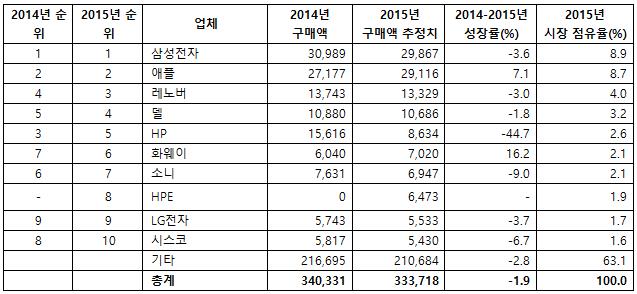
▲ Table. Estimated Purchase Values by Top 10 Global Semiconductor Design TAM Companies in 2015 (Unit: Million USD)
As the growth of the personal electronics market continues to slow, the likelihood of declining revenue for semiconductor chip manufacturers from major customers has increased. Most general-purpose semiconductor chip manufacturers are reducing their dependence on a small number of mega-customers, such as Samsung Electronics, Apple, and Lenovo. Furthermore, to stabilize business growth, they are diversifying their sales targets to segmented, smaller "long-tail" customers by utilizing mass marketing strategies.
Researcher Yamaji stated, "Nine of the top companies in Design TAM in 2014 remained in the 2015 indicators. However, it was found that semiconductor demand decreased for seven of these companies in 2015. The slowdown in Samsung Electronics' Design TAM since 2014 should be recognized as a very significant change." "As the growth bubble of electronic devices and their life cycles shorten, it will become increasingly difficult for top companies to maintain strong performance going forward. There is no guarantee that current winners will continue to lead the market," they stated.
Comments
Related news
They say this is different in the 2nd generation Apple Watch...
The most anticipated aspect of the second-generation Apple Watch is an improvement in battery capacity. This is because the Apple Watch has faced continuous criticism regarding insufficient battery capacity since its initial launch. Additionally, as Apple unveiled Watch OS 2.0 with FaceTime voice call functionality, a recent report from Digieco (KT Economic and Management Research Institute) indicated that the second-generation product is expected to support video calls along with voice calls.
2016.01.04by 신윤오 기자
[Semicon Korea] The Third Wave of Semiconductors Is Imminent; Avoid Excessive Optimism for IoT
SEMICON Korea 2016, a semiconductor manufacturing technology exhibition, opened on the 27th at COEX in Gangnam-gu, Seoul. On the opening day, SEMICON Korea held a keynote address under the theme "Innovation: Creating the Future," with speakers invited from Synopsys, Texas Instruments, and Audi participating in the themed presentations.
2016.01.27by 신윤오 기자
[Semicon Korea] TI CTO: Power devices defy Moore's Law, and innovation is needed.
SEMICON Korea 2016, a semiconductor manufacturing technology exhibition, opened on the 27th at COEX in Samseong-dong, Seoul. On the opening day, SEMICON Korea held a keynote speech under the theme "Innovation: Creating the Future," with invited speakers from Synopsys, Texas Instruments, and Audi participating in the themed presentations.
2016.01.27by 신윤오 기자

Intel Unveils Next-Generation 'Core Ultra Series 3' and vPro Platform for Enterprise PCs
Intel has officially unveiled the "Intel Core Ultra Series 3" for next-generation enterprise PCs and the latest vPro platform, addressing a wide range of demands from enterprise notebooks to high-performance workstations.
2026.03.26by 배종인 기자

ROHM Launches ESD Protection Diode Compatible with High-Speed Interfaces of 10Gbps or Higher
Semiconductor specialist ROHM has developed the 'RESDxVx series' of ESD (electrostatic discharge) protection diodes capable of responding to next-generation high-speed data communication environments exceeding 10Gbps, simultaneously enhancing both signal quality maintenance required in high-speed interfaces and IC protection performance.
2026.03.26by 배종인 기자











