



[MCU Q&A] 3. What is the difference between MCU and DSP?
 Published2016.02.01 17:06
Masaru Sugai
STMicroelectronics (www.st.com)
1. What criteria should I use when choosing an MCU?
2nd: How do I connect EEPROM to MCU?
3: What is the difference between MCU and DSP?
Part 4: MCU Peripheral Components Selection Guide Power

: Q UESTION
Both MCUs and DSPs (digital signal processors) are used for calculations. What is the difference between these two? How can I use them appropriately?
: A NSWER
A DSP is a computer designed solely for the purpose of processing a large number of complex calculations in a short period of time.
Specific applications include voice processing, image processing, signal modulation/demodulation, fast Fourier transforms, and digital filters. Some MCUs are capable of high-speed processing, but DSPs are better for complex and fast processing, as MCUs are designed primarily for general purposes.
The MCU is (16-bit data × 16-bit data) ± (16-bit data × While processing a task such as calculating 16-bit data + 64-bit data = 64-bit data requires multiple instructions, a DSP can execute this task with a single instruction in a single cycle.
This does not mean that DSPs are superior to all MCUs. MCUs are good enough for household appliances that do not require the high-speed processing capabilities that DSPs provide. MCUs are superior to DSPs in terms of versatility and usability.
However, some general-purpose MCUs, such as ARM's Cortex-M4 and M7, can support the same computations as DSPs.
DSPs can process complex calculations at high speed. A DSP can perform the following calculations with a single instruction in a single cycle:
(16 bit data × 16-bit data) ± (16-bit data × 16-bit data) = 32-bit data
(16 bit data × 16-bit data) ± (16-bit data × 16-bit data) + 32-bit data = 32-bit data
(16 bit data × 16-bit data) ± (16-bit data × 16-bit data) + 64-bit data = 64-bit data
High-speed processing of these complex calculations is It is required in processing, image processing, signal modulation/demodulation, fast Fourier transform, and digital filter. In order for the MCU to perform the same processing, it must execute multiple instructions at a very high speed. Since such execution requires an MCU with extremely fast processing performance, if not impossible, using a DSP is a more convenient choice for this purpose. However, household appliances do not require high-speed processing of complex calculations, and instead require general-purpose processing functions for various types of tasks. Since there are more types of MCUs than types of DSPs on the market, users can easily find the MCU that best suits their intended product.
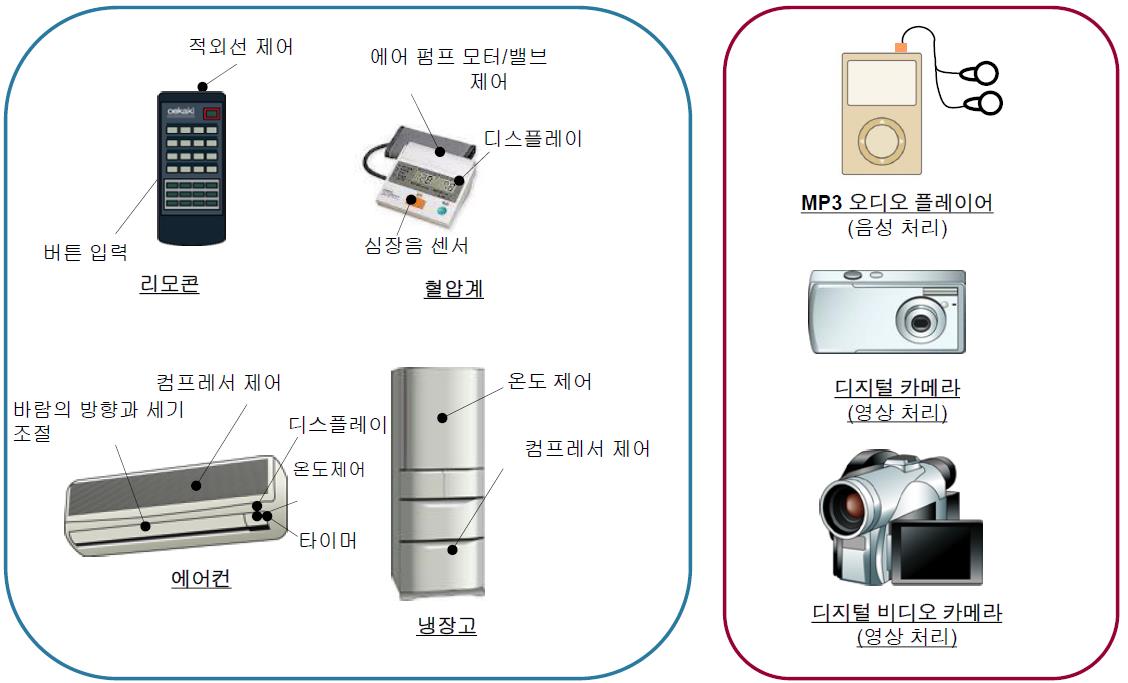
Figure 1 . MCU and DSP application examples (MCU application examples and DSP application examples)
To use a baseball analogy, if the MCU is an all-rounder who can play any position, the DSP is a player with exceptional specialized abilities, such as a fast runner, home run hitter, or fastball pitcher.
Figure 1 shows an application example of MCU and DSP.
Advantages of MCU
One of the best features of MCU is that it is extremely versatile and easy to use.
MCU was first born as an IC for pocket calculators, and has since continued to evolve and has been used as a control IC for home appliances and industrial equipment, and the market is growing even more. Today, MCU is used in a wide range of applications such as home appliances, industrial equipment, medical equipment, healthcare equipment, sports equipment, and gaming equipment.
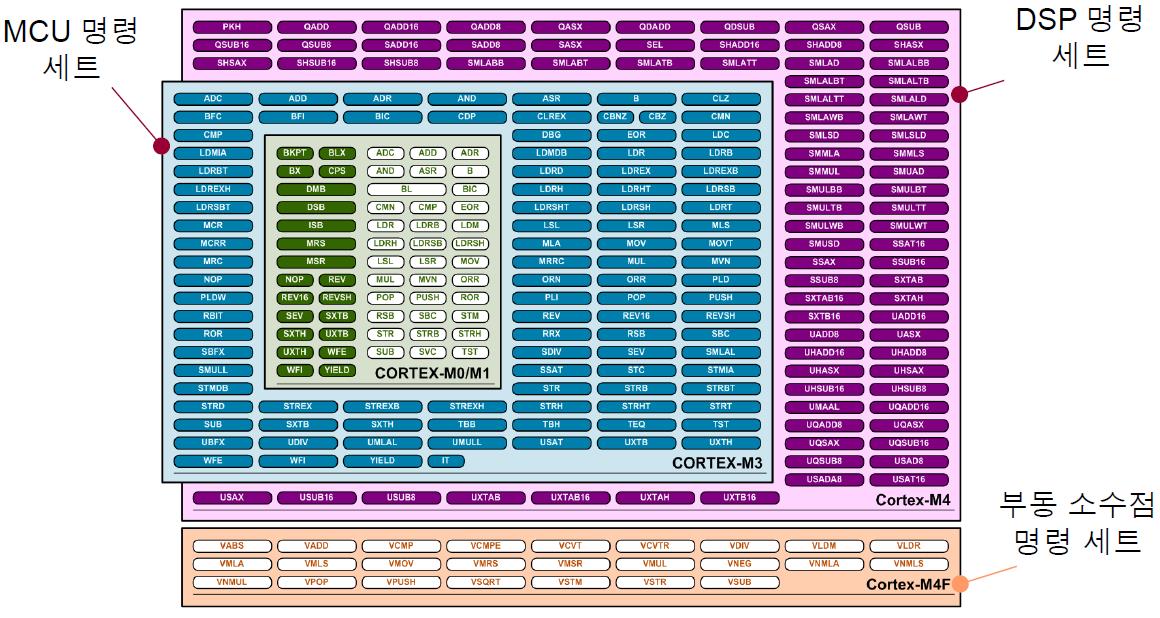
Figure 2. Cortex-M4 instruction set
Simple types of MCUs are used in TV and air conditioner remote controls, built-in clocks in home appliances, and brightness control for lighting. MCUs with complex functions are used to control motors for air conditioner and refrigerator compressors. It is also used for touch detection in tablet PCs and car navigation systems.
MCUs contain many functions for various applications and can be used in a variety of products.
In addition, starter kits and free integrated development tools provided by MCU manufacturers make it easy for even novice users to start using MCUs. MCUs do not require a high level of expertise, so even middle and high school students can use them. Robot contests using MCUs and student MCU-equipped miniature car rallies are popular these days.
Advantages of DSP
DSPs perform complex calculations very quickly. The MCU needs to be able to perform calculations at extremely high speeds to perform the following calculations:
(16-bit data × 16-bit data) ± (16-bit data × 16-bit data) = 32-bit data
(16-bit data × 16-bit data) ± (16-bit data × 16-bit data) + 32-bit data = 32-bit data
(16-bit data × 16-bit data) ± (16-bit data × 16-bit data) + 64-bit data = 64-bit data
32-bit data ± (32-bit data × 32-bit data) = 32-bit data
(32-bit data × 32-bit data) + 64-bit data = 64-bit data
A DSP can perform these calculations in a single instruction in a single cycle. DSPs are extremely useful for applications that require high-speed processing of complex calculations.
In the final chapter, we'll look at some application examples to see just how fast DSP is.
MCU with DSP function
Some recent types of MCUs, including ARM's Cortex-M4 and Cortex-M7, have built-in high-speed computational capabilities that were once a DSP's function. The "M" in the Cortex-M series stands for microcontroller. This series was first introduced to the market as an MCU, and later the Cortex-M4 series began supporting DSP instruction sets, making it possible for it to be used as a DSP as well.
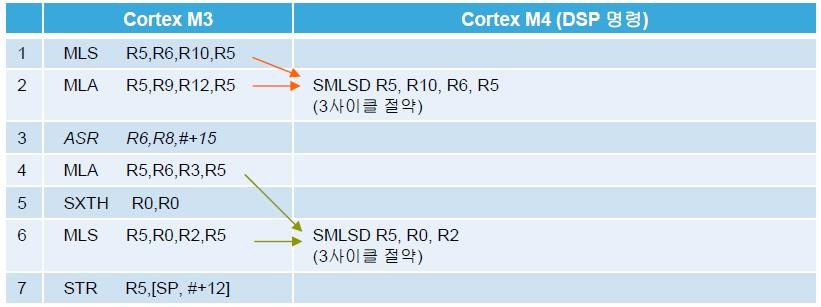
Figure 3. Example of application of DSP commands (coding for sensorless motor)
The Cortex-M4 and Cortex-M7 can be used as either an MCU or a DSP, as the DSP instruction set is a new addition to the existing Cortex-M3 MCU instruction set. Figure 2 shows the Cortex-M4 instruction set. The DSP instruction set is added to include the Cortex-M3 MCU instruction set. Note that Cortex-M4 supports floating point arithmetic instructions (IEEE 754 compliant).
Let's look at the speed difference between Cortex-M3 and Cortex-M4 using DSP instructions using an example of coding for a sensorless motor. The left side of the table in Figure 3 is a portion of the coding using the Cortex-M3 instruction set. The right side is a portion of the coding using the Cortex-M4 DSP instructions that replace the left side.
The instructions in lines 1 and 2 can be replaced by a single DSP instruction, and similarly the instructions in lines 4 and 6. Since each DSP instruction is executed in a single cycle, each saves 3 cycles.
Comparing MCU and DSP
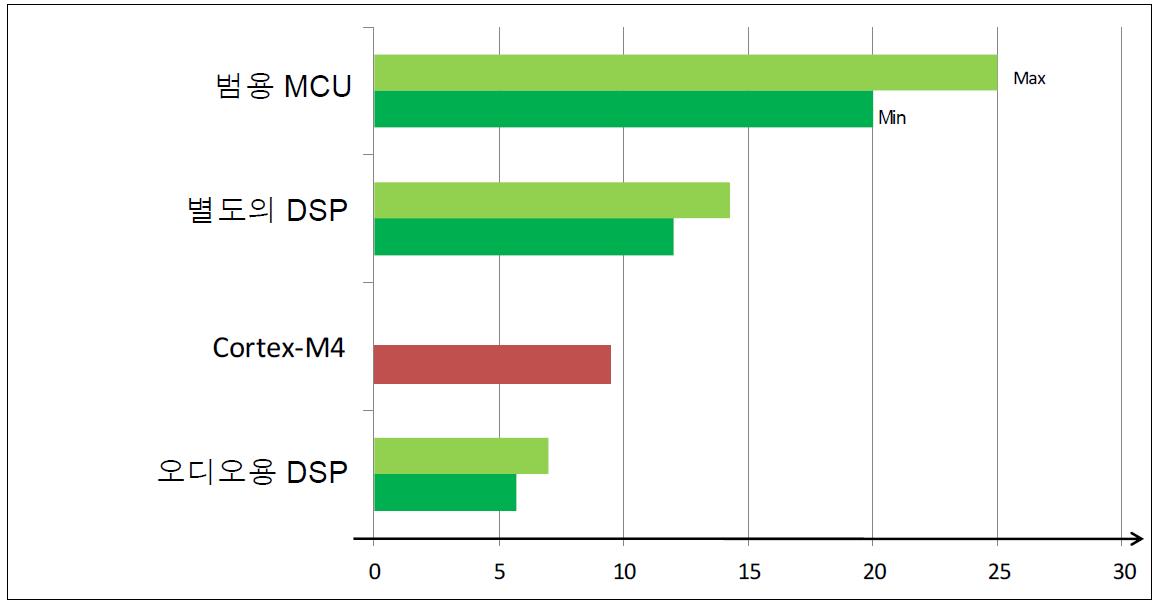
Figure 4. Comparison of MCU and DSP
Figure 4 compares the MP3 audio reproduction performance between MCU, general DSP, Cortex-M4, and audio DSP. The horizontal axis represents the operating frequency required for MP3 decoding. The lower the frequency value, the higher the performance. Naturally, the audio-only DSP shows the best performance, followed by Cortex-M4 (estimated value) and a regular discrete DSP. The general purpose MCU shows the lowest performance, which is understandable since audio reproduction is not the target application of this MCU.
Even a typical discrete DSP is showing performance that is twice as fast as a general-purpose MCU. This shows how suitable DSP is for performing complex calculations quickly.
Comments
Related news

[MCU Q&A] 1. What criteria should I apply when selecting an MCU?
MCU Q&A ① Microcontrollers (MCUs) are essential components with diverse applications, ranging from rice cookers in our everyday lives to cutting-edge automobiles. But how much do we really know about MCUs? Do we simply select products based on the basic specifications that match the system we want to use? Or are you curious about how to connect an EEPROM to an MCU, what the differences are between MCUs and DSPs, or what the criteria are for selecting MCU peripherals? Starting today, e4ds News will run a four-part MCU Q&A series. We hope that information you have been curious about or may have overlooked will help you in selecting the right products.
2016.01.18by 신윤오 기자

[MCU Q&A] 2. How do I connect EEPROM to MCU?
MCU Q&A ② Microcontrollers (MCUs) are essential components with diverse applications, ranging from everyday rice cookers to cutting-edge automobiles. But how much do we really know about MCUs? Do we simply select products based on basic specifications that match the system we intend to use? Or do we wonder how to connect EEPROM to an MCU, what the differences are between MCUs and DSPs, or what criteria to use when selecting MCU peripherals? e4ds News will run a four-part MCU Q&A series. We hope that information you may have been curious about or previously overlooked will help you in making product selections.
2016.01.25by 명세환 기자

[Contribution] Designing a flexible and affordable blood glucose meter using an 8-bit MCU
Blood glucose measurement is affected by external factors such as temperature, humidity, and altitude. This is because enzyme reaction rates depend on these environmental and other factors. Additionally, for test strips made from different chemical materials, the predetermined regression equation must be modified using MATLAB or Microsoft Excel. When designing a blood glucose meter with a specific test strip, these factors must be taken into account. Therefore, this article presents a flexible and cost-effective blood glucose meter design method using Microchip's 8-bit MCU.
2016.01.29by 명세환 기자
.jpg)
SalePoint Signs Multi-Year Partnership Agreement with AWS… Promoting Identity Security that Integrates Even AI Agents
Sailpoint has entered into a multi-year strategic partnership agreement with AWS and is moving forward with establishing an integrated governance system that manages both human and non-human identities together. The plan is to consistently manage access permissions in an environment where AI agents are increasing as work execution entities, while applying the principle of least privilege and automated policy enforcement. The two companies plan to jointly expand capabilities to manage the identities of various entities, including AI agents, within a single layer in the AWS environment. This collaboration is interpreted as a move to design security and governance together in corporate environments where AI adoption is expanding.
2026.03.26by 배종인 기자
.png)
Databricks Unveils Open AI Security Monitoring 'Lakewatch'
Databricks entered the security market on March 24 by unveiling LakeWatch, an open-source agentic SIEM. The core functionality of this product is to integrate and analyze security, IT, and business data in a single environment to support AI-based threat detection and investigation. The company explained that it reduces the limitations of existing security operations centers, which have had to forgo some data due to high cost structures, and enables large-scale data analysis and automation based on open formats and ecosystems. LakeWatch is currently offered as a private preview, with Adobe and Dropbox mentioned as early customers. Databricks also announced an expanded partnership with Anthropic as well as the acquisition of Antimatter and SiftD.ai.
2026.03.26by 배종인 기자











