



[Feature] Visiting MCU Companies ⑦ Atmel: “Remodeling AVR Loved by Developers, Expanding 32-bit Products”
 Published2016.02.15 17:15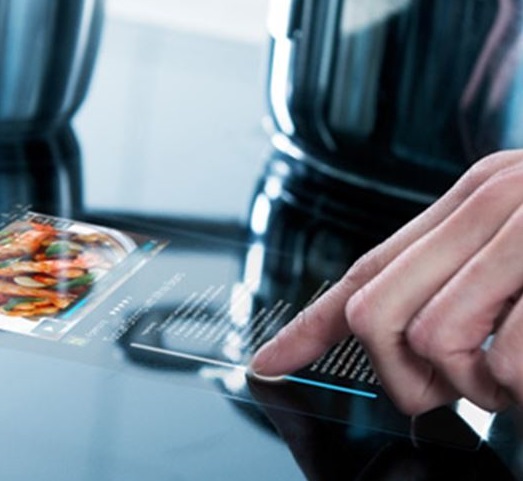
The start of simplifying development time and methods
E4ds News visits major semiconductor companies specializing in Micro Controller Units (MCUs), often referred to as the "brains" of various electronic products. As the applications of MCUs expand from simple electronic devices to automobiles and robots in the IoT era, their high-performance and low-power capabilities are becoming increasingly enhanced. Accordingly, we aim to assist readers in their product selection by focusing on introducing the functions and features of various MCU products and examining the technologies and trends emphasized by these leading companies through interviews. [Reporting by Shin Yun-oh and Kim Su-jin]
MCUs from 20 years ago contained memory rather than flash. Consequently, it was a very cumbersome process to download code and run tests every time development took place. However, the introduction of flash memory dramatically simplified the development process, and the company that replaced memory with flash was Atmel. Since then, Atmel's 8-bit MCU, the AVR, has gained sensational popularity, and currently, the largest community in Korea is 'Danggeuni's AVR Playing'. There are various theories regarding the origin of the unique name AVR, but the most likely one suggests it is an abbreviation of the R -ISC Processor of Al -Egil Bogen (co-founder of Chipcon and EnergyMicro, current Board member of Silicon Labs, and operator of Novelda) and Vegard Wollan (current VP & General Manager of Atmel Touch Business Unit). We met with Seo Moon-jun (pictured), Field Marketing Manager at Atmel, who emphasized that while large corporations are manufacturing smart home appliances in the era of IoT, development by startups is crucial to securing a long-term and large market. We were able to hear in detail about the support and development environment provided for them.
 ♦ MCUs are products applied in a wide variety of fields. Please introduce Atmel MCUs by their main areas of focus.
Atmel manufactures General MCUs for general use as its main products, but there are several specialized fields among them. They are touch screens, touch keys, and low-power products.
The actual hardware for the touch screen utilizes a standard MCU, and products are supplied to major domestic mobile phone manufacturers using the dedicated 'Touch Screen Library' provided by Atmel. The touch keys are improved products utilizing algorithms used in touch screens and are primarily used by major domestic home appliance companies.
Finally, low-power products, which have lower power characteristics than general MCUs, are being supplied to domestic manufacturers developing and manufacturing mobile accessories such as smartwatches and smart bands.
In addition, there is the connectivity division. It is stronger than its competitors in fields such as ZigBee, Bluetooth, and Wi-Fi. While competitors have business units divided by product, making collaboration difficult, Atmel’s strength lies in its excellent collaboration structure in the home appliance, wearable, and mobile sectors related to touch keys.
General MCUs are the main products, and it possesses touch technology specialized for the IoT era.
While the mobile industry was dominant, it has now expanded to the wearable and automotive sectors.
♦ Looking at Atmel MCU's market share (2014), it stands out in wired and wireless communications, consumer, and industrial sectors, followed by the automotive computing field. What is the reason for its strength in the aforementioned communications sector, and have there been any recent changes in this market share?
As mentioned earlier, the touch keys are currently being enhanced. This is because the potential for business utilizing touch keys in the IoT field is limitless. For example, the automotive sector has begun incorporating touch keys into dashboards. Furthermore, door and handle buttons are also being converted to touch interfaces. Given the scale of the touchscreen business, touch keys related to this are being promoted intensively.
The primary market is increasingly shifting from mobile to automotive. The mobile (telecommunications) market is characterized by rapid changes in customer needs and market dynamics. Consequently, selling suitable products and shortening development cycles are of paramount importance. To this end, Atmel maintains a team of Field Application Engineers (FAEs) and Account Executives (AEs) at its Korean branch, alongside its superior products, to launch products tailored to the ever-changing requirements of its clients.
Market share increased until last year but has since declined slightly. This is because OEMs have started embedding MCUs within their applications as price has become a key factor due to changes in the application environment. Instead, with the release of many accessories such as smartwatches and smart bands since last year, the supply of Atmel's low-power 8-bit MCUs suitable for these devices is increasing.
 ♦ Are you planning to expand into the wearable device sector, which has emerged as a new market compared to the saturated mobile market?
It doesn't seem like that is necessarily the case. This is because while shipments of mobile products reach hundreds of millions of units, shipments of smartwatches and bands are still negligible, falling short of even 10 million units. Of course, the market is growing. However, it remains uncertain whether end users will continue to find accessories appealing.
Atmel's touchscreen
Students start studying based on 8-bit.
Atmel's AVR core is simple yet powerful, making it suitable for educational purposes.
♦ Recently, the development of solutions aligned with the IoT (Internet of Things) trend is in full swing across all industries. What are the merits that give Atmel MCUs strengths in the IoT field?
The general outlook is that IoT products will emerge from numerous startups with more creative ideas rather than large corporations. In this context, Atmel products leverage over 30 years of accumulated product know-how and a user-friendly product environment as strengths to provide easier development and debugging.
In addition, students who are new to MCUs start by studying based on 8-bit, and Atmel's AVR core is widely used for learning purposes by freshmen because it is very simple and powerful. When these students graduate and begin product development, they use Atmel's MCUs, which they are already familiar with. Atmel's strength lies in its ability to consistently maintain market share based on this foundation.
♦ What kind of technical know-how does Atmel MCU possess?
It is an 8-bit microcontroller based on hardware processing of 16-bit bus width for instructions and 8-bit word length for data. Its advantages include low power consumption and the ability to process most instructions in a single clock cycle using an advanced RISC architecture and pipeline processing method.
In addition, depending on the model, there are about 90 to 133 instructions, and high-performance higher models have a built-in hardware multiplier so that multiplication instructions can be executed in 2 clock cycles.
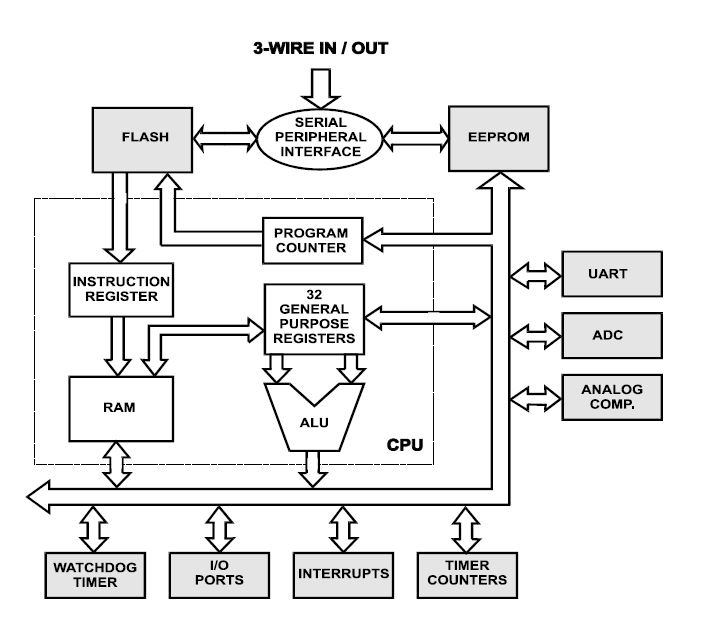
AVR Architecture
The general outlook is that IoT products will emerge from numerous startups with more creative ideas, rather than from large corporations. In this situation, Atmel products leverage their strengths, such as over 30 years of accumulated product know-how and a user-friendly environment, to provide easier development and debugging.
So that even startups, not just large corporations, can develop easily and quickly
Establishing a development environment and systematic community management
♦ Nowadays, it is a trend to establish development environments that allow developers to develop quickly and easily. How does Atmel's development environment differ from that of other companies?
Unlike paid tools sold by specialized compiler companies, Atmel provides its own IDE tool called Atmel Studio for free. It offers various types of example source code and libraries for free to developers who are new to Atmel or starting with a specific product.
The first things developers need are a software 'IDE', a hardware target board, and a JTAG. A JTAG typically costs around 300,000 won. Atmel has integrated the JTAG into its development board. It can be purchased for about 20,000 to 30,000 won, which is the price of a single chip. The total cost is approximately 30,000 won, and the software IDE can be used for free. Additionally, touch keys can be developed. In addition, when developing an MCU, you often wonder how to use peripheral devices; the Atmel tool maps the MCU type according to the product.

Atmel Studio
♦ MCUs are solutions where establishing infrastructure, such as a community, is crucial in relation to the development environment. Are there any separate support measures?
Atmel has long focused on building a community among developers. By operating product blogs, Twitter, Facebook, and YouTube, as well as 'myAtmel,' the company helps resolve technical questions through internal experts.
The AVR Freaks site is the largest AVR MCU community with 10,000 posts. The second is the Atmel SMART ARM-based MCUs and MPUs site, which has forums categorized by type of MCU and MPU. The communities also have internal forums, and since the coordinators within each are connected with us, we can provide immediate answers if you have any questions.
♦ If there is a reason why an engineer should choose an Atmel MCU, please briefly state the key point.
A developer's biggest concern is how to develop a reliable product as easily and quickly as possible. As mentioned earlier, Atmel products provide a diverse range of free tool environments and support the resolution of problems and questions that arise during development through various channels. This is precisely what makes Atmel microcontrollers, which have a long history of over 30 years, so advantageous.
Does that mean it is an MCU suitable for beginner engineers?
There is nothing better for beginners. It is easy to access and offers the most affordable way to start. If you proceed with actual mass production after verification is complete, support is well-established thereafter. While many people use Arduino as a verification tool, they do not build and use it as a commercial platform. It is merely an open-source tool. However, if you finish verification with Arduino and move on to actual mass production, it is a completely different matter. Since there was no way to import the Arduino workspace, I had to recreate the board and source code from scratch.
However, Atmel recently released a tool to migrate Arduino workspaces to the Atmel tool. Therefore, we are supporting startup companies, rather than large corporations, to expand commercially in open markets.
Moving away from the existing 8-bit strategy and strengthening 32-bit products, focusing on the mobile and automotive sectors.
8-bit products are being remodeled again
♦ If I were to briefly discuss the roadmap for future MCU products.
Atmel is currently moving away from its existing 8-bit strategy and expanding its 32-bit products. In addition, it plans to remodel its 8-bit AVR/Tiny products, which were popular among many developers. New versions of several Mega AVR products have already been released, and new versions of Tiny MCUs are scheduled to be released this year.
Does this mean it will be extended to 32-bit as well?
That is correct. Of course, the 32-bit product line is not extensive right now, but we plan to expand it. Applications will likely be in the mobile, IoT, and automotive sectors. Three automotive products have already been added to the lineup, and mass production has already begun on one of them.

Comments
Related news

[Planning] Going to MCU Companies ④ Renesas (1), “The Secret to Being No. 1 in the World MCU Market is Low-Power, High-Performance Proprietary Technology”
[Planning Special Feature] 'Visiting MCU Companies' introduces Renesas, the absolute leader with the number one position in the global MCU market (based on 2014 Gartner statistics). Renesas, which holds nearly 40% of the global automotive MCU market, supplies application-specialized MCU products to the extent that it divides its business divisions by sector.
2015.12.21by 신윤오 기자

[Planning] Going to MCU Companies ④ Renesas (2), “Providing ‘A to Z’ of Automotive MCUs with Reliability Built Up Over a Long Time”
"Visiting MCU Companies" introduces automotive MCUs from Renesas, the absolute leader holding the number one position in the global MCU market (based on 2014 Gartner statistics). Renesas, commanding nearly 40% of the global automotive MCU market, supplies application-specialized MCU products to the extent that it has organized its business divisions by field. We met with Kim Se-yong, Director at Renesas Korea (photo), who is pursuing Renesas's vision of a high-performance, safety-oriented automotive single-chip solution.
2015.12.28by 신윤오 기자
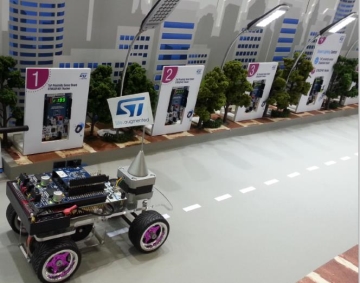
[Planning] MCU Company ⑤ STMicroelectronics: "Highly integrated, low-power MCUs are perfect for IoT products, and we plan to expand into the low-end market in the future."
"Visiting MCU Companies" has this time sought out ST Microelectronics (hereinafter ST), renowned for its broad range of MCU offerings. ST possesses over 600 products that can be applied to diverse applications suited to the IoT era. Since the launch of STM32 in 2007, the company has currently moved into mass production of the STM32 F7 based on Cortex-M7. Additionally, ST plans to provide development environments free of charge to developers and hold training sessions. We meet with Manager Choi Kyung-hwa (photo), who oversees MCU operations at ST Korea, to hear about the secrets to competitiveness.
2016.01.11by 신윤오 기자

[e4ds Tech Day 2026 ⑨] Sim Sang-gyu, Autocrypt CTO: "In the Physical AI Era, Automotive Security Must Extend Beyond the Vehicle"
At e4ds Tech Day 2026, Sim Sang-gyu, CTO of Autocrypt, explained automotive cybersecurity strategies in the era of Physical AI and SDV (Software-Defined Vehicle). Automobiles are evolving as part of an ecosystem connected to AI, cloud, chargers, IoT, and robots, and he emphasized that the scope of security must expand beyond the vehicle interior to the entire connected environment. In particular, AI model tampering, adversarial attacks, OTA updates, and EV charger hacking were identified as major threats. He explained that response measures require zero trust, AI model integrity protection, intrusion detection, Security by Design and Default, and full lifecycle security management, and that proactive security system establishment beyond regulatory compliance is critical for securing future mobility competitiveness.
2026.10.12by 배종인 기자

Practical HIL Construction Strategy for Automotive and Off-Highway Controller Validation
As vehicle E/E architecture transitions to zonal structures and shifts to software-defined vehicles (SDV), the number of controllers (ECUs) requiring validation and software complexity are surging dramatically. Meanwhile, real vehicle testing cannot provide repeated verification under identical conditions and entails lead time and safety concerns. This white paper explains the principles of HIL (Hardware-in-the-Loop) validation and the structure of the NI platform composed of PXI, SLSC, and VeriStand, and through two actual implementation cases—Camera Record & Replay HIL for In-Cabin Monitoring Controller (ICMU) and Forklift Controller (VCU) HILS—describes how controller-level regression testing becomes possible. Additionally, it explicitly states application boundaries and limitations, such as lack of A2B support.
2026.10.12by 편집부











