


Wearables are on the rise, but obstacles to mainstream adoption are numerous.
 Published2016.02.29 14:28
A proactive standardization strategy is needed.
Can the wearable market, one of the hottest topics in the IT industry, overcome the chasm (the stagnation period before general public use) and achieve mass adoption?
According to market research firm Gartner, global wearable device sales are expected to reach 274.6 million units in 2016, an 18.4% increase from 232 million units in 2015, and revenue is expected to increase to $17.5 billion by 2019. Furthermore, wearable device sales are expected to reach $28.7 billion this year, with smartwatches accounting for $11.5 billion of that. Smartwatch sales, in particular, are expected to grow at a compound annual growth rate of 30% through 2017.
However, in order for the wearable market to continue growing as expected, it is urgent to resolve compatibility issues and establish standardization.
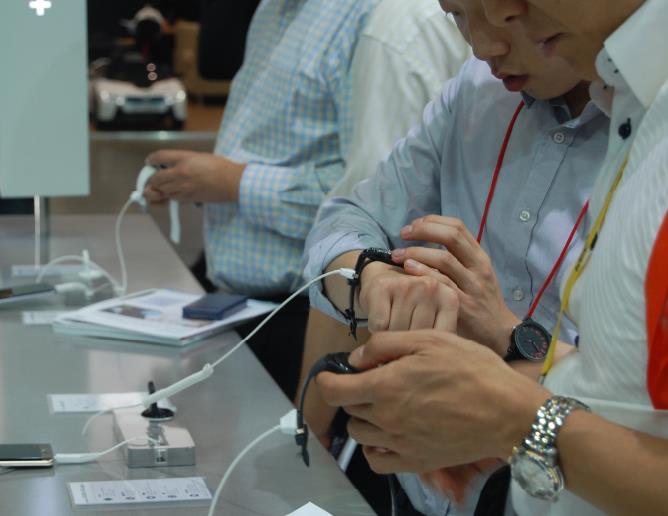
▲Who will ultimately emerge victorious between traditional wristwatches and smartwatches? Will either device survive, or will each establish its own market? Attendees wearing wristwatches try out a smartwatch at an electronics show.
For wearable devices to become a new growth engine for the ICT industry, various hardware technical limitations remain, including power batteries, broadband communications, and design elements. Furthermore, there is an absolute lack of killer content suitable for wearable devices.
First, their short battery life prevents them from delivering the value of wearable devices that are always on. The lack of a primary battery limits their role as peripheral devices, such as smartphones or network devices.
Due to battery life issues, Bluetooth, a low-power, short-range network, is mainly used, but since it cannot transmit and receive independent data as its own wide-area network, smartphones are acting as a hub for wearable devices.
Design has also emerged as a crucial factor. Wearable devices, which require both functionality and aesthetics, are failing to deliver satisfactory results from both a user experience and design perspective.
Additionally, it has strong platform dependency, making it difficult to utilize across different OS devices, and lacks killer content suitable for wearable devices, making it difficult to effectively link and utilize across various applications.

▲Samsung Electronics released its latest strategic smart wearable device, the Samsung Gear S2, last October. Measuring distance using the 'Golf Navi' feature of the 'Gear S2'
In particular, wearable compatibility issues are one of the biggest obstacles to device proliferation. Platform dependency, such as the inability of Android smartwatches to work with iPhones, is manifesting as smartphone dependency. This is a major obstacle to app availability, application compatibility, and usability. While efforts are being made to achieve platform-independent integration, this is only possible to a limited extent.
Application interoperability of smart wearable devices refers to the ability of different smart wearable devices to provide or receive related services, such as communication and data exchange, and to operate together efficiently using these exchanged services. Interoperability encompasses hardware interoperability, communication protocol compatibility, data and content representation compatibility, and application compatibility.
Proposal of a standard for interoperability between smart wearable applications
Regarding smart wearable application interoperability standards, Dr. Jeon Jong-hong of ETRI presented a smart wearable application interoperability reference model consisting of five layers (Hardware to Application) defined by referencing the OSI seven-layer model (Physical to Application). The five layers of the interoperability reference model, which can also be referred to as a smart wearable stack, are vertically divided into layers according to the level of interoperability required when interconnecting smart wearable devices.
Wearable standardization is also being promoted, but progress is sluggish. Although South Korea proposed establishing a technical committee (TC) to develop international standards for WSD, the committee has yet to establish a technically independent field, aligning with TCs in various fields. The uncooperative behavior of Japan, the secretariat of IEC TC 100 (Multimedia), is also a significant obstacle.
Based on the SMB decision, a wearable smart device expert group (ad hoc group 56) was formed, but due to the sharp conflict between Korea and Japan, no conclusion was reached, and it was decided to reexamine the establishment of a TC for one year.

▲LG Chem developed and unveiled a wristband-type wire battery in October of last year to address the battery issue, which is considered a shortcoming of wearable devices.
Regarding the difficulties in establishing a wearable TC, Han Tae-soo, a standard coordinator at the Korea Agency for Technology and Standards, said, “Recently, Japan is facing two important issues in IEC activities,” and “One is that a Japanese representative is planning to run for the IEC SMB chairmanship, which is scheduled to be elected in October of this year, and so they are requesting cooperation from our country (the Korea Agency for Technology and Standards), which is an SMB member country. The other is that they are proposing to establish a new IEC TC for ‘Life Management of Electrical Components Related to Power Grids’ in January, and are also requesting cooperation from our country.”
Accordingly, the government is developing a wearable standardization roadmap through the Wearable National Standards Coordinator project. 10 to 15 experts participated in the development of a roadmap for each of the six technology fields, identifying 81 key technologies requiring technological development and 139 standardization items requiring standard development in connection with each technology.
In response, a standard coordinator said, “There is a need to implement a policy that interconnects the establishment of a wearable TC with cooperation with Japan,” adding, “There are far more standards to be developed than technologies to be developed, and this roadmap is expected to serve as a guideline for the development of preliminary standards in related fields.”
Dr. Jeon Jong-hong also said, “The smart wearable market is a market where standardization discussions are still in the beginning stages and many issues still exist,” and added, “A standardization approach from the user’s perspective is needed, and an active standardization strategy and response are needed, such as considering convergence applications and IoT application linkage perspectives.”
Comments
Related news

[Contribution] Designing Platform Architecture that Meets Power and Cost Requirements for Medical Wearables
To survive in a market demanding extensive complexity, tremendous cost pressure, and continuously evolving underlying hardware, applications must be deployed on robust and flexible platforms. Such platforms must be abstract while simultaneously capable of optimizing specific hardware features. Today, platforms are defined not by processing architecture or peripheral sets, but by the programming environment available to developers. Standard platforms such as Windows, Android, iOS, and Linux aimed at achieving this have reached their limits in terms of minimum hardware requirements. These limitations cannot be reconciled with the price, power, and physical constraints of medical wearable devices. Currently, the only option meeting these requirements is an RTOS environment with high adaptability and scalability, as RTOS can replace bare metal and overlap with the lower-end segment of fully-featured operating systems.
2016.02.03by 명세환 기자
Global wearable sales grew 18.4% in 2016, with smartwatches accounting for 40% of revenue
Gartner Inc., a global IT consulting firm, forecasted that global wearable device shipments in 2016 would reach 274.6 million units, an 18.4% increase from 232 million units in 2015 (refer to Table 1). Wearable device revenue in 2016 was projected to reach $28.7 billion, with smartwatches accounting for $11.5 billion.
2016.02.04by 신윤오 기자
Expanding support for testing and certification of wireless charging, 3D printers, smart wearables, etc.
The government is selecting promising testing and certification services for the future and moving forward with commercialization support to accelerate market launch of new products such as wireless charging, 3D printers, and smart wearable devices. This year's selection of promising services introduced voting among testing and certification institution employees and customers, unlike last year, to enhance objectivity and concentrated on services capable of commercialization within a short timeframe. Seven services including bio-convergence material evaluation received low scores in business preparation readiness and were excluded, and with the increase in e-commerce, packaging and logistics safety evaluation was newly selected, resulting in a total of 10 promising testing and certification services being finally selected.
2016.02.26by 신윤오 기자

ESP32 Development Environment Selection and GPS Application Implementation
The ESP32 is a microcontroller that integrates Wi-Fi, Bluetooth, 12-bit ADC, capacitive touch, PWM, DAC, and UART in a single SoC. However, the abundance of features does not by itself solve the designer's problems. The real challenges lie in selecting the appropriate development environment, determining which pins can be used and which must be avoided, and converting raw data from modules into usable information. This document addresses ESP32 peripheral constraints (ADC2 and Wi-Fi coexistence limitation, UART1 occupancy, ADC non-linear regions), the trade-offs between Arduino IDE and ESP-IDF, and the process from connecting NEO-6M/NEO-M8N GPS modules to UART2, parsing NMEA sentences, and visualizing routes in Google Earth, all organized based on documented references.
2026.10.12by 편집부

MIPI CSI-2, DSI-2, C-PHY, D-PHY Test Solution Technical White Paper
The MIPI interface adopts a burst mode that transitions between low-power (LP) and high-speed (HS) states for low-power consumption, and in return, strict timing rules are imposed on state transitions. Additionally, the high-speed section operates as a packet-based protocol with headers, ECC, and CRC, so verification engineers must handle waveforms and protocols simultaneously. Traditional configurations combining general-purpose oscilloscopes and AWGs reveal limitations in setup complexity, measurement uncertainty, and lack of reproducibility when faced with these requirements. This white paper, based on webinar materials, organizes the structure of this problem and describes how the SV5C-DPTXCPTX generator for receiver testing and SV5C-DPRXCPRX analyzer for transmitter testing integrate state transition testing, stressed eye testing, and protocol analysis into a single bench, along with their application boundaries.
2026.10.12by 편집부











