


Can Samsung's IoT platform, 'ARTIK,' succeed?
 Published2016.03.07 16:39
Convenience, including specifications and certification, is expected to be key to future expansion of the IoT ecosystem.
Will Samsung's ambitious IoT platform, ARTIK, succeed in creating an ecosystem and dominate the IoT market?
Samsung Electronics, which officially announced the launch of ARTIK last month, began full-scale marketing by holding a product briefing session for engineers from small and medium-sized enterprises on the 3rd.
Samsung Electronics' ARTIK is an ultra-compact IoT module comprised of a processor (AP), memory, communications, and sensors. As highlighted by the platform's integration of software/drivers, storage, security solutions, development boards, and cloud functionality into a single module, the company is confident that developers will be able to quickly and easily commercialize IoT devices using ARTIK.
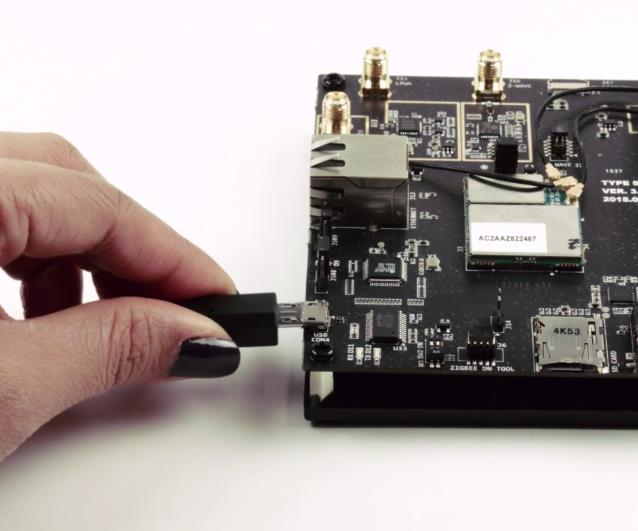
▲ARTIK installation (homepage)
This confidence is evident, first and foremost, in the product name, "ARTIK." Known as "arctic," derived from the word "arctic," meaning polar regions, the name reflects Samsung's commitment to achieving the "best." Along with this, it also contains the meaning of aiming for low power, that is, low temperatures like polar regions.
Samsung Electronics Managing Director Kang Myung-koo said, “ARTIK is Samsung’s first IoT platform, and it is receiving more attention globally, including in Silicon Valley, than in Korea,” adding, “The ARTIK platform is a suitable platform for developers who have good ideas but find it difficult to actually implement them.”
In other words, the background of the development was that developers have to consider everything from the hardware design, device driver, OS app DB, and hub, to the cloud, such as data analysis services, and the connection and security between them, which is not realistically easy.
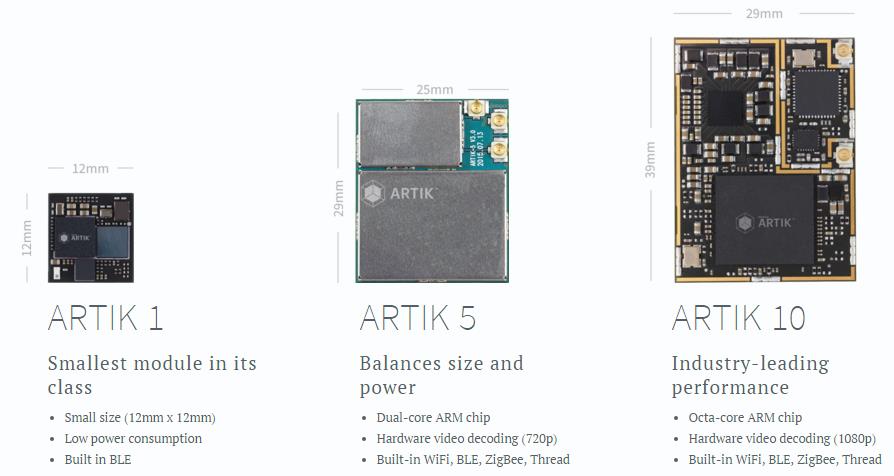
▲Main specifications of ARTIK1, ARTIK5, and ARTIK10 products.
ARTIK, born from these challenges, aims to realize time-to-market through one-stop shopping. As Managing Director Kang puts it, it's a solution that perfectly complements the "missing elements" of the IoT ecosystem. This is why ARTIK offers an end-to-end platform for IoT. The ARTIK platform, consisting of ARTIK modules, ARTIK cloud, and ARTIK ecosystem, will significantly reduce the time it takes to bring commercial products to market, emphasized Managing Director Kang.
ARTIK, which offers functions like Lego blocks, adopts a modular approach and will be released first as ARTIK 1, ARTIK 5, and ARTIK 10, depending on the application. ARTIK 1 is a simple MCU-based platform with a small form factor (12mm x 12mm). It supports a 250MHz dual-core, 1MB SRAM, 4MB flash, and Bluetooth 4.0 end node with Secure Element security.
The ARTIK 5 offers optimized size (25mm x 29mm), power, and performance for wearables and hubs. It features a 1GHz dual-core processor, supports qHD displays, and features a HW Secure Element with 512MB of DRAM and 4GB of NAND flash.
The ARTIK 10 is a platform (29mm x 39mm) that supports smartphone-like functionality and is primarily intended for high-performance applications. It features a 1.3GHz octa-core processor, a WUXGA display, 2GB of DRAM, and 16GB of NAND flash. Its high-performance specifications enable the implementation of video processors, smart beamers, and even drones.
ARTIK also emphasizes that it is easy to use. For example, with ARTIK 5, ① connect the antenna to the WiFi connector, ② connect the USB for debugging (you can check the Rx and Tx LEDs blinking when connected), ③ turn the switch to the Off position and connect the 5V power supply, ④ turn the switch to ON, and the LED to the right of “SW3 Power” will light up, indicating preparation is complete.
Samsung Electronics Senior Vice President Kim Dae-hwan said, “The ARTIK series is numbered 1, 5, and 10 for each application, but we will continue to release products with different functions within each product family,” adding, “In this way, ARTIK hardware is differentiating itself through the stability of the full lineup of modules, open platform, and expanded ecosystem.”
ARTIK also supports a variety of networks, including Ethernet, WiFi, Zigbee, Bluetooth, BLE, Z-Wave, and cellular. It also supports TCP/IP, which assigns unique addresses to every device. For network security, it supports OpenSSL using a private key that exists only in the security element.
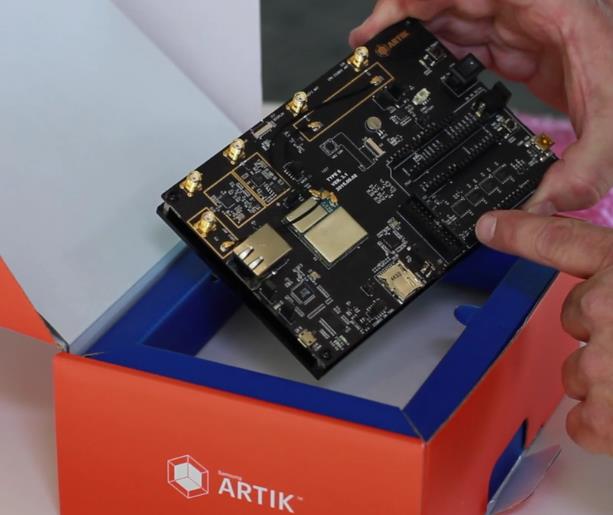
▲Appearance of an unopened ARTIK product (homepage)
ARTIK's cloud services also differentiate Samsung's IoT platform. Kim Min-soo, Senior Vice President at Samsung Electronics, explained, "While typical clouds utilize device-specific cloud services and apps, ARTIK Cloud is a single data bank that accommodates all devices and clouds through data-driven services."
Engineers from small and medium-sized enterprises who attended the briefing that day showed great interest in ARTIK. These engineers focused on whether ARTIK supported their respective network and security standards, whether it had various certifications, and whether it had scalability.
In response, Senior Researcher Kim Min-soo stated, "We plan to gradually expand compatibility with various operating systems, and we plan to support Arduino expansion modes by June." Senior Researcher Kim Dae-hwan added, "While ARTIK is currently focused on indoor products for smart home and building applications, we plan to expand to industrial products in the future."
ARTIK is praised for its ability to understand engineers' needs and make them simple and convenient. It particularly reflects the IoT industry's need to rapidly transform ideas into development and minimize time to market. It integrates everything from IoT modules to the cloud and ecosystem, and also alleviates the burden of certification issues that developers often face.
The question lies in how quickly the ecosystem can be built. Samsung also plans to continue expanding its portfolio by addressing the shortcomings of its current products by June, so attention is focused on ARTIK's future.
Comments
Related news

Samsung Electronics Smart TV Now Evolves into IoT Platform
Samsung Electronics will debut its 2016 Samsung Smart TV at CES 2016, the world's largest consumer electronics exhibition, establishing a new standard for IoT-based televisions.
2015.12.29by 명세환 기자
Zigbee Alliance to Launch Solutions for Smart Homes and IoT in Q3
ZigBee Alliance announced that it is collaborating with Thread Group to develop an end-to-end solution for IP-based Internet of Things (IoT) networks. This solution will be part of ZigBee Alliance's comprehensive range of product development specifications, technologies, branding, and certification programs. ZigBee Alliance is a non-profit organization formed by institutions that create open global standards, which define IoT used in consumer, commercial, and industrial applications.
2016.01.06by 신윤오 기자

Smart lighting meets IoT, growing rapidly in the home network market
LED lighting is expanding beyond its traditional role as a simple light source in the Internet of Things era, evolving into "connected lighting" that combines wireless communication technology to link people, spaces, and environments.
2016.01.18by
Korea Instrument, KOLAS Accredited Calibration Agency First to Simultaneously Acquire ISO/IEC 27,001·27,701
Korea Instrument has become the first among KOLAS accredited calibration agencies to simultaneously acquire ISO/IEC 27,001 and ISO/IEC 27,701 certifications. Through its proprietary platforms CWIZ Enterprise and CWIZ Partners, the company has embedded information security and personal data protection requirements across all business processes including customer information, equipment data, and calibration reports, with plans to continuously advance its management system through regular audits and security inspections.
2026.10.12by 배종인 기자
TeamViewer One, IT Incident Automation Workflow and Resolution Center Enhanced
TeamViewer has added IT incident automation capabilities and an advanced Resolution Center to its integrated digital workplace management platform 'TeamViewer ONE'. Recurrent service disruptions, configuration errors, and capacity shortages are automatically handled according to preset policies, and device status verification through script deployment can be managed in a unified interface, significantly reducing repetitive tasks for IT teams.
2026.10.12by 배종인 기자











