


KT Focuses on Smart Energy Business Based on MEG Platform
 Published2016.03.28 06:27
The government plans to strongly promote the development of new energy industries by enacting the Special Act on the Promotion of New Energy Industries. It has decided to reduce greenhouse gas emissions by 37% compared to the Business As Usual (BAU) scenario by 2030. This reflects a determination not to fall behind global trends.
To this end, the plan is to first establish an 'Energy Prosumer Power Market' to enable the sale of small-scale electricity generated by individuals or buildings, and to expand it nationwide. Additionally, the plan aims to improve electric vehicle performance by 2.5 times to supply 1 million pure electric vehicles by 2030 and replace 33,000 city buses with electric vehicles. Furthermore, to revitalize the ESS (Energy Storage System) market, a key element of the new energy industry, the plan intends to increase the ESS capacity to 10 GWH by 2030 and actively support not only the expansion of infrastructure for widespread adoption but also exports.
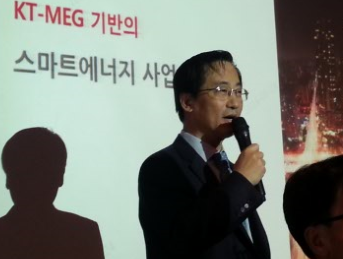
▲ Yoo Yang-hwan, Head of Smart Energy Business Division
Along with such government support policies, private companies are also moving swiftly, with the ICT industry, led by KT, identifying and pursuing new energy businesses to secure new growth engines. KT announced that it will differentiate itself in the new energy business market based on its ICT capabilities.
The KT-MEG Center (Energy Integrated Control Center), which opened last December, integrates and controls production, consumption, and trading. It aims to accommodate and optimally operate various smart energy services, such as renewable energy, energy efficiency, and demand resource services. To this end, 35 energy specialists are stationed 24 hours a day, enabling rapid response to failures for KT customers using energy solutions in all regions, both domestically and internationally.
KT-MEG Center provides economical real-time integrated operation management services based on energy IoT and the cloud, big data-based intelligent analysis engine technology, and integrated management functions for individual services to customers at an economical cost for the optimal operation of all smart energy services. Currently, KT-MEG Center provides real-time integrated monitoring of approximately 1,700 sites, including renewable energy, energy efficiency, electric vehicle charging, and demand resource operation. In the future, it plans to expand and enhance its capabilities by additionally integrating various energy solutions such as ESS (Energy Storage Systems) and AMI (Advanced Metering Infrastructure).
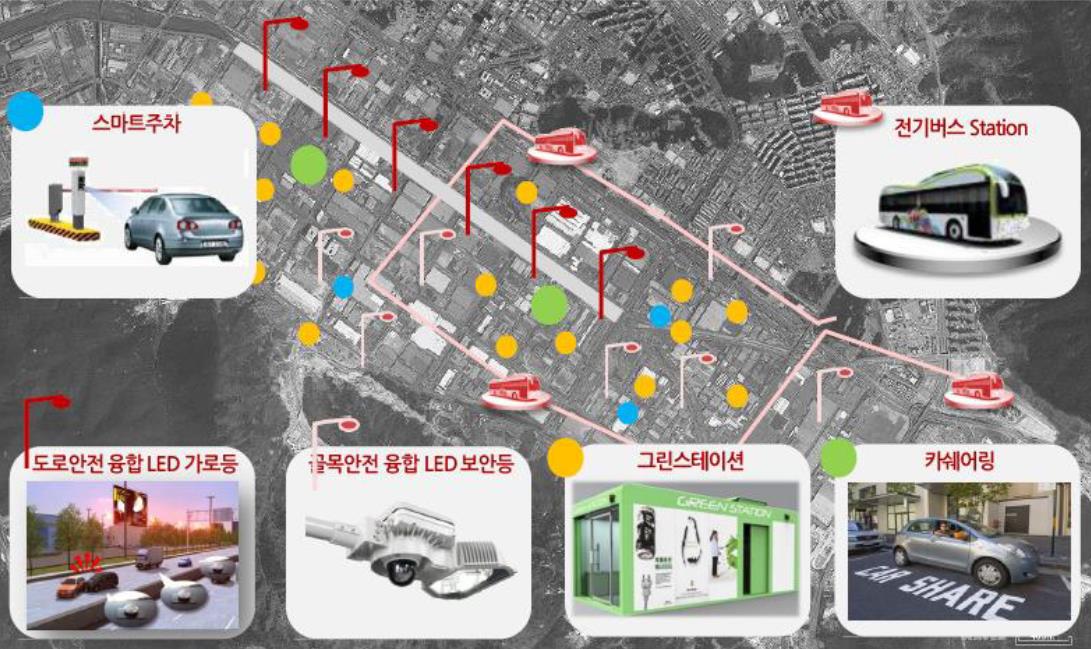
▲ Case Study of KT's Industrial Complex Efficiency Project
In addition, KT signed an agreement with Korea Electric Power Corporation last year to promote a remote meter reading pilot project using an LTE communication network, achieved a reading success rate of nearly 100%, and won the KEPCO high-voltage LTE remote meter reading project in March.
KT is currently carrying out a project in conjunction with the Smart Grid Expansion Project promoted by the Ministry of Trade, Industry and Energy, alongside the "Smart Industrial Complex Construction Plan," which involves establishing communication infrastructure such as dedicated LTE networks and Wi-Fi, as well as energy efficiency systems, in the Banwol and Sihwa Industrial Complexes, where key SMEs in the machinery and electrical/electronic industries are concentrated. Through this project, KT plans to provide ICT convergence energy efficiency services to make large industrial complexes, which are the main culprits of greenhouse gas emissions, more eco-friendly.
Also pursuing various new and renewable energy projects in partnership with small and medium-sized enterprises
In line with the trends in renewable energy, such as solar power, KT is pursuing various renewable energy projects by partnering with excellent small and medium-sized enterprises that possess core technologies related to renewable energy. Starting with the construction of the 7.5MW Daecheok Solar Power Plant in 2014, the company has secured references for various types of projects, including Roof-Top solar power plants utilizing chicken farm roofs and floating solar power plants utilizing the idle surface of reservoirs. Furthermore, it is gradually expanding its business scope by participating in renewable energy convergence support projects and building support projects organized by the Korea Energy Agency.
Recently, we have established solar power plants at logistics centers in Jangseong, Jeonnam and Icheon, Gyeonggi-do to demonstrate an IPP (Independent Power Plant) business that directly promotes solar production and sales, and to develop an optimal operating system for ESS (Energy Storage Systems), which is essential for new and renewable energy. We are also formulating plans to continuously expand by utilizing office buildings and idle sites scattered throughout the country.
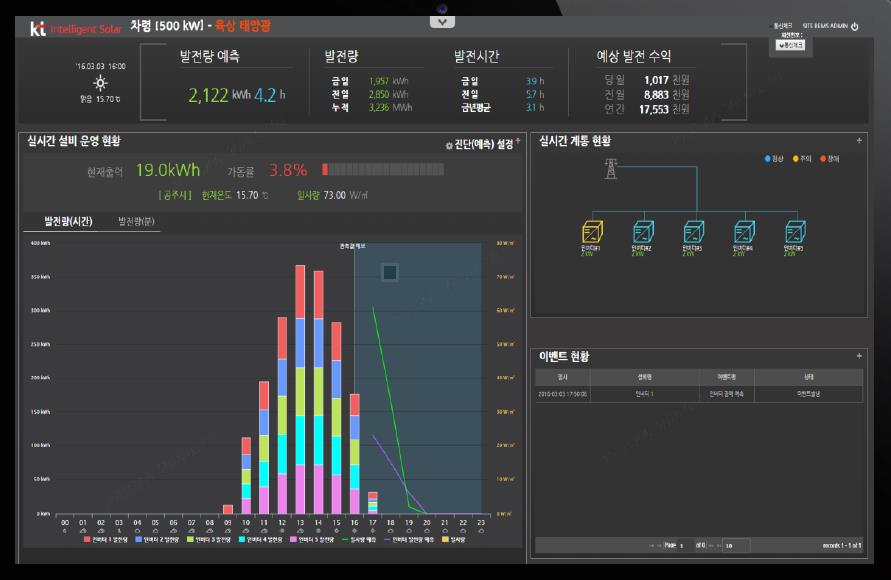
▲ KT MEG demonstration
KT is pursuing global business targeting the Asian region in the fields of new and renewable energy and energy efficiency. Asian countries such as Thailand and the Philippines have announced roadmaps for new and renewable energy projects and policies regarding the Feed-in Tariff system with the goal of reducing dependence on fossil fuels and cutting energy imports.
Accordingly, various energy-related businesses, including manufacturers of solar modules and energy storage systems and IT companies, are actively seeking to enter the renewable energy market in Asia. KT is also accelerating the construction and operation of solar power plants and energy storage systems (ESS), as well as the development of Advanced Metering Infrastructure (AMI) businesses. The solar residential supply project in Quang Binh Province, Vietnam, and the AMI project in Uzbekistan, both awarded in 2015, are examples demonstrating the fruits of KT's efforts to expand into the global energy business.
Advanced charging services and development of convergence services utilizing ICT related to electric vehicles
On July 23, 2015, KT jointly established Korea Electric Vehicle Charging Service Co., Ltd. with six companies including Korea Electric Power Corporation, Hyundai Motor Company, and Kia Motors to create a private electric vehicle charging market and is developing advanced charging services and convergence services utilizing ICT in line with the expansion of electric vehicle adoption.
Korea Electric Vehicle Charging Service aims to contribute to the adoption and expansion of the electric vehicle market by installing and operating approximately 300 electric vehicle charging stations by 2020 based on the capabilities of each shareholder and supplying approximately 100,000 electric vehicle charging facilities to the private and public sectors.
KT plans to soon introduce the world's first mobile charging service utilizing Internet of Things (IoT) technology in Korea through cooperation with Powercube, a small and medium-sized enterprise.
In addition, KT plans to develop and launch subscriber-based charging services and various convergence value-added services. First, we plan to promote the convenience of electric vehicle users by providing convenient charging services based on ICT and communication service capabilities, and in the future, we plan to pursue eco-friendly and future-oriented businesses through the convergence of existing industries and new energy industries, such as smart cars, autonomous driving, trading of electricity stored in electric vehicles, and renewable energy.
Comments
Related news

KT to transform Jeju Island into a 'smart tourism island'.
Korea's top tourism destination, Jeju Island, will soon be transformed into a 'smart tourism island' equipped with world-class giga infrastructure. This is expected to increase foreign tourists visiting Jeju Island and revitalize the local economy of the Jeju region.
2016.02.12by
KT Expands Investment in Companies Fostering Development of Vehicle Safety Driving Assistance Systems
KT is actively proceeding with investments and joint projects for companies incubated at the Gyeonggi Creative Economy Innovation Center (Director Lim Deok-rae, hereinafter referred to as Gyeonggi Center), taking full-scale steps to commercialize startups. On the 17th, KT announced that it has decided to invest 2 billion won in "Cavi," a camera image-based advanced driver assistance system (ADAS) development company that is an incubated enterprise of the Gyeonggi Center.
2016.03.24by 명세환 기자
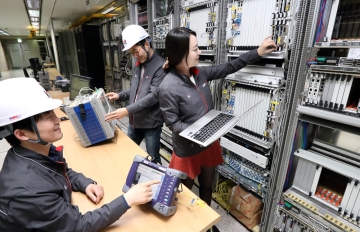
KT provides broadband services approximately 100 times faster than before
KT has successfully commercialized software-defined network infrastructure (hereinafter T-SDN) nationwide for the first time globally and declared the completion of successful implementation on the 27th. T-SDN is a software-based network infrastructure technology that enables dedicated line services to be provisioned approximately 100 times faster than conventional methods.
2016.03.28by 명세환 기자
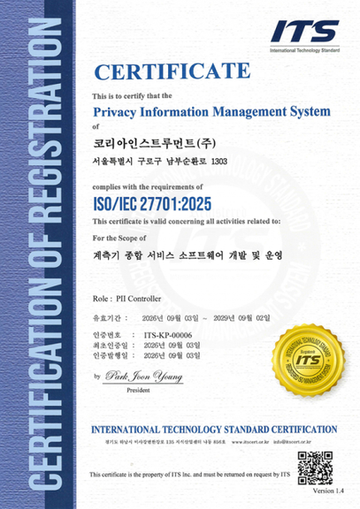
Korea Instrument, KOLAS Accredited Calibration Agency First to Simultaneously Acquire ISO/IEC 27,001·27,701
Korea Instrument has become the first among KOLAS accredited calibration agencies to simultaneously acquire ISO/IEC 27,001 and ISO/IEC 27,701 certifications. Through its proprietary platforms CWIZ Enterprise and CWIZ Partners, the company has embedded information security and personal data protection requirements across all business processes including customer information, equipment data, and calibration reports, with plans to continuously advance its management system through regular audits and security inspections.
2026.10.12by 배종인 기자
TeamViewer One, IT Incident Automation Workflow and Resolution Center Enhanced
TeamViewer has added IT incident automation capabilities and an advanced Resolution Center to its integrated digital workplace management platform 'TeamViewer ONE'. Recurrent service disruptions, configuration errors, and capacity shortages are automatically handled according to preset policies, and device status verification through script deployment can be managed in a unified interface, significantly reducing repetitive tasks for IT teams.
2026.10.12by 배종인 기자











