



Creating an IoT world with low-cost, low-power, and low-capacity 'Internet of Things'
 Published2016.03.29 19:59
'LTE-M', a global standard network technology specialized for the Internet of Things
A world where communication once limited to people is now possible even with the smallest objects; now, any South Korean citizen can encounter a world where all objects are connected, anytime and anywhere.
At a press conference on the "Direction of Small IoT Business Promotion" held at the Grand Ballroom of the Seoul Plaza Hotel on the 29th, KT announced the launch of its Small IoT business through the world's first commercialization of the nationwide "LTE-M" network service, along with acceleration programs designed to foster an industrial ecosystem, such as support for Small IoT devices, the establishment of dedicated rate plans and making them free until the end of the year, support for commercialization, and the discovery of specialized services.
Creating an ecosystem including providing 100,000 modules for free and offering free fees within the year
The Internet of Small Things is a transmission technology characterized by low cost, low power consumption, and low capacity, based on the idea that not all objects necessarily require high-cost, ultra-high-speed networks to exchange data over the internet. It enables the transmission of small amounts of data and allows operation solely on batteries without the need for constant power.
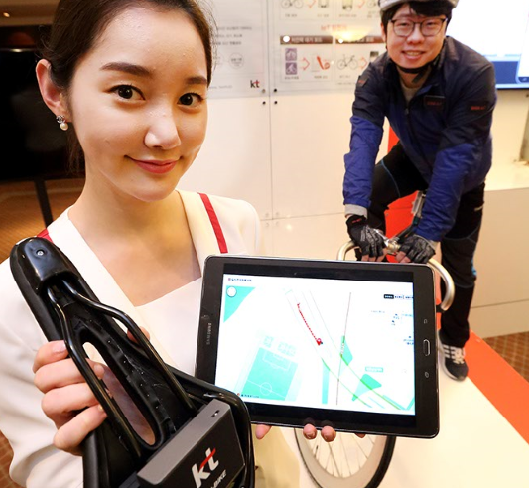
Since the Internet of Things only requires the installation of small and simple communication modules, control services previously provided to expensive objects such as automobiles can be applied to various objects such as bicycles or blood boxes.In addition, since power consumption is very low, long-term service is possible using only the built-in battery, which can further expand service areas such as water/gas meter reading and heavy equipment parts management.
At the press conference, KT showcased various services powered by LTE-M, including a 'Bicycle Theft Control Service' that allows users to check the real-time location of bicycles, a 'Smart Blood Box' capable of measuring the temperature and monitoring the movement of blood being transported, and a 'Smart Lighting Service' that controls the on/off status of store signs and alerts users to abnormal signs by linking with in-store temperature, humidity, CO2, and fire sensors.
Revealed 150 billion won investment in NB-IoT and a goal of 4 million connected IoT devices by 2018.
'LTE-M', for which KT has launched nationwide commercial service, is a global standard network technology specialized for the Internet of Things (IoT) and is evaluated as superior to other IoT technologies such as SIGFOX or LoRa in terms of coverage and stability.
LTE-M not only enables nationwide service in terms of coverage, but also prevents degradation of communication quality due to frequency interference because it uses licensed band frequencies. In addition, it can communicate bidirectionally with objects, enabling control of devices that is impossible with SIGFOX or LoRa, and because it utilizes the LTE network, it also has advantages in global scalability through roaming.
Creating an ecosystem through the Internet of Things business acceleration program
KT has completed the development of LTE-M dedicated modules with partners such as Telit, Techplex, and AM Telecom to accelerate the IoT market alongside the commercialization of the nationwide LTE-M network service, and has decided to provide 100,000 modules needed for device development free of charge.
A dedicated rate plan for the Internet of Things is being prepared with the goal of launching it in the second quarter, taking into account the environment and characteristics of each business. To develop and expand IoT services, we plan to provide it for free until the end of the year to reduce the burden on customers.
KT plans to not only provide financial support to developers to create excellent services through direct investment and funds contributed by KT, but also actively support the development of various IoT services for small devices by collaborating with funds managed by the Gyeonggi Creative Economy Innovation Center, and continuously identify related specialized services.
KT also announced plans to invest 150 billion won in NB-IoT to provide more advanced IoT services. To this end, the NB-IoT Open Lab was opened at the Gyeonggi Creative Economy Innovation Center on the 22nd, and plans to complete commercial network interoperability testing and service verification of NB-IoT within the year to pursue the world's first nationwide commercialization of NB-IoT.
Kim Jun-geun, Head of KT’s GiGA IoT Business Unit, stated, “Since the Internet of Things (IoT) involves the transmission of small amounts of data but a rapid increase in the number of devices, infrastructure to accommodate this is essential.” He added, “Through aggressive investment and the creation of an ecosystem for the IoT business, we aim to achieve the goal of 4 million connected IoT devices by 2018 and become a leading player in the IoT market.”

Comments
Related news
KT Successfully Demonstrates LTE-MTC-Based IoT Service
KT (Chairman Hwang Chang-gyu) announced that it has showcased demonstrations of various Internet of Things services applying LTE-MTC technology on LTE commercial networks in collaboration with domestic and overseas developers including Nokia, a global network equipment manufacturer.
2015.11.26by 명세환 기자
Domestic IoT companies must secure a breakthrough by entering the global market
The Ministry of Science, ICT and Future Planning held the "2016 Third ICT Policy Forum for Visualizing Creative Economy" on the 19th at Cisco Korea (ASEM Tower, Samseong-dong), presided over by Second Vice Minister Choi Jae-yoo, with the theme of activating overseas expansion of domestic Internet of Things (IoT) companies. This ICT Policy Forum was organized as a follow-up measure to the "K-ICT Internet of Things Diffusion Strategy" announced on December 7 of last year, and brought together global IoT enterprises and promising domestic startups to conduct in-depth discussions on ways to activate overseas expansion of domestic IoT companies, including sharing overseas expansion strategies and challenges.
2016.02.26by 명세환 기자
e4ds Regular Seminar and Industrial Internet of Things (IIoT) Innovation Day Successfully Held
This seminar, hosted by COEX and held in conjunction with the International Smart Factory Automation Exhibition (Automation World 2016), focuses on disseminating Industrial Internet of Things technology to the industry by providing the latest information in the Industrial IoT field spanning from semiconductors to communications, platforms, software, testing, and security.
2016.03.14by 명세환 기자
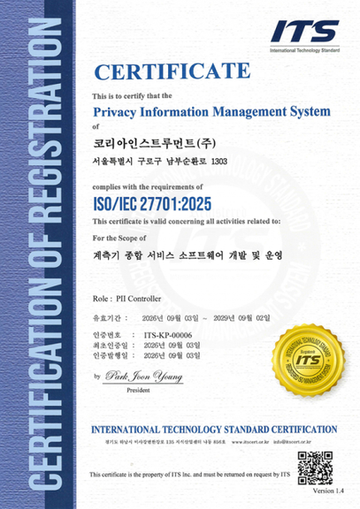
Korea Instrument, KOLAS Accredited Calibration Agency First to Simultaneously Acquire ISO/IEC 27,001·27,701
Korea Instrument has become the first among KOLAS accredited calibration agencies to simultaneously acquire ISO/IEC 27,001 and ISO/IEC 27,701 certifications. Through its proprietary platforms CWIZ Enterprise and CWIZ Partners, the company has embedded information security and personal data protection requirements across all business processes including customer information, equipment data, and calibration reports, with plans to continuously advance its management system through regular audits and security inspections.
2026.10.12by 배종인 기자
TeamViewer One, IT Incident Automation Workflow and Resolution Center Enhanced
TeamViewer has added IT incident automation capabilities and an advanced Resolution Center to its integrated digital workplace management platform 'TeamViewer ONE'. Recurrent service disruptions, configuration errors, and capacity shortages are automatically handled according to preset policies, and device status verification through script deployment can be managed in a unified interface, significantly reducing repetitive tasks for IT teams.
2026.10.12by 배종인 기자











