


Smart healthcare, do you have a 'medical assistant' just for you?
 Published2016.04.04 18:27
Companies Dominating Platforms Seize Dominance in Healthcare Industry
“We will enter the top 5 in the world for personalized wellness by 2020”
Expectations for the healthcare industry are rising as the government deliberated and finalized the implementation plan for future growth engines (8th National Science and Technology Council Special Committee on Future Growth Engines), stating that it will prioritize the wellness industry starting this year (budget of 58.3 billion won).
The wellness industry is a sector supported as part of the customized investment strategy for the 19 future growth engines, collectively referring to mobile-based healthcare such as wearable devices and health-related applications. The wellness investment strategy promotes wellness IT programs linking hospitals and companies, supports platform development, fosters the training of specialized personnel for wellness device services, assists in obtaining international standards for devices, and facilitates the development of testing and certification methods and service guidelines. This includes pilot projects for mobile healthcare at public health centers.
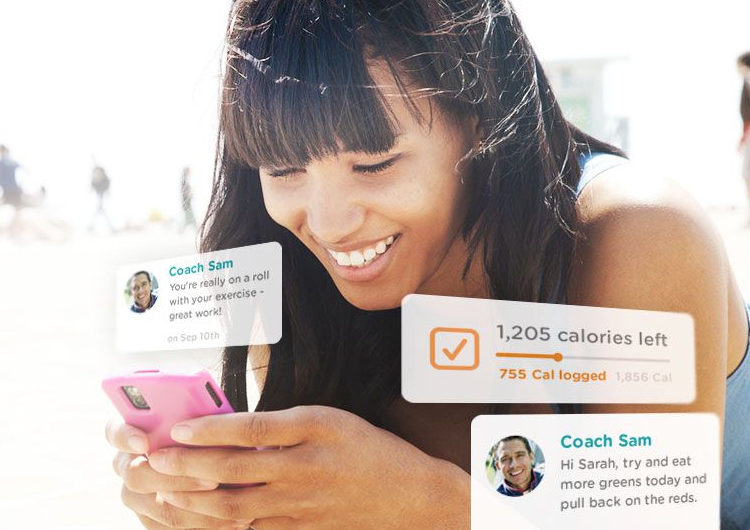
▲ One-on-one personalized service through Noom's health coach. (Noom Homepage)
Accordingly, we examine the potential for a global leap by analyzing the current status of the domestic smart healthcare market. Smart healthcare, which refers to services that utilize information and communication technology to manage individual health conditions and provide personalized medical care without the constraints of time or place, is one of the fields that has recently been actively demonstrating synergy with the Internet of Things (IoT). With the domestic and international smart healthcare markets projected to continue growing at a double-digit rate, the government and related companies are also moving swiftly.
Expansion of the IoT-based smart healthcare market
A fierce battle is underway to gain a foothold in the smart healthcare market, involving not only global IT giants like Apple and Google but also various electronics companies. In June 2014, Apple unveiled HealthKit, an open healthcare platform that links the Apple Watch with healthcare-related applications, devices, and hospitals. HealthKit is a comprehensive health management platform that remotely transmits medical information, such as user blood pressure, weight, and heart rate collected through apps, to medical professionals and hospitals. Centered around the HealthKit platform, Apple has created an ecosystem in which all players in the healthcare market—including existing apps, devices, and hospitals—can participate.
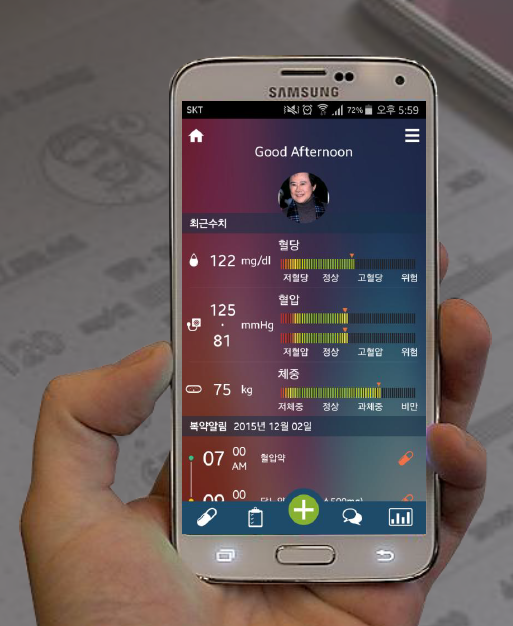
▲ Aimmed's conversational interface
Google focuses on utilizing its healthcare platform, Google Fit, for personal health management. Google Fit is a platform that collects health information generated from medical mobile apps, and because it is open, multiple developers can participate as partners. Google is building an ecosystem that focuses on utilizing individual fitness data rather than providing medical services through integration with healthcare systems.
Samsung Electronics aims to become a healthcare platform operator that analyzes and researches data. Having unveiled the healthcare platform SAMI and the wristband-type wearable device 'Simband' in 2014, Samsung is expanding its global partners and striving to build a mobile healthcare ecosystem.
Having moved beyond the initial stage driven by communication and sensor technologies, smart healthcare is now entering a mature phase led by data and content. Moving forward, a competitive landscape among platform operators encompassing transportation services, social infrastructure, and remote management services is expected to intensify. The core of the platform ecosystem consists of device manufacturers, solution providers, healthcare service providers, and data analytics firms.
Aimmed Helps Users Manage with Interactive Interface
Aimmed (www.aimmed.com) and Noom Korea (www.noom.com), healthcare service companies, are examples of companies that have established their own distinct domains in healthcare services. Aimmed has maximized user convenience and information provision through its chronic disease solutions and activity management solutions.
The company introduces Recover Health Talk as a chronic disease self-management solution and a health management application created by medical professionals for the self-care of patients with diabetes, hypertension, hyperlipidemia, and obesity. The Recover solution meticulously manages diabetes by monitoring blood glucose and HbA1c, and also features a blood pressure management function based on target blood pressure. It provides systematic obesity management as well as cholesterol level analysis and datafication.
Jeon Hye-won, a manager at Aimmed, stated, “The most important feature of the Recover solution is its conversational interface. For patients with chronic diseases, the willingness to consistently use the app to take their medication or manage their health is crucial.” She added, “To this end, we introduced a conversational interface. Users participate because they understand the content and find it engaging.” The administrator page tracks and displays the actual number of times a patient has taken their medication. Recover is currently being supplied to hospitals and related institutions.
Noom Korea Provides One-on-One Personalized Services Through Health Coaches
Noom Korea, which has entered the Korean market, currently offers the applications Noom Coach, Noom Health, and Noom Walk. The Noom Diet Coach mobile app, which positions itself as a pocket-sized health coach for a healthy and beautiful body, has stated that 40 million people worldwide have successfully lost weight in a healthy way over the past two years. Noom's diet app has ranked first in revenue in the health category on the Google Play Store for three consecutive years and integrates with Google Fit and HealthKit.
The Noom mobile app screen provides not only automatic calorie calculation but also calorie density feedback based on a traffic light color system. Ryu Seong-gon, Communication Manager at Noom Korea, said, “The Noom app is an application that helps you easily manage your health on mobile. As you can see on the screen, a message saying ‘Record today’s meal’ appears, and calories are calculated automatically. It indicates that high-calorie foods are not helpful for weight management.”
Market expansion due to the rapid growth of smartphone health apps
Legal and regulatory issues must also be resolved, and security issues must be addressed as well.
The rapid growth of smartphone health apps, the proliferation of wearable healthcare devices, and IoT-based continuous personal health monitoring services have played a significant role in the spread of smart healthcare. The types of services are also gradually expanding from initial focus on health measurement to healthcare measurement.
The reason healthcare devices have been able to spread is not unrelated to the development of various advanced sensors. Accelerometer sensors, which measure the acceleration or impact of moving objects, are utilized in smartbands; temperature sensors that measure the temperature of localized areas, as well as heart rate sensors that measure the human heartbeat, are also widely used. Furthermore, oxygen saturation sensors, which measure oxygen saturation in the blood, determine the state of hemoglobin in the blood using optical signals from complex light sources, while blood glucose sensors can measure blood glucose levels by irradiating the skin with infrared light and utilizing light absorbance. Companies are introducing healthcare devices utilizing these sensors.
Consumers are now demanding additional services alongside hardware featuring various functions. This is the reason why the global IT and healthcare companies mentioned earlier are providing differentiated platform services. Professor Park Jong-tae of Kyungpook National University stated, “In the new, dynamic IoT ecosystem, whoever dominates the platform holds industrial leadership,” adding that “for small-scale healthcare manufacturing startups, software platforms supporting firmware, cloud services, and big data analysis are crucial differentiating factors.”
There are also many obstacles. One is that the medical sector involves numerous stakeholders, including hospitals, pharmaceutical companies, and government agencies. There is also a mountain of medical regulations and policies. A legal framework must be established where data from each field can be shared and mutually acceptable. Security issues cannot be overlooked either, as the exposure of critical medical information could undermine fundamental trust in the healthcare industry.
Comments
Related news

[Reporter's Notebook] Healthcare: Why Do Auto Companies Pay Patent Fees to IT Firms?
Apple acquired Fingerworks, a company with touch technology, through M&A in 2005. After obtaining exclusive patent licenses from this small company that possessed touch recognition technology and patents, it acquired 17 patents. The result of this patent acquisition was realized with the launch of the touch UI iPhone in 2007.
2015.12.07by 신윤오 기자

If a healthcare car detects a driver's heart attack and stops the vehicle safely
A recent analysis report released by Frost & Sullivan Korea, titled 'Car as A Doctor - Automotive Industry Embracing In-car Health Monitoring and Wellbeing (https://www.frost.com/q295543940)', investigates health, wellness, and wellbeing (HWW) features in automobiles and discusses future prospects for the automotive industry.
2015.12.23by 신윤오 기자
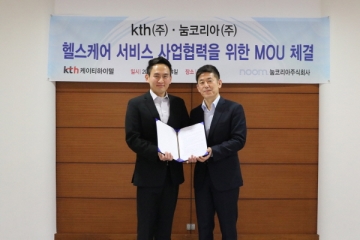
KTH Signs MOU with Mobile Healthcare Company Noom
KTH has announced that it has signed a Memorandum of Understanding (MOU) with mobile healthcare company Noom for mutual cooperation in health analysis information business, and has decided to implement 'Noom Health' in its own health management solution 'WellC'.
2016.01.14by 명세환 기자
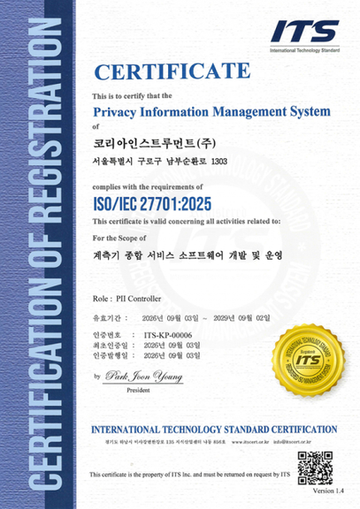
Korea Instrument, KOLAS Accredited Calibration Agency First to Simultaneously Acquire ISO/IEC 27,001·27,701
Korea Instrument has become the first among KOLAS accredited calibration agencies to simultaneously acquire ISO/IEC 27,001 and ISO/IEC 27,701 certifications. Through its proprietary platforms CWIZ Enterprise and CWIZ Partners, the company has embedded information security and personal data protection requirements across all business processes including customer information, equipment data, and calibration reports, with plans to continuously advance its management system through regular audits and security inspections.
2026.10.12by 배종인 기자
TeamViewer One, IT Incident Automation Workflow and Resolution Center Enhanced
TeamViewer has added IT incident automation capabilities and an advanced Resolution Center to its integrated digital workplace management platform 'TeamViewer ONE'. Recurrent service disruptions, configuration errors, and capacity shortages are automatically handled according to preset policies, and device status verification through script deployment can be managed in a unified interface, significantly reducing repetitive tasks for IT teams.
2026.10.12by 배종인 기자











