



PCB Market and Technology Trends (Part 1) High-function mobile and battlefield boards drive growth in domestic PCB market
 Published2016.04.18 17:07
Domestic single-sided and double-sided substrate production is expected to decrease due to expansion of Chinese-speaking substrate production
As the global electronic circuit board (PCB) market is expected to grow by an average of 3.1% annually until 2019, the domestic PCB market is also expected to return to growth this year after overcoming last year's decline (compared to the previous year).
According to the Electronic Circuit Board Industry Status Report published by the Korea Electronics Circuit Industry Association, high-end boards for mobile and network use and automotive electrical boards are expected to lead the upward trend in the PCB market this year.
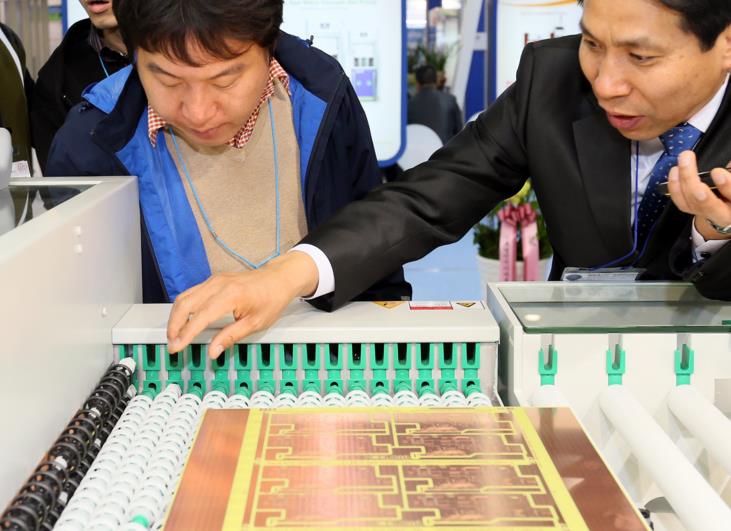
▲ The average annual growth rate of the global electronic circuit board market is expected to be 3.1%. <Photo: KPCA Show homepage>
Meanwhile, the KPCAshow 2016 (International Electronic Circuit Industry Exhibition), hosted by the Korea Circuit Industry Association (KPCA), will be held for three days from April 26 to 28 at KINTEX Exhibition Center 2 in Ilsan, Goyang-si.
The global electronic circuit board market is expected to grow from USD 581 million in 2015 to USD 656 million in 2019, with a compound annual growth rate of 3.1%. In 2015, the production volume of electronic circuit boards in major countries such as Korea (7,200), China (27,000), Japan (6,000), and Taiwan (8,500) was USD 48.7 billion, accounting for 83.8% of the global market. Japan's overseas production has exceeded domestic production since 2013, and Korea's overseas production ratio is also gradually increasing.
In terms of global substrate production by application (2015), 31.3% was for communication devices including mobile phones, and the average growth rate of mobile phone substrates was 4.7%. In 2016, low growth is expected due to the slowdown in the global market, and in particular, automotive (3.1%) and medical (6.3%) substrates are expected to continue to grow.
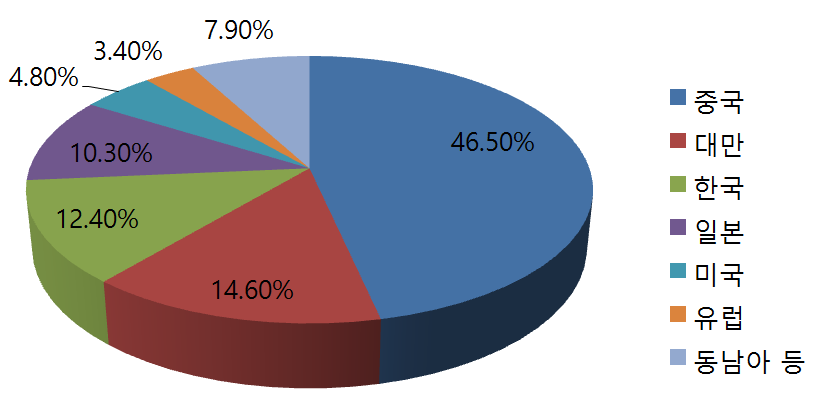
▲World electronic circuit board production share by region
By product, substrate production (2015) was 50.6% for rigid substrates, 20.8% for flexible substrates, 14.1% for HDI substrates, and 14.5% for IC-Substrates. Among rigid substrates, 4- to 6-layer substrates accounted for 23.8% of the total. Although the substrate market for mobile devices is facing increasing price pressure due to slowing growth, production of application substrates such as build-up substrates, semiconductor PKG substrates, and FPCs is expected to continue to grow by around 3%.
2015 Market, 9.1 Trillion Won, Down 1.6% from Previous Year
Flexible substrates, reverse growth halted, partial recovery expected this year
The domestic electronic circuit board production volume in 2015 was recorded at KRW 9.1 trillion, down 1.6% from the previous year due to stagnation in the domestic premium market. However, in 2016, it is expected to grow by 1.1% to KRW 9.2 trillion due to a slight increase in high-end boards such as component-embedded boards, semiconductor PKG boards, and network multilayer boards, as well as electric field boards. Domestic single- and double-sided board production is expected to slow down and decrease due to the expansion of board production in the Chinese region.
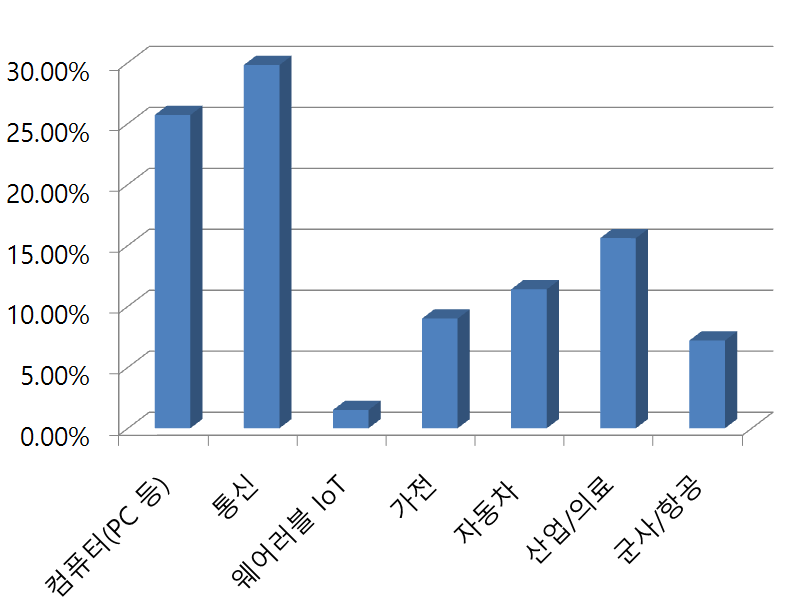
▲ World electronic circuit board market share by application (2015)
By substrate, rigid substrates (including HDI substrates) accounted for 50.8%, IC-Substrate 26.7%, and flexible substrates 22.5%. In particular, flexible substrates, which are widely used in smart devices, showed the largest decrease of 8.1% in line with smartphone performance. However, starting this year, the negative growth has stopped and partial recovery has occurred, with production expected to grow by 1.5% to KRW 2.8 trillion. In particular, with smartphones equipped with dual cameras, high value-added RF substrates are expected to increase, and PKG substrates (0.8% growth) are expected to reach KRW 2.45 trillion.
By substrate, high-density micro-pattern PKG substrates, build-up substrates (HDI), and high-layer substrates for servers and supercomputers for realizing multi-functionality and high functionality of electronic devices for IoT and IoE are leading the production, and rigid substrates are expected to grow by 1.1% to KRW 4.67 trillion in 2016.
The report stated, “This year, production of high-performance PKG substrates and build-up substrates for low- to mid-priced smart devices targeting overseas emerging countries including China is expected to increase,” and “Structural adjustments centered on high value-added substrate manufacturing are necessary based on the electronics industry infrastructure of domestic global set companies.”
Raw materials, down 2.9% year-on-year to KRW 165 billion
Production of auxiliary materials recorded 284 billion, down 5.0% from the previous year
In 2015, the raw materials sector in the secondary industry recorded KRW 1.65 trillion, down 1.3% from the previous year, with KRW 710 billion for rigid substrates, KRW 570 billion for flexible substrates, and KRW 370 billion for copper foil. The technological level of domestic manufacturers has improved significantly, but Japanese and American companies dominate the market for some high-end products. In the low- and middle-end markets, Chinese companies have been actively entering the domestic market since 2000, increasing their domestic market share. Currently, there are about 30 overseas import agency agencies operating in Korea.
In 2015, the production of auxiliary materials decreased by 5.0% year-on-year to KRW 284 billion, with Solder Resist (PSR) accounting for 32.4% of the auxiliary materials at KRW 92 billion. The domestic PSR market is dominated by foreign companies that do business with major substrate manufacturers, with two domestic companies following suit.
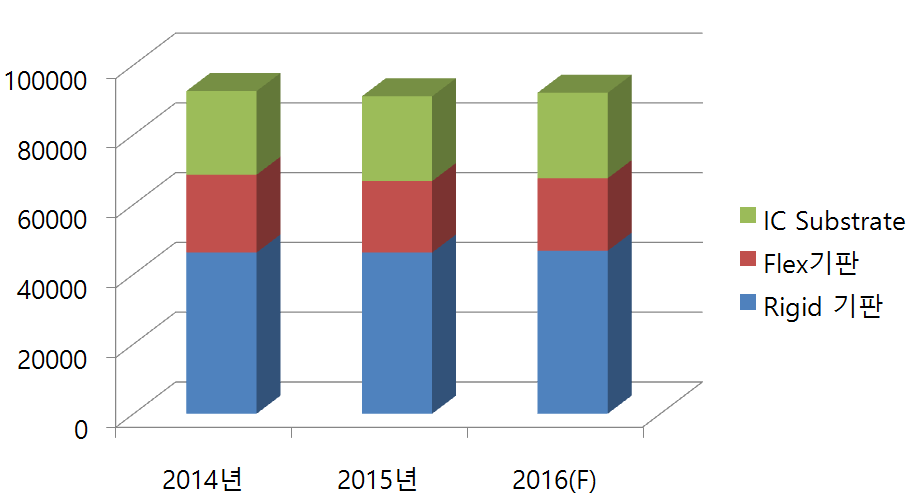
▲ Domestic PCB substrate year-by-year trend (100 million won)
This year, the production of auxiliary materials is expected to be similar to last year's level at 285 billion won, and Solder Resist (PSR) is expected to decrease by 2.2% to 90 billion won due to price declines and localization. In the case of bit production, it appears that the market share is being pushed out by the Chinese market, which has high price competitiveness, as manufacturing technology is standardized. CNC Drill Bit and Router Bit are expected to show the same performance as last year. Dry Film showed a production amount of 105 billion won in 2015, a 4.5% decrease from the previous year, and is expected to show a scale of 110 billion won in 2016.
“This year, new investments by substrate manufacturers are expected to be minimal,
“Investment in the semiconductor PKG sector and rationalization sector will continue.”
The pharmaceutical production market, which recorded a scale of 470 billion won last year, a 2.5% decrease from the previous year, had gold-plated and copper-plated pharmaceuticals accounting for the largest share, 61.5% of total pharmaceutical production. This year, the pharmaceutical market is expected to grow by 2.1% to reach 480 billion won, with gold plating growing by 3.9% and copper plating growing by 3.7% to reach 300 billion won. The pharmaceutical market is still dominated by foreign companies in high value-added drugs such as copper plating and PKG drugs. In particular, it has been a difficult market for latecomers to enter due to issues with drug approval and reliability, but recently, domestic companies are attempting to localize products through cooperation with domestic substrate manufacturers, creating opportunities to participate in the market.
The equipment sector saw a significant decline due to a decrease in investment by domestic substrate manufacturers. The equipment market (2015) was 285 billion won, a 44.7% decrease from the previous year, and equipment for plating/surface treatment processes was 70 billion won, a 57.6% decrease.
According to the industrial status report, “Among domestic equipment companies, although domestic demand has decreased significantly, overseas competitiveness is increasing as they advance into the Chinese market and Southeast Asia based on their technological prowess,” and “This year, new investments by substrate companies are expected to be minimal, but investments in the semiconductor PKG sector and rationalization sector will continue.”
☞ Next week (25th) in the PCB Market and Technology Trends (Part 2) article, we will introduce the roadmap for each PCB technology.
Comments
Related news

Complete the PCB design verification tool 'HyperLinx' that has become stronger at once
Mentor Graphics Korea (CEO Yang Young-in) announced the launch of a new version of its PCB design verification solution, 'HyperLynx®'. The latest version of 'HyperLynx®' enables integrated verification of signal and power integrity, 3D electromagnetic solving, and high-speed rule checking all at once. Based on the widely-used HyperLynx signal integrity/power integrity (SI/PI) application, the company stated that this product provides a comprehensive set of analysis technologies that enable designers to design any type of high-speed digital PCB.
2016.04.04by

Achieve Complete Verification with the Stronger Mentor PCB Design Validation Tool 'HyperLynx'
Mentor Graphics Korea (CEO Yang Young-in) announced the launch of a new version of its PCB design validation solution 'HyperLynx®'. The latest version of 'HyperLynx®' enables integrated verification of signal and power integrity, 3D electromagnetic solving, and high-speed design rule checking all at once. Based on the widely-used HyperLynx signal integrity/power integrity (SI/PI) application, this product provides a comprehensive set of analysis technologies that enable designers to design any type of high-speed digital PCB, according to the company.
2016.04.04by
ESP32 Development Environment Selection and GPS Application Implementation
The ESP32 is a microcontroller that integrates Wi-Fi, Bluetooth, 12-bit ADC, capacitive touch, PWM, DAC, and UART in a single SoC. However, the abundance of features does not by itself solve the designer's problems. The real challenges lie in selecting the appropriate development environment, determining which pins can be used and which must be avoided, and converting raw data from modules into usable information. This document addresses ESP32 peripheral constraints (ADC2 and Wi-Fi coexistence limitation, UART1 occupancy, ADC non-linear regions), the trade-offs between Arduino IDE and ESP-IDF, and the process from connecting NEO-6M/NEO-M8N GPS modules to UART2, parsing NMEA sentences, and visualizing routes in Google Earth, all organized based on documented references.
2026.10.12by 편집부
MIPI CSI-2, DSI-2, C-PHY, D-PHY Test Solution Technical White Paper
The MIPI interface adopts a burst mode that transitions between low-power (LP) and high-speed (HS) states for low-power consumption, and in return, strict timing rules are imposed on state transitions. Additionally, the high-speed section operates as a packet-based protocol with headers, ECC, and CRC, so verification engineers must handle waveforms and protocols simultaneously. Traditional configurations combining general-purpose oscilloscopes and AWGs reveal limitations in setup complexity, measurement uncertainty, and lack of reproducibility when faced with these requirements. This white paper, based on webinar materials, organizes the structure of this problem and describes how the SV5C-DPTXCPTX generator for receiver testing and SV5C-DPRXCPRX analyzer for transmitter testing integrate state transition testing, stressed eye testing, and protocol analysis into a single bench, along with their application boundaries.
2026.10.12by 편집부
NVIDIA to Invest $1 Billion in U.S. Science Over Next Five Years
NVIDIA has announced plans to invest $1 billion over the next five years to strengthen U.S. scientific and technological competitiveness. The company will enhance cutting-edge artificial intelligence research and development capabilities in key areas including quantum computing, healthcare, and energy security, while expanding support for higher education research institutions and cloud service providers. NVIDIA is participating as a major industry partner in the White House Office of Science and Technology Policy's Genesis Mission, and is promoting supercomputer construction in collaboration with national laboratories including Argonne and Los Alamos.
2026.10.12by 배종인 기자











