



Cisco Announces Optimized Solutions to Accelerate the IoT and 5G Era
 Published2016.05.11 12:38
Capturing the Korean market, the fastest-changing telecommunications network market in the world, with solutions optimized for telecommunications business.
Cisco Korea (CEO Kyung-won Jeong) has presented strategies to help telecommunications operators achieve business success in the future, driven by IoT and 5G. On the 11th, Cisco held a meeting attended by Chris Heckscher, President of Cisco's Asia Pacific and Japan Telecommunications Business Group, who was visiting Korea, to announce specific plans for the domestic telecommunications market.
Cisco, a leader in digitalization and projecting that the digital sector will create approximately $2 trillion in potential economic value over the next 10 years, plans to support telecommunications service providers in taking advantage of new opportunities in the digital age and creating an environment for improved profitability.
In this strategy announcement, Cisco focused specifically on the current issues facing domestic and international telecommunications operators, presenting specific end-to-end solutions and directions to address them. The telecommunications industry is currently undergoing rapid development and change, driven by the evolution of the Internet of Things (IoT), the cloud, and the rise of mobile users. Consequently, telecommunications operators face numerous challenges in expanding their businesses, including rapid infrastructure adoption, operational efficiency, cost reduction, risk minimization, and security.
Accordingly, Cisco proposed Cisco EPN (Evolved Programmable Network), ESP (Evolved Service Platform), and Core IoT Platforms as solutions to help telecommunications companies launch new services more quickly and operate them flexibly and safely, thereby generating revenue and achieving continuous innovation in IoT and 5G businesses.
Chris Heckscher, President and CEO of Cisco's Asia Pacific and Japan Telecom Business, said, "Telecom is one of the sectors undergoing the fastest digital transformation. In Korea, the pace of development is even faster. “The introduction of services with that level of safety and flexibility will determine success or failure in the future market,” he explained, adding, “While each operator has different situations, concerns, and stages of digital transformation due to these, Cisco’s EPN, ESP, and IoT platforms will be solutions that will accelerate the success of IoT and 5G businesses, which will be homework that telecommunications operators will have to solve and revenue-generating opportunities in the future.”
The solutions Cisco unveiled in this telecommunications business strategy are as follows. First, the standard architecture 'EPN (Evolved Programmable Network)' announced by Cisco is a new layer architecture that evolved from the existing IP NGN and can be applied to all the services that telecommunications companies are thinking of. EPN is the foundation layer of Cisco's open network and provides computing, network, and storage functions. It also flexibly and elastically integrates with the entire fabric, physical as well as virtual environments, and other NFV (Network Functions Virtualization) and network and data center infrastructure, simplifying operational processes and accelerating revenue realization and service innovation. Above all, it can be closely connected with 5G mobile networks, including network slicing, a core 5G technology, providing opportunities for the development of various IoT services.
In addition, it helps users realize rapid revenue by providing innovative on-demand services regardless of their access location, increasing predictability through scalability and dynamic resource distribution, and operating services flexibly through reduced cost per bit.
Another solution proposed by Cisco is the Cisco Evolved Service Platform (ESP), an open and scalable platform. In the past, infrastructure constraints meant it took telecommunications operators six months to a year to launch new services. However, Cisco's ESP, the most comprehensive, standards-based solution for NFV, automation, and orchestration, enables new service launches in minutes.
ESP comprehensively provides the following functions: 'Orchestration Engine' that automates the development and monitoring of all infrastructure, resources, and functions required across the architecture; 'Catalog of Virtual Functions' that can be linked to profiles with scalable network and application functions; 'Service Profiles' that provides policies and services associated with the profiles of all services; and 'Service Broker' that identifies business intent and executes service initialization and chaining transformation of the orchestration engine.
Cisco's IoT Platform Will Drive Telecom Operators' Business Performance
Cisco also introduced key IoT assets designed to strengthen the IoT business competitiveness of telecommunications operators. With approximately 50 billion devices and objects expected to be connected to the Internet by 2020, the era of IoT, which will lead this trend, is becoming increasingly realistic. To this end, Cisco has been supporting the IoT businesses of operators and partners through various acquisitions of IoT specialists.
LoRa is a large-scale, low-power, long-range wireless technology emerging as a key IoT technology. Its low standby power consumption and reasonable price make it primarily used in smart cities and outdoor environments. Among Cisco's devices, the IR829 supports LoRa, and Cisco is developing and supplying an LPWA-LoRa solution package together with its partner Actility.
Jasper, acquired by Cisco earlier this year, is a cloud-based IoT service platform provider. Through its IoT service platform, it supports new IoT services, such as enterprise Wi-Fi, security for connected devices, and advanced analytics for user management. Specifically, effectively leveraging the IoT requires more than simply connecting millions of devices; maintaining security, collecting, and analyzing data is crucial. In this regard, Jasper is the optimal platform for simplifying all processes and processes, enabling more operators to transition to the IoT. This platform can help service providers, such as telecommunications carriers, increase IoT revenue across outbound, inbound, and B2B IoT services.
ParStream, Cisco's first platform for IoT business architecture, analyzes and filters massive amounts of data in real time with minimal infrastructure and operational costs. Delivering immediate insights from big data and high-bandwidth data streams, ParStream delivers sub-second query response times across billions of data records, with 100-second time windows, and rapidly ingests new data. This ultra-fast interface and flexible analytics accelerate existing applications, enabling the creation of new applications and business models in telecommunications, renewable energy, manufacturing, and many other industries.
In addition, Cisco's LTE-M -EPC (Evolved Packet Core) solution 'ASR 5500' is the industry's first solution designed for mobile networks. It helps telecommunications operators achieve agility and scalability to meet exploding mobile traffic demands. Its flexible architecture allows operators to operate applications flexibly, quickly adapting to complex conditions and network usage patterns, along with resource availability, thereby improving cost efficiency and reducing total cost of ownership (TCO).

Comments
Related news
Cisco Presents 3 Solutions to Lead the 'Digitalization' Transformation of the Workplace
Cisco has presented three core solutions to lead successful digital transformation. As disruptive digital change is occurring across various industries today, digitization has emerged as a critical factor for enterprises to generate business results, and this trend is expected to accelerate further going forward.
2016.02.25by
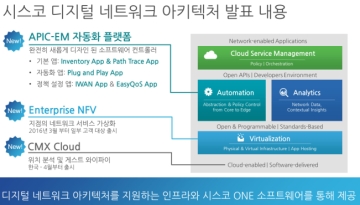
Cisco Unveils 'Digital Network Architecture', Delivering Powerful Automation and Virtualization Capabilities
Cisco Korea (CEO Jung Kyung-won) has announced Digital Network Architecture (DNA), which integrates key networking software innovations optimized for digital business. During the digitalization process, numerous networking innovations have been achieved, including Software Defined Networking (SDN), Network Functions Virtualization (NFV), overlay networks, open Application Programming Interfaces (APIs), and cloud management. However, adoption has been delayed due to the complexity of the technology and difficulties in efficient integrated operations.
2016.03.31by 명세환 기자

Hyundai Motor Vice Chairman Chung: “Creating amazing life value based on connected cars through collaboration with Cisco”
Hyundai Motor will establish an ultra-high-speed in-vehicle communication network for controlling data transmission and reception within vehicles through collaboration with Cisco. The two companies will also conduct testing through various virtual connected car simulation projects. Hyundai Motor's collaboration with Cisco is part of its strategy to secure a connected car platform through open innovation collaboration with global companies that possess leading technological capabilities in their respective fields. On the 19th (Tuesday), at Hyundai Motor Group's Yangjae headquarters, Hyundai Motor and Cisco decided to develop "vehicle network technology," one of the core technologies for connected cars, through mutual cooperation, with attendees including Hyundai Motor Executive Vice Chairman Euisun Chung and Cisco CEO Chuck Robbins.
2016.04.20by 명세환 기자

Korea Instrument, KOLAS Accredited Calibration Agency First to Simultaneously Acquire ISO/IEC 27,001·27,701
Korea Instrument has become the first among KOLAS accredited calibration agencies to simultaneously acquire ISO/IEC 27,001 and ISO/IEC 27,701 certifications. Through its proprietary platforms CWIZ Enterprise and CWIZ Partners, the company has embedded information security and personal data protection requirements across all business processes including customer information, equipment data, and calibration reports, with plans to continuously advance its management system through regular audits and security inspections.
2026.10.12by 배종인 기자

TeamViewer One, IT Incident Automation Workflow and Resolution Center Enhanced
TeamViewer has added IT incident automation capabilities and an advanced Resolution Center to its integrated digital workplace management platform 'TeamViewer ONE'. Recurrent service disruptions, configuration errors, and capacity shortages are automatically handled according to preset policies, and device status verification through script deployment can be managed in a unified interface, significantly reducing repetitive tasks for IT teams.
2026.10.12by 배종인 기자











