



[Reporter's Notebook] What will IBM Watson, which is also teaching Korean, do?
 Published2016.05.16 16:15
The reason IBM was able to reap the windfall of being a stock that benefited from AlphaGo was because of Watson, an artificial intelligence computer system that can answer questions in natural language. In the chess match of the century held in New York in 1997, world chess champion Garry Kasparov and IBM's supercomputer Deep Blue faced off, and in 2011, Watson competed against humans on the quiz show Jeopardy. In both of these matches, the machine (artificial intelligence) ultimately won.
Interest in Watson continued at the IBM Connect 2016 - A New Era of Thinking event held on the 12th. About 1,500 industry insiders showed keen interest at the event, which showed how IBM's cognitive business is being implemented in all areas including Watson, cloud, analytics, security, and IT infrastructure.
At the event, IBM Korea President Jeffrey Rhoda said, “80% of the data being created worldwide is unstructured data, and 80% of all data is not being utilized,” and “In the cognitive era, we will enable computers to acquire and learn from more data.” Jason Leonard, who is in charge of Watson's business in the Asia Pacific region, began his keynote by talking to Nao-mi, a robot equipped with Watson's cognitive computing technology.
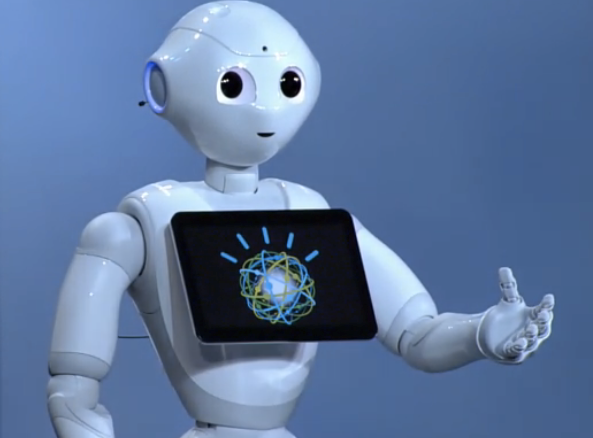
▲ Pepper, a robot from Softbank, Japan, equipped with IBM's Watson
Of course, this many people did not gather because of Watson alone, but it was clear that behind IBM's cognitive business, there was an artificial intelligence like Watson. Before this, at the CES exhibition last January, IBM President Ginni Rometty declared the advent of the cognitive business era, saying, "A huge amount of data is connected to form a huge Internet of Things (IoT) in various industries, but digital alone cannot create differentiated value in the huge IoT market," and emphasized that "cognitive computing is the only answer that can create differentiated value."
IBM's cognitive computing refers to the implementation of cognition, or a kind of thinking ability, in all digital intelligence (digital applications, products, processes, systems, etc.). In order to analyze data and obtain differentiated business insights, it is necessary to understand, infer, and learn data like a person based on natural language to provide the best solution. IBM judged Watson's cognitive ability to be the future of the Internet of Things, and announced in March 2015 that it would invest 3 billion dollars in combining cognitive computers and the Internet of Things.
In fact, it is accurate to say that Watson is a kind of software. To use Watson, a SaaS (Software as a service) solution built on a cloud environment, you can go to the Watson Developer Cloud site, open the API (Application Programming Interface), and immediately create various applications. IBM plans to continuously expand the 28 APIs currently available to 50 next year and 70 the year after. Here, artificial intelligence solutions created by hundreds of startup companies play a central role in forming the ecosystem, and are currently widely used in fields such as finance, public, and medical.
Kim Yeon-joo, managing director of IBM Korea, said in a statement, “Since Watson was introduced on the Jeopardy show in 2011, it has only been three years since a commercial product that can be applied to real life and corporate environments was released in 2014,” adding, “AI is no longer a technology of the future; it is a technology of the present.” She also said that Watson will learn Korean by the end of the year, reflecting the relationship with IBM Korea’s partners and the keen interest.
In his keynote speech titled “Watson Reinvents Business in the Cognitive Age,” Executive Vice President Jason emphasized, “We are continuously teaching Watson to respond to natural language. We are inputting commands, but we are teaching it to naturally understand human expressions.” He added, “However, it will not replace human work, but will act as an assistant to help people make decisions.”
Watson that makes an employee with 2 years of experience work like an employee with 10 years of experience?
So how does this mean that artificial intelligence helps people? Jason says that Watson, with its information knowledge, memory function, and machine learning, advises humans with senses, imagination, and experience to make decisions without bias. For example, Watson applied in the medical field recommends (advises) treatment for patients complaining of dizziness based on various diagnostic information, symptoms, and family history, helps analyze customers by reading and analyzing people's writing, and can even be used to counsel students who are having trouble adjusting to college life.
IBM introduced the term 'Watson IoT' for this. 'Watson IoT' is the concept of learning from the real world and infusing intelligence into the real world. For example, an engine manufacturer may collect and transmit real-time performance data and use predictive analytics, or an automobile company may use vehicle and other IoT data to reduce fuel costs and improve the safety of drivers and fleet managers.
IBM Korea President Jeffrey Rhoda said that Watson will work like a person, learning and acquiring information, so “an employee with two years of experience will be able to work like an employee with ten years of experience.” This is also why some of the people who attended the event said that Watson will ultimately be a battle of ideas. In order for even new employees to work like someone with five or ten years of experience, a lot of rich application development will have to follow.
Comments
Related news
[AI Symposium] Rob High, IBM Chief Technology Officer: No Need to Fear AI. It Will Give Humans More Freedom
Reflecting the century's showdown between Google's artificial intelligence AlphaGo and professional Go player Lee Sedol, approximately 500 industry officials gathered at the International Symposium on Artificial Intelligence held in the COEX Conference Room. The International Symposium on Artificial Intelligence, organized under the theme of artificial intelligence ICT strategy for implementing future creative economy, was conducted by the Ministry of Science, ICT and Future Planning and the National Research Foundation of Korea (NRF).
2016.03.16by 신윤오 기자
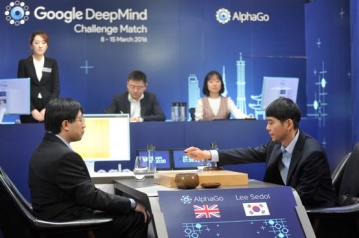
Following the rise of AlphaGo, a decision has been made to invest 1 trillion won in Korean-style 'artificial intelligence'.
Following the recent match between Lee Sedol, 9-dan professional, and AlphaGo, which has become a national point of interest, President Park Geun-hye held a 'Public-Private Joint Discussion on Intelligent Information Society' on the afternoon of the 17th at the Blue House, inviting approximately 20 executives and experts from companies related to artificial intelligence (AI) and software (SW) technology. The discussion was attended by Choi Yang-hee, Minister of the Ministry of Science, ICT and Future Planning, Yoo Il-ho, Deputy Prime Minister and Minister of Strategy and Finance, Kim Jin-hyung, Director of the SW Policy Research Institute, and Kim Dae-sik, Professor at the Korea Advanced Institute of Science and Technology (KAIST), among others.
2016.03.18by 신윤오 기자
[Reporter's Notebook] Have We Ever Been This Thirsty for 'Artificial Intelligence'!
People and media outlets eager for artificial intelligence focused intently, hanging on every word of the seminar speakers. At this symposium, artificial intelligence experts from IBM's Watson—famous for defeating humans at chess—as well as Microsoft, Samsung Electronics, and MIT presented their views on the current state of artificial intelligence technology and its potential impact on humanity.
2016.03.28by 신윤오 기자
.jpg)
SalePoint Signs Multi-Year Partnership Agreement with AWS… Promoting Identity Security that Integrates Even AI Agents
Sailpoint has entered into a multi-year strategic partnership agreement with AWS and is moving forward with establishing an integrated governance system that manages both human and non-human identities together. The plan is to consistently manage access permissions in an environment where AI agents are increasing as work execution entities, while applying the principle of least privilege and automated policy enforcement. The two companies plan to jointly expand capabilities to manage the identities of various entities, including AI agents, within a single layer in the AWS environment. This collaboration is interpreted as a move to design security and governance together in corporate environments where AI adoption is expanding.
2026.03.26by 배종인 기자
.png)
Databricks Unveils Open AI Security Monitoring 'Lakewatch'
Databricks entered the security market on March 24 by unveiling LakeWatch, an open-source agentic SIEM. The core functionality of this product is to integrate and analyze security, IT, and business data in a single environment to support AI-based threat detection and investigation. The company explained that it reduces the limitations of existing security operations centers, which have had to forgo some data due to high cost structures, and enables large-scale data analysis and automation based on open formats and ecosystems. LakeWatch is currently offered as a private preview, with Adobe and Dropbox mentioned as early customers. Databricks also announced an expanded partnership with Anthropic as well as the acquisition of Antimatter and SiftD.ai.
2026.03.26by 배종인 기자











