


Three Chinese companies among the top five smartphone manufacturers account for 17% of the sales market.
 Published2016.05.23 06:35
Apple records first-ever double-digit decline
Gartner Inc. announced that global smartphone sales to end users totaled 349 million units during the first quarter of 2016, a 3.9% increase from the first quarter of 2015. Smartphone sales accounted for 78% of total mobile phone sales in the first quarter of 2016.
Demand for low-cost smartphones in emerging markets drove smartphone sales, and for low-cost 4G smartphones, it was assessed that 4G promotions by Communication Service Providers (CSPs) in many markets around the world were effective.
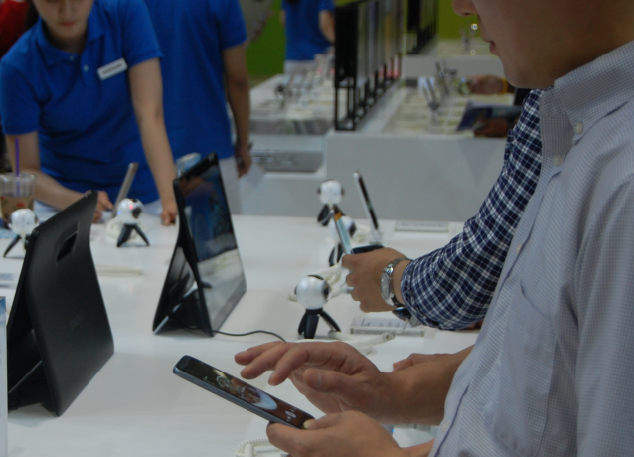
"In a slowing smartphone market where major players are experiencing growth saturation, emerging vendors are increasing their market share by disrupting the long-standing business models of established vendors," said Anshul Gupta, Research Director at Gartner. "Amid these shifting dynamics in the smartphone market, Chinese brands are emerging as the world's largest brands. In the first quarter of 2015, two Chinese brands were included among the world's top five smartphone manufacturers, accounting for 11% of the total market." "In the first quarter of 2016, three Chinese companies, including Huawei, Oppo, and Xiaomi, were included and accounted for 17% of the market," it was stated.
Oppo achieved record performance in the first quarter and rose to fourth place, driven by a 145% year-over-year increase in sales volume. Like Huawei and Xiaomi, Oppo demonstrated strong growth in China, encroaching on the market share of companies such as Lenovo, Samsung, and Yulong. Huawei saw high smartphone demand in Europe, the Americas, and Africa, while Xiaomi and Oppo saw smartphone sales in the emerging Asia-Pacific region increase by 20% and 199%, respectively, year-over-year.
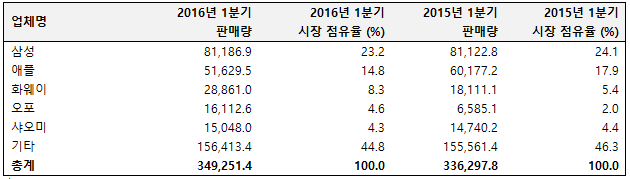
▲ Global End-User Sales by Smartphone Manufacturer, Q1 2016 (Unit: Thousand Units)
In the first quarter of 2016, Samsung surpassed Apple with a 23% market share, further strengthening its dominance. Gupta stated, "Samsung has solidified its position as a strong competitor in the smartphone market through its Galaxy S7 series smartphones and revamped portfolio, and the same is true in emerging markets where competition with local manufacturers is fierce."
Apple Explores Ways to Resell Used iPhones in Emerging Markets
Apple recorded a double-digit annual decline for the first time in history. Apple's 'Upgrade Program' in the U.S. helped boost sales in the U.S. by easing the price burden of its flagship products, the iPhone 6s and 6s models. Apple is exploring ways to resell used iPhones acquired through this program to emerging markets.
In the smartphone operating system (OS) market, Android regained market share surpassing iOS and Windows, recording an 84% market share (see Table 2). Roberta Cozza, Research Director at Gartner, stated, "The smartphone market in developed countries has reached saturation, and Google is pursuing new revenue growth opportunities by expanding the scope of its platform to automobiles, wearables, connected homes, and immersive experiences."
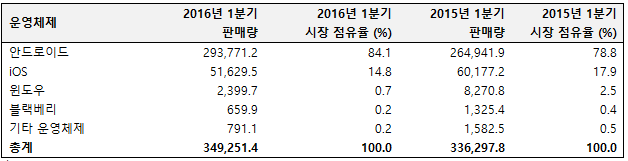
▲ Global Smartphone End-User Sales by Operating System, Q1 2016 (Unit: Thousand Units)
He added, “Despite the advancement of the Android platform and its dominant market share, many Android vendors continue to face the challenge of securing profitability. This will impact the competitive landscape among vendors, as new or more innovative business models are increasingly becoming the key to success.”
"Nokia's stated return to the smartphone and tablet market will not be easy. To sell devices in today's market, much more is required than just a well-known brand," Gupta said. "While manufacturing superior hardware may not be an issue for Nokia, users are demanding a clear reason to maintain loyalty to the same brand. Furthermore, as the smartphone market gradually slows down, it is difficult for mobile phone manufacturers to recover previous levels of growth. For HMD, a new entrant, entering a market that has passed its boom period has made it much more difficult to successfully enter the market in the short term," they stated.

Comments
Related news
The era of double-digit growth smartphones is over.
Gartner Inc., a globally recognized IT advisory firm, forecast that the worldwide smartphone market would record single-digit growth for the first time in 2016. Gartner anticipated that global smartphone sales in 2016 would reach 1.5 billion units, representing only a 7% increase compared to the previous year, while total mobile market sales would reach 1.9 billion units. Gartner also projected that total shipments of all devices, including PCs, tablets, ultra-mobile devices, and mobile phones, would reach 2.4 billion units, a 0.6% increase compared to the previous year (see table). Meanwhile, end-consumer spending was predicted to decline by 1.6% year-over-year in US dollar terms.
2016.04.04by 명세환 기자
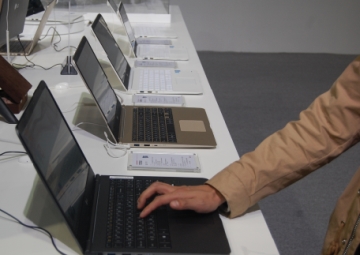
Domestic PC shipments in the first quarter remain at last year's levels; recovery expected in public and education markets
According to Korea IDC's recent research analysis of the domestic PC market (led by Hong Yoo-sook), domestic PC shipments in Q1 2016 reached 1.53 million units, maintaining the previous year's level. Compared to the global PC market's 12.5% decline in Q1, the domestic market is analyzed as relatively stable due to the expanded adoption of ultra-slim notebooks with a thickness of 21mm or less and increased demand from the education sector. Meanwhile, corporate PC shipments declined 9.0% year-over-year due to reduced IT investments resulting from weakened export conditions, and desktops continue to account for over 70% of the market share in terms of cost and security considerations.
2016.05.18by 신윤오 기자
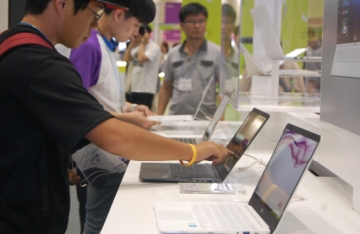
PCs Stuck in the Bottom: Will They Find a Breakthrough in the High-Margin, High-End Market?
Gartner Inc. revealed that despite the global PC market recording the lowest quarterly growth rate in history during the first quarter of 2016, multiple revenue opportunities exist for PC vendors. Meike Escherich, Principal Research Director at Gartner, stated, "The PC is no longer the device users first or exclusively choose for internet access. Over the past five years, global shipments of traditional PCs such as desktops and notebooks have declined from 343 million units in 2012 to 232 million units (estimated) in 2016. Additionally, in terms of revenue, the market has contracted from $219 billion in 2012 to $122 billion in 2016."
2016.05.19by 신윤오 기자
ESP32 Development Environment Selection and GPS Application Implementation
The ESP32 is a microcontroller that integrates Wi-Fi, Bluetooth, 12-bit ADC, capacitive touch, PWM, DAC, and UART in a single SoC. However, the abundance of features does not by itself solve the designer's problems. The real challenges lie in selecting the appropriate development environment, determining which pins can be used and which must be avoided, and converting raw data from modules into usable information. This document addresses ESP32 peripheral constraints (ADC2 and Wi-Fi coexistence limitation, UART1 occupancy, ADC non-linear regions), the trade-offs between Arduino IDE and ESP-IDF, and the process from connecting NEO-6M/NEO-M8N GPS modules to UART2, parsing NMEA sentences, and visualizing routes in Google Earth, all organized based on documented references.
2026.10.12by 편집부
MIPI CSI-2, DSI-2, C-PHY, D-PHY Test Solution Technical White Paper
The MIPI interface adopts a burst mode that transitions between low-power (LP) and high-speed (HS) states for low-power consumption, and in return, strict timing rules are imposed on state transitions. Additionally, the high-speed section operates as a packet-based protocol with headers, ECC, and CRC, so verification engineers must handle waveforms and protocols simultaneously. Traditional configurations combining general-purpose oscilloscopes and AWGs reveal limitations in setup complexity, measurement uncertainty, and lack of reproducibility when faced with these requirements. This white paper, based on webinar materials, organizes the structure of this problem and describes how the SV5C-DPTXCPTX generator for receiver testing and SV5C-DPRXCPRX analyzer for transmitter testing integrate state transition testing, stressed eye testing, and protocol analysis into a single bench, along with their application boundaries.
2026.10.12by 편집부











