


Mid-range smartphones driving growth are seeing a trend of upgrading core component specifications.
 Published2016.05.23 12:03
Increased display and memory capacity, and more fingerprint sensors and NFC integration.
It has been observed that the specifications of key components in mid-range phones, which are leading the global smartphone market, are also being upgraded. There is an increasing number of cases where core components, such as application processors (APs), are being equipped with proprietary products, and memory capacities like NAND and DRAM are also expanding. Furthermore, led by Chinese phone manufacturers, there is a growing trend of adopting larger display sizes of 5 inches or more, and components such as fingerprint sensors and NFC are acting as growth drivers for mid-range phones.
The Korea Semiconductor Association and global market research firm GfK stated this in their recent 2016 Market Briefing report and forecasted specific trends in handset components.
First, it was predicted that Qualcomm, which dominates the global AP (Application Processor) market, would be affected in some way by the in-house AP trend now being led by Samsung and Huawei.

With Qualcomm expected to take 38.2% of the AP market in the second quarter, following a 34.9% share in the first quarter, Samsung’s AP is projected to expand its market share from 2.5% in the first quarter of last year to 8.6% in the same quarter this year. Huawei, backed by HiSilicon APs, is also expected to see its market share grow from 1.8% last year to 3.6% in the same quarter this year, beginning to crack the solid AP market that had been Qualcomm's exclusive domain.
Reflecting this trend, Samsung's use of proprietary APs is projected to reach up to 37% in the first quarter of 2016. Although Huawei saw a slight drop in the first quarter, it is also expected to adopt its own APs up to 45% in the second quarter. However, Xiaomi expanded its use of proprietary Leadcore APs to 22% in the third quarter of 2015, only to fall to 16% in the first quarter of this year. The decline in Xiaomi's AP market share is largely attributed to the impact it suffered from the rise of Chinese online smartphone manufacturers (in fact, Xiaomi's online market is being eroded as companies like Oppo and Vivo grow rapidly in the Chinese handset market).
Looking at Qualcomm APs, sluggish sales continue as Samsung replaces the Snapdragon 400 series with its own APs, and the slowdown in sales of the Snapdragon 200 series is no different. On the contrary, the Snapdragon 600 series, which served as the foundation for growth, is making a comeback in mid-range smartphones. There is high anticipation as the improved Snapdragon 820 has been adopted in the Samsung Galaxy S7 series, which was recently released in the North American and Chinese markets.
MediaTek expects its market share to increase due to surging LTE demand, with second-generation LTE SoCs driving growth and sales of products such as the MT6735 and MT6795 increasing significantly.
China's Spreadtrum is struggling due to weaknesses in the LTE sector. Despite the rise in market share of Indian brands, the volume supplied to Samsung has decreased because it failed to effectively compete with Samsung phones. GfK analyzed that a major reason for failing to follow Samsung's transition from low-cost phones to 4G phones was this.
AP Roadmap: Major AP Companies Lead 14/16nm Processes
The AP technology roadmap anticipates an expansion of mid-range APs driven by support for Cat.6 and higher, which are category grades classified by the mobile telecommunications standardization technical cooperation organization '3GPP' based on LTE speeds; furthermore, the 14/16nm process is expected to expand in the second quarter of 2016. A key feature of AP technology processes is the rapid transition to 14/16nm. While the current mainstream is 28nm, companies such as Samsung Electronics, Apple, and Qualcomm are leading the 14/16nm process, continuously encroaching upon the 20/22nm process.
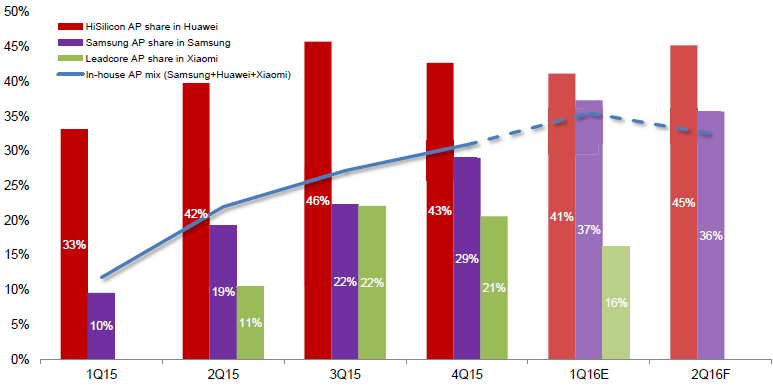
▲ Samsung, Huawei, and Xiaomi Adopt In-house APs (Gfk Research)
Newly released Qualcomm Snapdragon 820, Samsung Electronics Exynos 8890/7870, and Apple A10 are leading the 14/16nm process in the high-end market. Sean Weng, Senior Researcher at GfK, stated, “While the 28nm process appears likely to remain in the low-end market for a long time according to the product roadmaps of major AP vendors, the 20nm process is expected to be replaced by the 14/16nm process in the high-end market.” This means that the 28nm process still has price competitiveness and decent performance, so it will maintain its position in the mainstream market for the time being.
Qualcomm Continues Baseband Market Dominance
Qualcomm Baseband continues to maintain its market dominance, not only as Samsung applied an integrated SoC to the Galaxy S7 series but also with the launch of the iPhone SE. Regarding baseband technology manufacturing processes, the number of 28nm products is also expected to increase following the release of the iPhone SE. Furthermore, for LTE baseband, Category 4 support will be maintained in the mid-range smartphone market, while the market share of Category 6 is growing.
Looking at the baseband LTE category roadmap, it is confirmed that Qualcomm is once again leading baseband technology. The Snapdragon 820 can support Category 12 download speeds and Category 13 uplink speeds. MediaTek's Category 10 product is scheduled to be announced in the fourth quarter of 2016.
Fingerprint sensors and NFC, which became growth drivers
The adoption of fingerprint sensors in major mid-range markets is expected to reach 51% by the end of 2016. Chinese companies are actively adopting fingerprint sensors due to increasingly fierce competition among manufacturers. The mid-range and low-end markets are expected to lead the adoption of fingerprint sensors. Looking at the adoption rates from the fourth quarter of last year to the first and second quarters of this year, Samsung Electronics increased its share in the mid-range market from 29% to 32% and then to 34%, while Huawei also rose to 50%, 60%, and 65%. Notably, VIVO saw a sharp increase from 11% to 57% and then to 65%. In the low-end market, Huawei surged from 3% to 13% and then to 18%, while Xiaomi increased significantly from 4% to 24% before slowing down slightly to 20%.
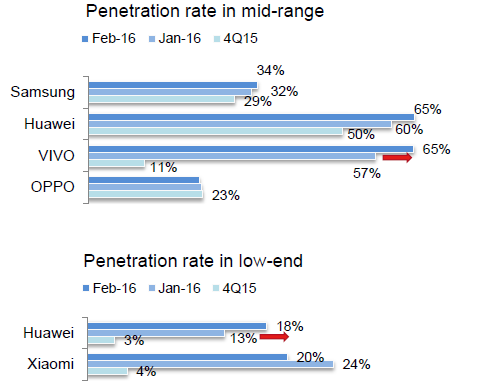
▲ Fingerprint sensor adoption rates in mid-range and low-end phones (Gfk Research)
Fingerprint Cards' market share has exceeded 50% due to Chinese brands. On the other hand, Synaptics' market share has decreased due to its high dependence on Samsung Electronics. Fingerprint Cards supplies products to companies such as Huawei, Xiaomi, OPPO, and VIVO.
NFC, primarily used as a payment method, is on a declining trend due to low demand even in the high-end market, but it is expanding due to demand in the mid-range smartphone market driven by Chinese brands and the Apple iPhone SE. "NFC is showing stagnation in the saturated high-end market, but demand will increase this year as Chinese brands incorporate NFC," said Sean Weng, a senior researcher. "Growth is expected in the mid-range market this year, and there are high expectations for this as payment transactions via Apple Pay and Samsung Pay increase." He also predicted that while the adoption rate of NFC in China is lower than in the global market, a recovery in the mid-range market is expected as Xiaomi and Huawei incorporate NFC features into their new strategic models.
Increase the screen size and increase the memory capacity.
Smartphone display sizes are expected to see a notable increase from 5.5 inches to 7 inches due to the influence of Oppo's R7 and Huawei Ascend Mate 8. The market share of FHD (UXGA) is growing due to the expansion of the Vivo X6, while 720HD is also expanding its share due to the Xiaomi Redmi 3 following the poor performance of the iPhone 6/6s.
Handset NAND capacity is expected to show growth of over 53% in 2016, with an average growth rate of over 43% up to 20GB. Samsung Electronics' NAND saw a slight increase in January 2016 as 32GB NAND was applied to the Galaxy Note 5 and Galaxy S6 series. It is reported that Samsung equipped 82% of the Galaxy Note and S6 Plus with 32GB NAND and 18% with 64GB NAND, and sold the Galaxy S6 and Edge with similar levels of NAND capacity.
The 64GB NAND used in the Apple iPhone 6s/6s Plus held a 50% market share in February 2016, showing only a slight change compared to the previous month. However, Senior Researcher Sean Weng predicted that the situation would change with the release of the iPhone 7. He added, “The market share of 16/32/64GB NAND for handsets in 2016 is expected to rise following the decline in 4/8GB NAND,” but noted, “Overall NAND demand will decline due to lower demand for high-end phones.” "This is because the iPhone is showing weakness while mid-range phones are showing strength," he said.
Handset DRAM capacity is expected to grow by more than 39% in 2016, similar to last year, with DRAM expected to grow by more than 30% annually on average up to 1.6GB. GfK predicted that as the market share of 1GB handset DRAM decreases, the market for 2GB and higher capacities will expand in 2016. In the mid-range market, capacities of 3GB or more are being used.
Comments
Related news

The era of double-digit growth smartphones is over.
Gartner Inc., a globally recognized IT advisory firm, forecast that the worldwide smartphone market would record single-digit growth for the first time in 2016. Gartner anticipated that global smartphone sales in 2016 would reach 1.5 billion units, representing only a 7% increase compared to the previous year, while total mobile market sales would reach 1.9 billion units. Gartner also projected that total shipments of all devices, including PCs, tablets, ultra-mobile devices, and mobile phones, would reach 2.4 billion units, a 0.6% increase compared to the previous year (see table). Meanwhile, end-consumer spending was predicted to decline by 1.6% year-over-year in US dollar terms.
2016.04.04by 명세환 기자

ARM Expands Smartphone Camera Market Through Acquisition of Imaging Specialist
ARM has acquired Apical, a world-leading company in imaging and embedded computer vision technology that enables next-generation devices to understand information transmitted from their surrounding environment and perform intelligently. Apical is one of the fastest-growing technology companies in the United Kingdom, and its advanced imaging products are used in over 1.5 billion smartphones and approximately 300 million internet cameras, digital cameras, tablets, and other consumer/industrial devices.
2016.05.20by 명세환 기자
Three Chinese companies among the top five smartphone manufacturers account for 17% of the sales market.
Gartner Inc. announced that global smartphone sales to end users during the first quarter of 2016 totaled 349 million units, representing a 3.9% increase compared to the first quarter of 2015. Smartphone sales accounted for 78% of total mobile phone sales in the first quarter of 2016. Demand for low-cost smartphones in emerging markets drove smartphone sales, and for low-cost 4G smartphones, communications service providers (CSPs) implementing 4G promotions across many global markets were evaluated as having been effective.
2016.05.23by 명세환 기자
ESP32 Development Environment Selection and GPS Application Implementation
The ESP32 is a microcontroller that integrates Wi-Fi, Bluetooth, 12-bit ADC, capacitive touch, PWM, DAC, and UART in a single SoC. However, the abundance of features does not by itself solve the designer's problems. The real challenges lie in selecting the appropriate development environment, determining which pins can be used and which must be avoided, and converting raw data from modules into usable information. This document addresses ESP32 peripheral constraints (ADC2 and Wi-Fi coexistence limitation, UART1 occupancy, ADC non-linear regions), the trade-offs between Arduino IDE and ESP-IDF, and the process from connecting NEO-6M/NEO-M8N GPS modules to UART2, parsing NMEA sentences, and visualizing routes in Google Earth, all organized based on documented references.
2026.10.12by 편집부
MIPI CSI-2, DSI-2, C-PHY, D-PHY Test Solution Technical White Paper
The MIPI interface adopts a burst mode that transitions between low-power (LP) and high-speed (HS) states for low-power consumption, and in return, strict timing rules are imposed on state transitions. Additionally, the high-speed section operates as a packet-based protocol with headers, ECC, and CRC, so verification engineers must handle waveforms and protocols simultaneously. Traditional configurations combining general-purpose oscilloscopes and AWGs reveal limitations in setup complexity, measurement uncertainty, and lack of reproducibility when faced with these requirements. This white paper, based on webinar materials, organizes the structure of this problem and describes how the SV5C-DPTXCPTX generator for receiver testing and SV5C-DPRXCPRX analyzer for transmitter testing integrate state transition testing, stressed eye testing, and protocol analysis into a single bench, along with their application boundaries.
2026.10.12by 편집부











