


[Reporter's Notebook] Is the Wearable Device Industry Really an Item for SMEs?
 Published2016.06.14 11:45
We are currently in the golden age of wearable devices. The term "wearable" itself is familiar. Anyone interested in IT gadgets likely wants to own a smartwatch at least once. If you visit an IT exhibition, visitors are busy trying on the displayed smartwatches and manipulating them. It is also not uncommon to see people wearing smartbands. Wearable smart devices are no longer a story of the future, but have become an active, ongoing trend.
Market research firms predict that the wearable device market will grow from $6.6 billion this year to over $250 billion by 2023. This can certainly be described as explosive growth. The wearable device market has the advantage of allowing entry even for companies that are not large corporations. The winners are companies that create products consumers want and need, and offer ways to use them more "smartly." Given the high level of technology currently available in Korea, the potential is virtually limitless.
However, this is not an easy market. As it is a high-risk industry, active government support is required. We must also secure patents, which form the foundation for market dominance. Doing it well on your own is not enough. To survive in the market, you must create an ecosystem capable of building integrated services linked with smartphones.
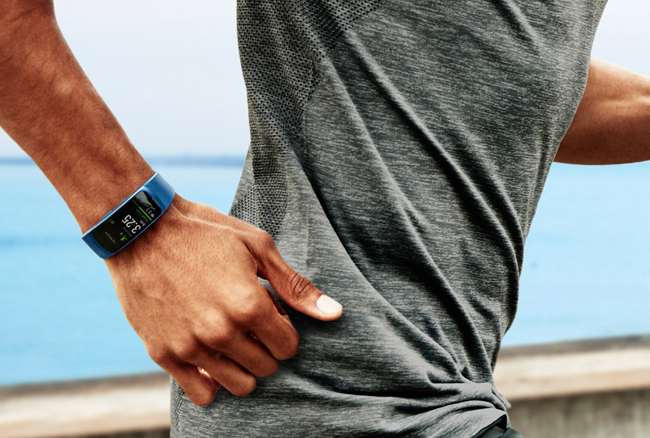
Samsung Electronics unveiled the 'Gear Fit 2,' a wearable device optimized for fitness, on the 2nd.
Perhaps for this reason, it is said that the wearable device business is an industry inherently biased toward large corporations. This is evident from the reality where major companies, having lost their growth momentum in smartphones and general home appliances, have rushed to release wearable devices and entered into fierce competition. This is also why one cannot shake the feeling that an owner has been determined in a market that has no owner.
Consumers are just as confused. While they show interest in the wearable devices flooding the market, they find it difficult to actually open their wallets. This likely stems from the mindset of, "It would be nice to have one, but I don't really need it." This is why the term "Wearable Chasm" is emerging. It refers to the stagnation that must be overcome before the general public adopts a product, no matter how excellent it may be, and this concept is now beginning to apply to wearable devices. Indeed, it is true that reports are coming in from various sources indicating a slowdown in sales of smartwatches and smartbands, which were at the forefront of the wearable device market.
There are also technical solutions needed for wearable devices to get closer to consumers. As long as it operates on battery power, low power consumption is an inevitable challenge that must be addressed to extend usage time; additionally, features are required to ensure mutually compatible input and output processing elements, as well as the ability to run applications seamlessly even when transferred to different operating systems. Furthermore, scalability and interoperability are essential to become a leading device in the market.
For wearable smart devices to become mainstream, more specific barriers must also be overcome. They must provide a comfortable fit that minimizes the sensation of foreign objects or discomfort, and since they are worn on various parts of the body, they must also reduce fatigue and the feeling of weight. For instance, if users quickly experience a heavy sensation and dizziness after wearing a VR or AR device, it will be difficult for them to readily adopt it.
The government has been conducting the Wearable Smart Device Component and Material Technology Development Project since last year. The aim is likely to foster global competitiveness by encouraging active participation from small and medium-sized enterprises (SMEs). The project includes numerous technical tasks encompassing four major material and component fields—wearable input, output, processing, and power technologies—as well as three major platform fields: lifestyle/culture, specialized tasks, and user device connection platforms. It is reported that a total of 455 billion won will be invested in this project across three phases until 2024. While this is a substantial amount of money, it remains to be seen whether this budget will be continuously procured or executed.
It is clear that the wearable device industry is one that must be developed and prepared for both the present and the future. Technology and the market are important. However, what is even more crucial is creative R&D befitting the era of the Internet of Things. Due to the nature of the industry, a creative R&D environment must be established to produce high-quality products and services. Creativity is not a problem that can be solved simply by constructing buildings everywhere. It is time to examine whether we are supporting startups with creative ideas so that they can pursue more profitable businesses and expand into larger markets. That is, if you really consider the wearable device industry as an item for small and medium-sized enterprises .
Comments
Related news
Global wearable sales grew 18.4% in 2016, with smartwatches accounting for 40% of revenue
Gartner Inc., a global IT consulting firm, forecasted that global wearable device shipments in 2016 would reach 274.6 million units, an 18.4% increase from 232 million units in 2015 (refer to Table 1). Wearable device revenue in 2016 was projected to reach $28.7 billion, with smartwatches accounting for $11.5 billion.
2016.02.04by 신윤오 기자
Could Micro LED Displays Solve Everything from VR Wearables to TVs?
Can micro LED displays catch up with the OLED display market beyond conventional LED displays? As interest in next-generation smart devices such as wearable devices increases, demand for technological development of micro LED displays is intensifying. Micro LED displays, which are manufactured with chip sizes typically in the 10–100 μm range and can be applied to all optical applications requiring low power consumption, miniaturization, and weight reduction, can be extensively utilized in flexible displays, smart textiles, bio contact lenses, HMDs, wearable body-attached devices, and wireless communication applications. In a situation where LEDs, which were primarily used in lighting and display applications, are increasingly showing potential for use in biomedical and medical fields, micro LEDs—which have secured stability in high efficiency, yield, and reliability—have emerged as a next-generation display technology.
2016.05.30by 신윤오 기자
Maxim Announces Standalone Battery Level Monitor Suitable for Wearables, Drones, and IoT Devices
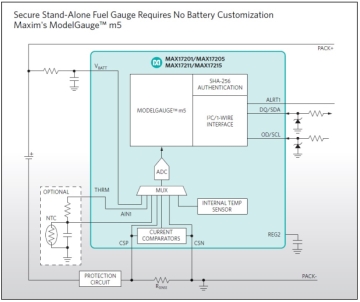
Maxim Integrated Products Korea (CEO Kim Hyun-sik) has launched the 'ModelGauge m5' portfolio, which easily and safely measures remaining battery capacity in portable devices. The Maxim ModelGauge m5 battery gauge (MAX17201/MAX17205, MAX17211/MAX17215) integrates SHA-256 security authentication for the first time in the industry and combines a 160-bit secret key to prevent battery pack counterfeiting. Since battery voltage changes with temperature and load, measuring battery capacity is challenging, and sophisticated calibration is required to eliminate cumulative offset errors in coulomb-counting. Through sophisticated algorithms, the Maxim ModelGauge m5 accurately converts raw measurement values of battery voltage, current, and temperature into state of charge (SOC%), absolute capacity (mAhr), time-to-empty, and time-to-full during charging, enabling users to use their devices more conveniently and for longer periods.
2016.06.08by 명세환 기자

ESP32 Development Environment Selection and GPS Application Implementation
The ESP32 is a microcontroller that integrates Wi-Fi, Bluetooth, 12-bit ADC, capacitive touch, PWM, DAC, and UART in a single SoC. However, the abundance of features does not by itself solve the designer's problems. The real challenges lie in selecting the appropriate development environment, determining which pins can be used and which must be avoided, and converting raw data from modules into usable information. This document addresses ESP32 peripheral constraints (ADC2 and Wi-Fi coexistence limitation, UART1 occupancy, ADC non-linear regions), the trade-offs between Arduino IDE and ESP-IDF, and the process from connecting NEO-6M/NEO-M8N GPS modules to UART2, parsing NMEA sentences, and visualizing routes in Google Earth, all organized based on documented references.
2026.10.12by 편집부
MIPI CSI-2, DSI-2, C-PHY, D-PHY Test Solution Technical White Paper
The MIPI interface adopts a burst mode that transitions between low-power (LP) and high-speed (HS) states for low-power consumption, and in return, strict timing rules are imposed on state transitions. Additionally, the high-speed section operates as a packet-based protocol with headers, ECC, and CRC, so verification engineers must handle waveforms and protocols simultaneously. Traditional configurations combining general-purpose oscilloscopes and AWGs reveal limitations in setup complexity, measurement uncertainty, and lack of reproducibility when faced with these requirements. This white paper, based on webinar materials, organizes the structure of this problem and describes how the SV5C-DPTXCPTX generator for receiver testing and SV5C-DPRXCPRX analyzer for transmitter testing integrate state transition testing, stressed eye testing, and protocol analysis into a single bench, along with their application boundaries.
2026.10.12by 편집부











