



SCCG for restoring receiver sensitivity of Toshiba wireless connection ICs
 Published2016.06.16 06:44
Toshiba Corporation has developed a spur-canceled clock generator (SCCG) that restores receiver sensitivity in wireless connectivity ICs.
SCCG restored receiver sensitivity by suppressing spurs, which are interference generated from clock signals, and achieved a receiver sensitivity of -93 dBm for all channels of Bluetooth® Smart ICs.
Toshiba plans to announce this at the VLSI Circuits Symposium 2016, an international semiconductor device conference held in Honolulu, Hawaii, on June 15.
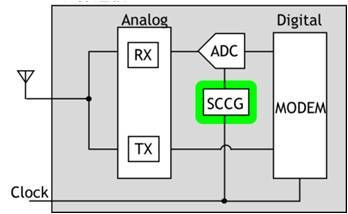
Recent wireless connectivity ICs integrate analog blocks such as RF circuits, mixed-signal blocks such as AD converters, and digital blocks on a single chip. However, some harmonics of the reference clock signal for digital circuits and AD converters, known as clock spurs, degrade receiver sensitivity, and existing sensitivity recovery technologies face issues such as additional power consumption, chip size, and development costs.
Toshiba proposes a clock generator as a solution that suppresses spurts by delaying a portion of the clock. This clock delay generates two types of clock spurts with the same amplitude and reverse phase, which then cancel each other out. Since the clock generator has a power consumption of 18μW and a size of 40μm × 120μm, clock spurs can be suppressed without increasing power consumption or size. This method recovers the 4dB of sensitivity weakened by spurs and is applied to Bluetooth Smart ICs to achieve -93dBm receiver sensitivity.
With the recent proliferation of applications such as wearable devices leading to increased demand for wireless connectivity ICs, Toshiba plans to continue expanding its production lineup of high-performance wireless ICs and launch a Bluetooth Smart IC equipped with SCCG this summer.

Comments
Related news
Toshiba's Q300 Pro SSD with Enhanced Stability is Now on Sale
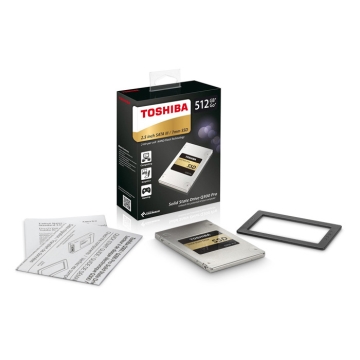
Toshiba Electronics Korea (hereinafter Toshiba) announced on the 20th that it will simultaneously implement a price reduction for the SSD 'TOSHIBA Q300 Pro (hereinafter Q300 Pro)' with enhanced durability and performance, along with a promotional event offering keyboard and mouse sets. The Q300 Pro is the third series introduced by Toshiba as a consumer-oriented product, equipped with the company's top-tier MLC NAND Flash memory (Toshiba Advanced 1xnm Toggle MLC NAND Flash memory) and Toshiba TC358790 controller, delivering an SSD with enhanced performance, stability, reliability, low power consumption, and lifespan. The Q300 Pro is the third series introduced by Toshiba as a consumer-oriented product, equipped with the company's top-tier MLC NAND Flash memory (Toshiba Advanced 1xnm Toggle MLC NAND Flash memory) and Toshiba TC358790 controller, delivering an SSD with enhanced performance, stability, reliability, low power consumption, and lifespan.
2016.04.22by
Toshiba Launches 4-Channel Power Amplifier IC to Prevent Speaker Fires
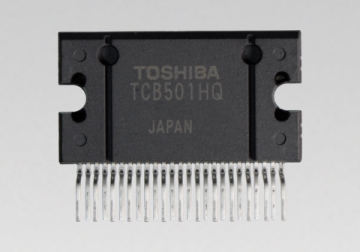
Toshiba Corporation's Storage & Electronic Devices Solutions Company announced on the 28th the launch of "TCB501HQ," a 4-channel power amplifier IC. This new IC features a built-in full-time offset detection circuit that detects speaker output offset voltage, which is a cause of speaker fires. It detects output DC offset voltage generated by leakage from input capacitors and other sources during sound playback, preventing speaker fires. The new IC employs a current feedback system of the type adopted in high-end hi-fi audio. This prevents audio quality degradation across a wide bandwidth and ensures stable sound quality.
2016.04.28by
Toshiba Announces PCI Express for Custom LSI Platforms
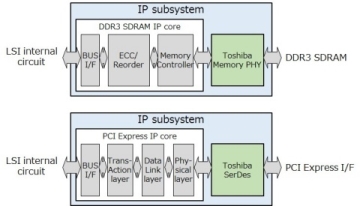
Toshiba Corporation's Storage and Device Solution Company announced the launch of PCI Express and DDR3 SDRAM IP subsystems. These products were jointly developed with Northwest Logic, a leading company providing high-performance, easy-to-use, and silicon-proven PCI Express and Memory Interface IP cores. These subsystems can be used on custom LSI platforms including ASICs and FFSA*4. The PCI Express core includes standards-compliant and fully-featured PCI Express 3.0/2.1/1.1 cores, high-performance scatter-gather DMA cores, and drivers (Linux & Windows). The DDR3 SDRAM Controller Core delivers high-bandwidth support through additional core full options such as ARM AMBA AXI, multi-port, reordering, ECC, and memory test support.
2016.06.03by 명세환 기자

Intel Unveils Next-Generation 'Core Ultra Series 3' and vPro Platform for Enterprise PCs
Intel has officially unveiled the "Intel Core Ultra Series 3" for next-generation enterprise PCs and the latest vPro platform, addressing a wide range of demands from enterprise notebooks to high-performance workstations.
2026.03.26by 배종인 기자

ROHM Launches ESD Protection Diode Compatible with High-Speed Interfaces of 10Gbps or Higher
Semiconductor specialist ROHM has developed the 'RESDxVx series' of ESD (electrostatic discharge) protection diodes capable of responding to next-generation high-speed data communication environments exceeding 10Gbps, simultaneously enhancing both signal quality maintenance required in high-speed interfaces and IC protection performance.
2026.03.26by 배종인 기자











