



If selected for the soft robot research team, a total of 12.5 billion won will be provided over 7 years.
 Published2016.07.21 15:06
All or part of the existing robot is manufactured with a flexible and elastic structure
The Ministry of Science, ICT and Future Planning announced that it will accept applications for research teams starting Tuesday, July 19, to support the soft robot field as an Engineering Research Center (ERC).
Soft robots are one of the promising future technologies identified by the Ministry of Science, ICT and Future Planning last year (2015) as a follow-up measure to the annual work report, and include soft robots, neuro-mimetic chips, biomimetic sensory sensors, and nanomachines for diagnosis and treatment.
Soft robots, in which all or part of existing robots are replaced with flexible and stretchable structures, are a new type of robot based on the principles of movement and interaction of living organisms in irregular environments.
This was derived as a new technology worth pursuing for Korea by comprehensively analyzing market potential, technological competitiveness, and national agendas based on information on approximately 590 future technologies predicted by about 60 domestic and international institutions.
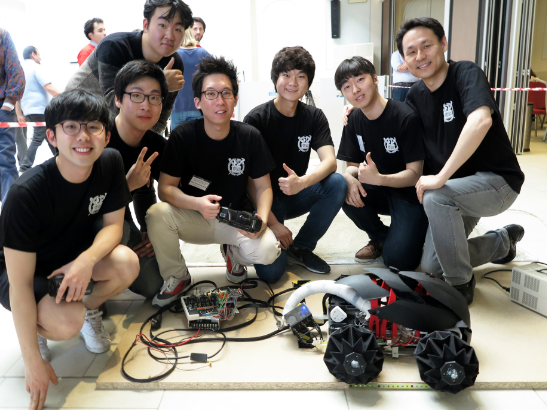
'SNUMAX', developed by a Seoul National University research team and modeled after the shape of an armadillo, is a robot that transforms freely using origami techniques.
Korea's implementation of softness through hardware (H/W) and control algorithms, surgical robots using cable drives, highWe have been conducting research using soft materials such as molecules and biomaterials, and have accumulated significant research capabilities in each element technology of soft robots.
Representative examples of recent major research achievements include 'SNUMAX' by Professor Kyu-Jin Cho's team at Seoul National University and the stingray bio-robot by Professor Jeong-Woo Choi's team at Sogang University.
'Snumax', which won first place in the World Soft Robot Grand Challenge, is modeled after the shape of an armadillo and features wheels that can be freely transformed using origami, and a robot arm made using a flexible material that mimics spinal joints.
The stingray bio-robot was recently featured as a cover article in the world-renowned journal Science. As a robot that moves using light stimulation with animal biological tissues without relying on electric power, it is expected to have diverse potential applications in the future, such as in disease diagnostic sensors.
Excellent results were derived from collaborative group projects rather than division of labor research.
Applications will be accepted until the end of August, followed by an evaluation, and research will begin in earnest in November.
Over the past four months, the Ministry of Science, ICT and Future Planning formed a working group centered on relevant researchers to analyze global research trends in soft robots and held an expert discussion at Ewha Womans University on June 24.
During the discussion, there was a consensus that securing research leadership is essential for developing globally competitive soft robot technology and acquiring core technologies. Furthermore, an analysis of overseas research trends revealed that superior results were derived from collaborative group projects rather than the existing division of labor, leading to the agreement that intensive investment should be made in collaborative research such as ERCs.
The selected research teams are expected to receive approximately 12.5 billion won in funding over a maximum of seven years, following the application deadline at the end of August. We plan to start the research in earnest starting in November following an evaluation.
The Soft Robot ERC plans to conduct research with the goal of advancing soft robots from the current basic research level to a prototype level for commercialization, and ultimately completing the development and performance evaluation of approximately five soft robot prototypes.
The Ministry of Science, ICT and Future Planning stated, “Through the Soft Robot ERC, we expect to secure global competitiveness in the field of soft robot applications, such as reconnaissance robots for extreme environments that are difficult to implement with existing robot technology, medical device robots, and wearable robots.”
Comments
Related news
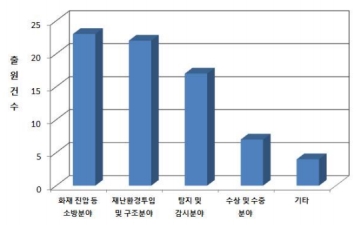
Notable Increase in Patent Applications Related to Disaster Response Robots
According to the Korean Intellectual Property Office (Commissioner Choi Dong-gyu), domestic patent applications related to disaster response robots (based on application date) have shown continuous growth since 2010, whereas previously there were only 2-3 applications per year on average, with 22 applications filed during 2010-2012 and 51 applications during 2013-2015. Disaster response robots are a technology that integrates multiple technologies, including kinematic design technology, self-localization technology, object and environment recognition technology, information and communication technology, autonomous mobility technology, and battery performance improvement technology.
2016.05.10by 명세환 기자
Running robot industry, crawling parts technology 'Localization rate less than 20%'
The domestic localization rate of components in the robotics sector, spurred by interest in artificial intelligence technology, has been below 50% according to statistics over the past three years, with major core components showing a localization rate of less than 20%. Robots are broadly categorized into industrial, professional service, and personal service robots. According to 2014 data, industrial robots accounted for 9.5B (64%), professional service robots for 3.6B (24%), and personal service robots for 1.7B (12%). The domestic component market for these robots reached a total sales volume of 396.2 billion won, representing 13.9% of total components; however, from an import perspective, 50.1% of components were found to be import-dependent. In other words, this means that half of the core components such as image sensors were imported and used. This aligns with the fact that there are not many domestic companies manufacturing core robot components, which are categorized into sensors, controllers, and actuators. When examining the technology level and localization rate for each component type, this situation becomes clearly evident.
2016.06.27by 신윤오 기자
Robots to be actively utilized for PyeongChang Winter Olympics—'Professor Oh Jun-ho' appointed as director-general
The Ministry of Trade, Industry and Energy (Minister Joo Hyung-hwan) presented an appointment certificate on July 11 at the Government Sejong Building to Professor Oh Jun-ho from KAIST (Korea Advanced Institute of Science and Technology), who was appointed as director-general of the PyeongChang Winter Olympics Robot Support Group. The support group was established to effectively utilize robots in various fields related to the 2018 PyeongChang Winter Olympics and support the successful hosting of the Olympics at a time when cross-government support for the successful hosting of the PyeongChang Winter Olympics is gaining momentum.
2016.07.12by 신윤오 기자
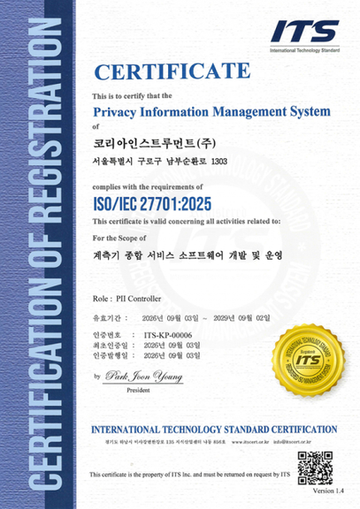
Korea Instrument, KOLAS Accredited Calibration Agency First to Simultaneously Acquire ISO/IEC 27,001·27,701
Korea Instrument has become the first among KOLAS accredited calibration agencies to simultaneously acquire ISO/IEC 27,001 and ISO/IEC 27,701 certifications. Through its proprietary platforms CWIZ Enterprise and CWIZ Partners, the company has embedded information security and personal data protection requirements across all business processes including customer information, equipment data, and calibration reports, with plans to continuously advance its management system through regular audits and security inspections.
2026.10.12by 배종인 기자

TeamViewer One, IT Incident Automation Workflow and Resolution Center Enhanced
TeamViewer has added IT incident automation capabilities and an advanced Resolution Center to its integrated digital workplace management platform 'TeamViewer ONE'. Recurrent service disruptions, configuration errors, and capacity shortages are automatically handled according to preset policies, and device status verification through script deployment can be managed in a unified interface, significantly reducing repetitive tasks for IT teams.
2026.10.12by 배종인 기자











