
[Photo News] Enjoying VR Ski Jumping in Snowy Rio with KT
 Published2016.08.09 23:33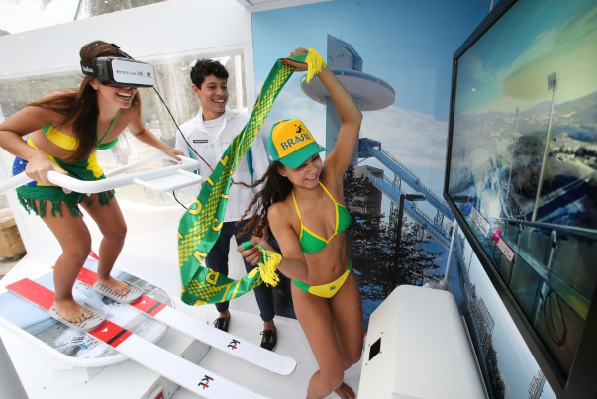
KT installed a PyeongChang promotional pavilion in Rio de Janeiro, Brazil during the 2016 Rio de Janeiro Olympics and held an opening ceremony at 6 p.m. on August 6 local time.
KT, as the official telecommunications partner of the PyeongChang Winter Olympics, showcased various experiential items enabled by 5G.
Comments
Related news
KT Hosts 'GiGA Colla Festival' for Drones and VR in Haeundae
KT announced on the 20th that it will hold the 'GiGA Collabo Festival' at Haeundae Beach in Busan, one of the most popular vacation destinations during summer holidays, from August 5th (Friday) to 7th (Sunday) for three days, allowing people to directly experience, feel, and enjoy the fastest and most innovative GiGA services. The 'GiGA Collabo Festival' features ▲the 'GiGA Drone Racing World Masters' competition, which for the first time in Korea brings together drone racing champions from 12 countries around the world and top-ranked players from each country, and ▲the e-sports 'Second GiGA Legend Match' where StarCraft legends Kang Min, Kim Taek-yong, Lee Young-ho, and Hong Jin-ho compete for the top position, along with ▲an 'Overwatch' special match, the PC room occupancy leader, and ▲GiGA VR and GiGA IoT health experience zones, making it the largest festival of this summer filled with abundant entertainment options.
2016.07.20by 장은성 기자
[ICT R&D Overview] ① Digital content, VR/AR realistic content development is vital
Can we lead in immersive content technology, the core of virtual reality and augmented reality? As immersive and emotional intelligence-based content emerges as a future trend in the digital content industry, attention is concentrating on related industries. Digital content refers to the software and hardware technologies necessary for planning, producing/manufacturing, and utilizing databases of materials, information, knowledge, and data expressed in electronic form through the combination of codes, text, voice, sound, audio, images, video, and other elements with ICT technology in the form of services or products. This includes ▲immersive content ▲interactive content ▲emotional content ▲content distribution and services.
2016.08.01by 신윤오 기자
ESP32 Development Environment Selection and GPS Application Implementation
The ESP32 is a microcontroller that integrates Wi-Fi, Bluetooth, 12-bit ADC, capacitive touch, PWM, DAC, and UART in a single SoC. However, the abundance of features does not by itself solve the designer's problems. The real challenges lie in selecting the appropriate development environment, determining which pins can be used and which must be avoided, and converting raw data from modules into usable information. This document addresses ESP32 peripheral constraints (ADC2 and Wi-Fi coexistence limitation, UART1 occupancy, ADC non-linear regions), the trade-offs between Arduino IDE and ESP-IDF, and the process from connecting NEO-6M/NEO-M8N GPS modules to UART2, parsing NMEA sentences, and visualizing routes in Google Earth, all organized based on documented references.
2026.10.12by 편집부
MIPI CSI-2, DSI-2, C-PHY, D-PHY Test Solution Technical White Paper
The MIPI interface adopts a burst mode that transitions between low-power (LP) and high-speed (HS) states for low-power consumption, and in return, strict timing rules are imposed on state transitions. Additionally, the high-speed section operates as a packet-based protocol with headers, ECC, and CRC, so verification engineers must handle waveforms and protocols simultaneously. Traditional configurations combining general-purpose oscilloscopes and AWGs reveal limitations in setup complexity, measurement uncertainty, and lack of reproducibility when faced with these requirements. This white paper, based on webinar materials, organizes the structure of this problem and describes how the SV5C-DPTXCPTX generator for receiver testing and SV5C-DPRXCPRX analyzer for transmitter testing integrate state transition testing, stressed eye testing, and protocol analysis into a single bench, along with their application boundaries.
2026.10.12by 편집부
NVIDIA to Invest $1 Billion in U.S. Science Over Next Five Years
NVIDIA has announced plans to invest $1 billion over the next five years to strengthen U.S. scientific and technological competitiveness. The company will enhance cutting-edge artificial intelligence research and development capabilities in key areas including quantum computing, healthcare, and energy security, while expanding support for higher education research institutions and cloud service providers. NVIDIA is participating as a major industry partner in the White House Office of Science and Technology Policy's Genesis Mission, and is promoting supercomputer construction in collaboration with national laboratories including Argonne and Los Alamos.
2026.10.12by 배종인 기자