


Naver Introduces AI-Based Automatic Translation App 'Papago'
 Published2016.08.09 23:50
Naver has launched 'Papago', an automatic translation app based on artificial intelligence technology.
Papago is the result of combining Naver Labs' accumulated research know-how in speech recognition and synthesis, machine translation, and character recognition with artificial intelligence technology.
The app introduced this time can translate all language combinations of four languages, including Korean, Japanese, Chinese, and English, and can translate not only text and voice, but also characters in photos.
Papago has added convenient features that take into account various situations of users. It reduces errors by displaying words with ambiguous meanings as images, and if there is content related to money, it translates using real-time exchange rates. Additionally, in case your internet connection is unstable, you can immediately use the pre-built life conversation content in the app.
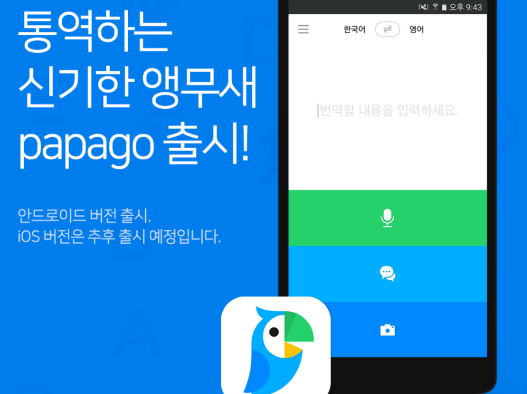
The Papago app, which was released as a beta version, is scheduled to be released for iOS in September following the release of the Android version, and plans to focus more on improving its quality so that it can be used as an essential interpretation app for domestic tourism by foreigners visiting Korea during the 2018 Pyeongchang Winter Olympics.
Naver has been strengthening its voice recognition, synthesis, and machine translation technologies, and based on its machine translation technology, it proved its competitiveness by winning first place in the Korean-Japanese translation machine category and third place in the English-Japanese translation machine category at the '2015 Asia Translation Quality Evaluation Contest', the first of its kind in Korea, in September last year. In particular, it has made efforts to secure global competitiveness by applying for a number of patents in the US and Japan in relation to this interpretation app.
Naver CTO Song Chang-hyun said, “Papago is the execution of Naver Labs’ technology strategy to implement smart services necessary for users’ real lives with AI technology and a simple and intuitive interface.” He added, “In order to compete with global companies in the future, we will further develop AI technology and strive to provide users with convenient and enjoyable experiences.”
Comments
Related news
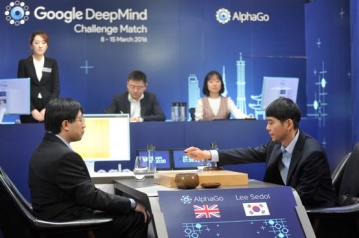
Following the rise of AlphaGo, a decision has been made to invest 1 trillion won in Korean-style 'artificial intelligence'.
Following the recent match between Lee Sedol, 9-dan professional, and AlphaGo, which has become a national point of interest, President Park Geun-hye held a 'Public-Private Joint Discussion on Intelligent Information Society' on the afternoon of the 17th at the Blue House, inviting approximately 20 executives and experts from companies related to artificial intelligence (AI) and software (SW) technology. The discussion was attended by Choi Yang-hee, Minister of the Ministry of Science, ICT and Future Planning, Yoo Il-ho, Deputy Prime Minister and Minister of Strategy and Finance, Kim Jin-hyung, Director of the SW Policy Research Institute, and Kim Dae-sik, Professor at the Korea Advanced Institute of Science and Technology (KAIST), among others.
2016.03.18by 신윤오 기자
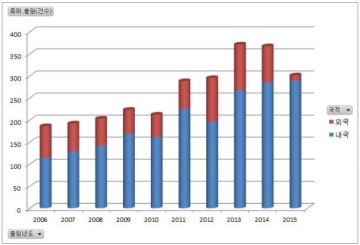
AI-related patents in the U.S. are nine times higher than those in Korea
According to the Korean Intellectual Property Office (Commissioner Choi Dong-gyou), an analysis of domestic artificial intelligence-related patent applications using natural language search methods reveals that over the past 10 years (2006-2015), patent applications totaled 2,638 cases, representing an average annual increase of approximately 5%. Natural language search is a search method that enables queries at the sentence level, utilizing search terms such as 'artificial intelligence, machine learning, artificial neural networks, deep learning, and decision-making'.
2016.03.21by 신윤오 기자
[Company Review] Power Voice, Expanding Global Market with AI-Based Voice Recognition Technology
PowerVoice (www.kpvoice.com) is a company that supplies voice recognition technology, speaker recognition technology, and voice processing technology based on deep learning technology. The company provides voice UI/UX solutions in the mobile, automotive, and IoT sectors to leading domestic companies such as Samsung and LG, as well as global companies overseas.
2016.06.13by 명세환 기자
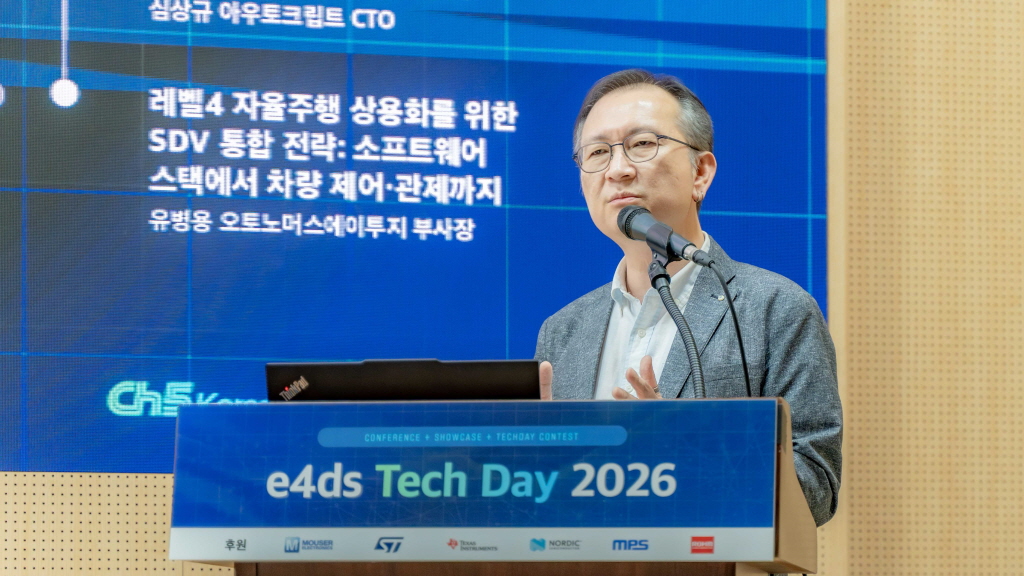
[e4ds Tech Day 2026 ⑨] Sim Sang-gyu, Autocrypt CTO: "In the Physical AI Era, Automotive Security Must Extend Beyond the Vehicle"
At e4ds Tech Day 2026, Sim Sang-gyu, CTO of Autocrypt, explained automotive cybersecurity strategies in the era of Physical AI and SDV (Software-Defined Vehicle). Automobiles are evolving as part of an ecosystem connected to AI, cloud, chargers, IoT, and robots, and he emphasized that the scope of security must expand beyond the vehicle interior to the entire connected environment. In particular, AI model tampering, adversarial attacks, OTA updates, and EV charger hacking were identified as major threats. He explained that response measures require zero trust, AI model integrity protection, intrusion detection, Security by Design and Default, and full lifecycle security management, and that proactive security system establishment beyond regulatory compliance is critical for securing future mobility competitiveness.
2026.10.12by 배종인 기자

NVIDIA to Invest $1 Billion in U.S. Science Over Next Five Years
NVIDIA has announced plans to invest $1 billion over the next five years to strengthen U.S. scientific and technological competitiveness. The company will enhance cutting-edge artificial intelligence research and development capabilities in key areas including quantum computing, healthcare, and energy security, while expanding support for higher education research institutions and cloud service providers. NVIDIA is participating as a major industry partner in the White House Office of Science and Technology Policy's Genesis Mission, and is promoting supercomputer construction in collaboration with national laboratories including Argonne and Los Alamos.
2026.10.12by 배종인 기자











