


SK Telecom and Intel Jointly Develop IoT Devices Equipped with Real-Time Communication Technology
 Published2016.08.18 11:21
Goal: To provide real-time communication capabilities to all internet-connected objects, excluding PCs and smartphones.
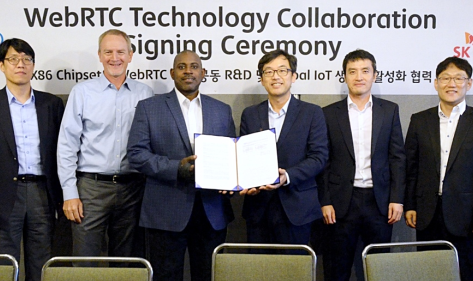
SK Telecom announced on the 17th that it has signed a memorandum of understanding with Intel, the world's largest semiconductor chip manufacturer, for the joint development of innovative IoT devices equipped with real-time communication technology.
SK Telecom CTO Jin-Sung Choi and Intel’s Michael A. Greene, VP of the Software Solutions Group, attended the signing ceremony held at the Intel Developer Forum (IDF) in San Francisco, USA on the 17th (16th local time).
'WebRTC (Web Real-Time Communication)' is a technology that enables the real-time transmission of video, audio, and data in web browsers, and is a next-generation web standard technology established by the 'W3C (World Wide Web Consortium)'. If this technology is applied to IoT devices, video and audio communication becomes possible without using a smartphone.
For example, if an online shopping mall or a delivery company uses this technology to create IoT devices dedicated to ordering, customers can easily order desired items and make calls with just a click of a button.
The two companies are jointly developing technology that enables the application of WebRTC to Intel's IoT device build board, 'Edison,' and plan to expand the scope of WebRTC, which has been limited to PCs and smartphones, to various IoT devices.
SK Telecom unveiled 'PlayRTC' in Korea for the first time last December, an upgraded version of 'WebRTC' designed to be easier to commercialize. By using 'PlayRTC', communication services can be launched and operated easily and quickly at a low cost without the need for expensive server setups, enabling the creation of new business models.
Both companies plan to actively contribute to revitalizing the IoT development ecosystem, including providing 'WebRTC' development tools (WebRTC SDK for x86 CPUs) to developers free of charge through their respective developer centers.
"We hope that PlayRTC will be utilized as a tool for innovation across various industrial sectors, including O2O, commerce, toys, and smart factories," said Cha In-hyuk, Head of the Platform Technology Institute at SK Telecom. "We plan to continue R&D collaborations with developers, small and medium-sized enterprises, and venture companies to enhance the usability of IoT devices and provide customers with a differentiated calling experience."
Intel Vice President Michael Green stated, “We will create an environment where customers can fully utilize Intel’s technology by providing software optimized for IoT devices,” adding, “Based on the IoT service development experience and WebRTC technology possessed by both companies, we will continue our efforts to develop and commercialize innovative IoT devices capable of real-time communication.”
Meanwhile, SK Telecom is leveraging the characteristics of a mobile carrier that possesses differentiated competitiveness in performance and quality—the most important elements in communication—to collaborate with various industries and develop services that enable customers to communicate conveniently and enjoyably.
On June 7, SK Telecom signed a memorandum of understanding with Toobisoft, a system software development and supply company, for the development and supply of a simple ordering IoT device for store owners in Dongdaemun Fashion Town. With this device, store owners in Dongdaemun Fashion Town can call a delivery driver via the IoT device 'One Click' to make reservations, place orders, and make calls.
In addition, in May, we completed the joint development of a voice-communicating toy prototype with 'EduChallenge,' a manufacturer of educational toys for infants and toddlers. Children can call their parents through the toy, and parents can remotely operate functions such as voice guidance for habit formation and storytelling via smartphone.
SK Telecom's 'PlayRTC' is also attracting attention from overseas startups. China's HEYI has been using 'PlayRTC' in 'Pandarin,' a service that provides 1:1 private tutoring to Chinese language learners worldwide, since 2015.
Comments
Related news

SK Telecom Develops 'Backpack-Type LTE Equipment' Unaffected by Base Station Damage
Heavy rainfall in the mountainous area of Jeongseon, Gangwon Province caused a large-scale landslide that severed communication networks. As a result, the National Safety Administration's situation room faced difficulties in grasping the extent of damage because civilian rescue requests could not be properly received. When firefighting and police personnel arrived at the disaster scene in the mountains and powered on the backpack-type LTE equipment they were carrying, communication facilities were restored. Reports from those in distress began to be received smoothly, and firefighting and police personnel initiated rescue operations using dedicated terminals equipped with real-time sharing technology. The central situation room received real-time video and photo feeds from the scene and was able to provide rapid rescue instructions to on-site personnel.
2016.08.04by 신윤오 기자
SK Telecom Expands Cooperation with Construction Companies by Supplying 'Customized' Smart Homes
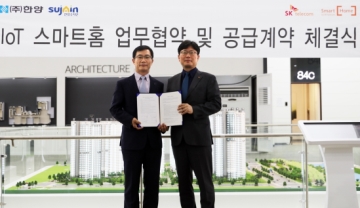
SK Telecom announced on the 9th that it has signed a smart home service supply contract with Hanyang Corporation (www.hycorp.co.kr) for 1,500 units of the 'Hanyang Sujaein' apartment complex in Cheongna International City, scheduled for delivery in August. SK Telecom stated that a distinguishing feature is that smart home experts participated directly from the apartment design phase, providing customized smart home services optimized to residents' needs by taking into account various factors such as regional characteristics and residential environment. According to SK Telecom, the smart home services applied to Hanyang Sujaein apartments focus on residents' convenience through ▲home appliance control functions via voice recognition ▲common facility control functions such as elevators, among other features.
2016.08.10by 신윤오 기자

SK Telecom Leads Global Standardization of IoT Dedicated Network Roaming and More
The LoRa Alliance global summit, which discusses future strategies for the IoT industry, will be held in Seoul. SK Telecom (CEO and President Jang Dong-hyun, www.sktelecom.com) announced that it will host the global summit of the LoRa Alliance, an international consortium and standard for IoT-dedicated networks, in Seoul in October, and will take a leading role in global standardization including IoT-dedicated network roaming.
2016.08.12by 신윤오 기자
Korea Instrument, KOLAS Accredited Calibration Agency First to Simultaneously Acquire ISO/IEC 27,001·27,701
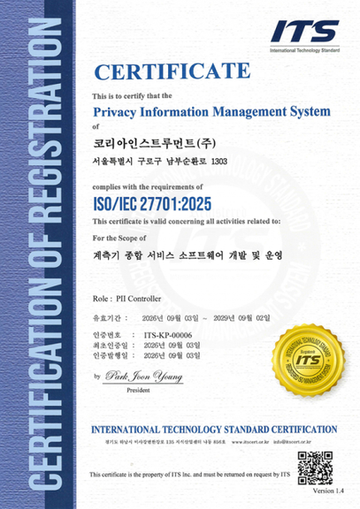
Korea Instrument has become the first among KOLAS accredited calibration agencies to simultaneously acquire ISO/IEC 27,001 and ISO/IEC 27,701 certifications. Through its proprietary platforms CWIZ Enterprise and CWIZ Partners, the company has embedded information security and personal data protection requirements across all business processes including customer information, equipment data, and calibration reports, with plans to continuously advance its management system through regular audits and security inspections.
2026.10.12by 배종인 기자

TeamViewer One, IT Incident Automation Workflow and Resolution Center Enhanced
TeamViewer has added IT incident automation capabilities and an advanced Resolution Center to its integrated digital workplace management platform 'TeamViewer ONE'. Recurrent service disruptions, configuration errors, and capacity shortages are automatically handled according to preset policies, and device status verification through script deployment can be managed in a unified interface, significantly reducing repetitive tasks for IT teams.
2026.10.12by 배종인 기자











