


Why did Intel bring a virtual reality (VR) headset to the developer forum?
 Published2016.08.18 11:41
Application of Intel RealSense technology, a 3D depth sensing technology
Intel unveiled Project Alloy, which brings the future of merged reality to life.
Intel CEO Brian Krzanich introduced an all-in-one virtual reality (VR) solution in his opening keynote speech at the 2016 Intel Developer Forum (IDF) held in San Francisco, USA on Tuesday the 16th (local time).
The Alloy platform can deliver a variety of new immersive experiences thanks to Intel RealSense technology, a 3D depth-sensing technology optimized for VR use.
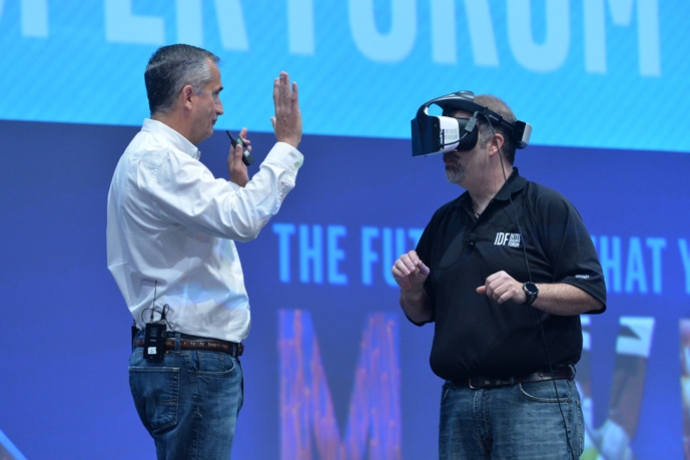
▲ Intel's Craig Raymond demonstrated the Project Alloy VR headset device during the IDF keynote.
On the left is Intel CEO Brian Krzanich.
At this year's 2016 IDF, Intel CEO Brian Krzanich's keynote speech highlighted virtual reality (VR), autonomous driving, and the industrial internet. We presented Intel's vision for future technologies, encompassing a wide range of fields, including the critical role developers will play in bringing this future to life.
“Merged reality will make virtual world experiences more immersive and natural than ever before,” said Krzanich. “This will make experiences that were previously impossible in the real world now possible.”
VR headsets, freedom from wires and immersive experiences
Project Alloy can operate without the cords of a VR headset that need to be connected to a computer. It integrates computing power into the head-mounted device (HMD), allowing users to freely experience VR.
This means that you can enjoy virtual reality with 6 degrees of freedom of movement without being constrained by cords in a wide area. This is made possible by combining collision detection and avoidance features, allowing users to utilize real physical movements when exploring virtual spaces.
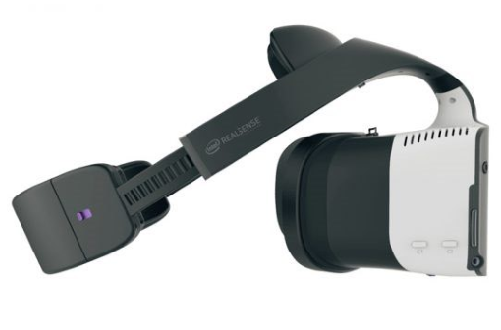
▲ Project Alloy
Through fused reality, users can see their own hands, their friends right in front of them, and even the wall they're about to bump into. Using Intel RealSense technology, users can not only see real-world elements like this, but also interact with virtual reality elements using their hands, merging the real and virtual worlds.
No external sensors required: Alloy's fused reality is realized through the Intel RealSense camera attached to the headset device, without the need for any external sensors or other cameras in the room.
By successfully combining Intel's sensing and computing technologies, such as Intel's RealSense technology, with the Alloy HMD, developers, makers, and inventors can now create new immersive experiences of the future. Intel is also collaborating with Microsoft to optimize Windows-based content for Intel-powered VR devices like Project Alloy.
Intel plans to release Project Alloy hardware and application programming interfaces (APIs) to the ecosystem in 2017, enabling developers and partners to build their own branded products based on Alloy designs.
Comments
Related news
To Avoid Repeating the Failure of 3D TV in the Virtual Reality (VR) Industry...
Virtual reality (VR) technology, which creates a realistic experience through real-time interaction with humans in a three-dimensional virtual space built using computers, is gaining significant attention. As VR becomes more mainstream, there is growing recognition that lessons from the problems encountered with 3D TV should be heeded. VR is a user interface technology that uses specialized glasses and gloves to enable humans to experience simulated scenarios realistically through their senses such as vision and hearing, based on what is possible within computer software programs. It allows users to view and manipulate environments as if they have entered spaces that are difficult to experience in everyday life. Consequently, VR is being utilized across diverse fields including military, entertainment, medical, education, film, and tourism.
2016.02.22by 신윤오 기자
Government Determined to Foster Virtual Reality Industry: 'Will It Be Different This Time?'
The government has rolled up its sleeves to foster the virtual reality industry. The government announced investment activation measures at the Trade and Investment Promotion Conference held on the 7th, and stated that the virtual reality sector included in the agenda will be implemented under joint efforts by related ministries including the Ministry of Strategy and Finance, Ministry of Science, ICT and Future Planning, Ministry of Culture, Sports and Tourism, and Ministry of Trade, Industry and Energy. The announcement is based on analysis of the current state and competitiveness of the domestic virtual reality industry and industry roundtables, and includes major projects such as leading projects from the Ministry of Science, ICT and Future Planning, Ministry of Culture, Sports and Tourism, and Ministry of Trade, Industry and Energy, content production support, and virtual training systems, as well as various plans including the establishment of a virtual reality specialized fund, R&D tax credits for virtual reality technology, the Seoul VR Festival, and global promotion initiatives tied to the PyeongChang Winter Olympics.
2016.07.11by 장은성 기자
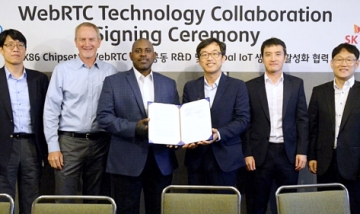
SK Telecom and Intel Jointly Develop IoT Devices Equipped with Real-Time Communication Technology
SK Telecom announced on the 17th that it has signed a memorandum of understanding with Intel, the world's largest semiconductor chip manufacturer, for joint development of innovative IoT devices equipped with real-time communication technology. The signing ceremony took place at Intel Developer Forum (IDF) in San Francisco on the 17th (16th local time), with SK Telecom CTO Choi Jin-sung and Michael A. Greene, VP of Intel's Software Solutions Group, in attendance.
2016.08.18by 신윤오 기자

ESP32 Development Environment Selection and GPS Application Implementation
The ESP32 is a microcontroller that integrates Wi-Fi, Bluetooth, 12-bit ADC, capacitive touch, PWM, DAC, and UART in a single SoC. However, the abundance of features does not by itself solve the designer's problems. The real challenges lie in selecting the appropriate development environment, determining which pins can be used and which must be avoided, and converting raw data from modules into usable information. This document addresses ESP32 peripheral constraints (ADC2 and Wi-Fi coexistence limitation, UART1 occupancy, ADC non-linear regions), the trade-offs between Arduino IDE and ESP-IDF, and the process from connecting NEO-6M/NEO-M8N GPS modules to UART2, parsing NMEA sentences, and visualizing routes in Google Earth, all organized based on documented references.
2026.10.12by 편집부
MIPI CSI-2, DSI-2, C-PHY, D-PHY Test Solution Technical White Paper
The MIPI interface adopts a burst mode that transitions between low-power (LP) and high-speed (HS) states for low-power consumption, and in return, strict timing rules are imposed on state transitions. Additionally, the high-speed section operates as a packet-based protocol with headers, ECC, and CRC, so verification engineers must handle waveforms and protocols simultaneously. Traditional configurations combining general-purpose oscilloscopes and AWGs reveal limitations in setup complexity, measurement uncertainty, and lack of reproducibility when faced with these requirements. This white paper, based on webinar materials, organizes the structure of this problem and describes how the SV5C-DPTXCPTX generator for receiver testing and SV5C-DPRXCPRX analyzer for transmitter testing integrate state transition testing, stressed eye testing, and protocol analysis into a single bench, along with their application boundaries.
2026.10.12by 편집부











