



The Effect of Intel's Acquisition of Altera? FPGAs Play a Crucial Role Between Cloud and IoT
 Published2016.08.19 13:23
Introducing 'Stratix 10', Intel's Latest FPGA Based on 14nm Tri-Gate
Intel held the first Intel SoC FPGA (Field Programmable Gate Array) Developer Forum at the same venue during the 2016 Intel Developer Forum (IDF). This event focused on the Intel Programmable Solutions Group, newly established following the acquisition of Altera, and the SoC FPGA technology being developed by the group.
In his keynote speech at the event, Intel CEO Brian Krzanich provided answers to various questions that many people have been wondering about since the acquisition of Altera, such as "What does the acquisition of Altera mean for SoC FPGA users?", "In what direction will Intel move forward now?", and, most importantly, "What role will FPGAs and SoC FPGAs play for Intel in the future?"
What Does the Altera Acquisition Mean for SoC FPGA Users?
In his keynote speech, Brian made it clear that FPGAs play a key role in Intel's growth strategy, which is being driven by a virtuous cycle of growth. In a smart and connected world, all objects are captured as data, measured in real time, and accessible from anywhere.
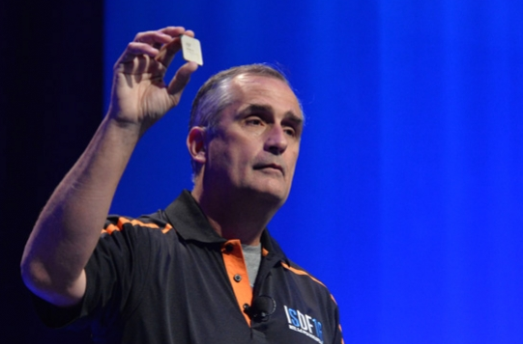
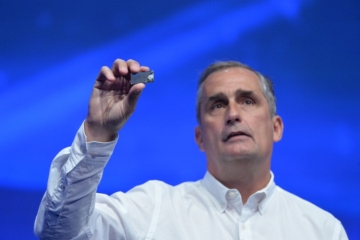
▲ CEO Brian Krzanich holding the Intel 'Stratix 10'
Brian emphasized that today's technology is continuously "breaking down the boundaries between the digital and physical worlds," as seen in emerging technologies such as virtual reality (VR) and artificial intelligence (AI). Intel's strategy to enable a smart and connected world involves every area, from sensors to actuators and the cloud. And FPGAs and SoC FPGAs will play a central role in realizing this world.
In what direction will Intel move forward now?
With the explosive growth of new devices, diverse new applications and workloads will emerge in data centers. Future data centers need to become more flexible to respond to these changing workloads. Furthermore, whether you are a manager of a smart, connected, advanced factory or a telecommunications service or cloud network provider, all of this performance and connectivity must be ensured at efficient power consumption levels.
Therefore, the ability to control performance per watt is essential. Summarizing the three challenges, they are: 1. Improving bandwidth and reducing latency in networks, 2. Data center flexibility to respond to new and changing workloads, and performance management per watt can be the three key challenges. All three of these challenges are crucial for enhancing the value of FPGAs.
Intel's FPGAs eliminate bottlenecks and accelerate a smart, connected world by providing greater flexibility and improving intelligence and efficiency. As multi-functional algorithm accelerators, FPGAs represent the optimal combination for hardware and software programmability. This enables system designers to develop better systems by exploring which workloads can run most efficiently across CPU and FPGA domains.
What role will FPGAs and SoC FPGAs play for Intel in the future?
In his keynote speech, Brian also emphasized that the company is expanding investments to grow its FPGA business. This includes investments in new FPGA and SoC FPGA product roadmaps, long-term product lifecycle support, and the continued provision of services and support that customers expect from Altera.
Based on its superior operational capabilities, Intel will continue to develop advanced FPGA products targeting a wide range of markets and applications, as well as derivative products tailored to the specific needs of Intel's data center and Internet of Things (IoT) sectors. Intel will continue to develop FPGAs for small systems, systems where performance is critical but limited, and systems of various sizes with optimal performance. In addition, Intel will provide standalone FPGAs, SiP (System in Package) solutions that closely combine an FPGA and a CPU to create a complete system, and monolithic SoC FPGAs that integrate ARM and Intel architectures, targeting these systems.
Prith Banerjee, CTO of Schneider Electric, who was present during Brian's keynote speech, demonstrated a perfect example proving the value of FPGAs throughout the entire virtuous cycle. Prith emphasized that Schneider Electric selected Intel FPGAs and SoC FPGAs as an end-to-end solution to power sensors, devices, networks, and the cloud on its industrial IoT systems. Intel's FPGAs provide Schneider Electric with the performance, capabilities, and flexibility necessary to build the smart factories of the future.
Brian concluded his keynote speech by introducing the latest FPGA, 'Stratix 10,' based on Intel's 14nm Tri-Gate process, to the event attendees. Stratix 10 is a product that brilliantly represents the FPGA innovations Intel can offer to its customers in terms of performance, system integration, and productivity. Furthermore, showcasing the Stratix 10 FPGA to the audience as part of the process of integrating the Intel brand into the FPGA product portfolio also symbolizes the brand transition from Altera to Intel.
Brian emphasized that Intel FPGAs and SoC FPGAs will continue to play an important role at Intel. Through FPGA technology and Intel's expanded processor family, Intel will be positioned to more effectively drive a virtuous cycle between the cloud and IoT.
Comments
Related news
Intel Launches Full-Scale Attack on Domestic Machine Learning Market with Next-Generation Xeon Phi Processors
Intel Korea (President Kwon Myung-sook) introduced the next-generation Intel® Xeon Phi™ processor (codename: Knights Landing) through a customer seminar and press briefing held at eltower in Yangjae-dong, and announced its strategy for market penetration in the machine learning and HPC sectors. The Intel Xeon Phi processor functions as a bootable host processor with flexibility to handle multiple analytical workloads. The Intel Xeon Phi product family provides up to 1.38x better scalability compared to GPUs on a 32-node infrastructure, and when using the Intel Xeon Phi product family on a 128-node infrastructure, models can be trained up to 50x faster compared to a single node.
2016.07.14by 김수지 기자
Why did Intel bring a virtual reality (VR) headset to the developer forum?
Intel has unveiled Project Alloy, a project that realizes future Merged Reality. Intel CEO Brian Krzanich introduced an all-in-one virtual reality (VR) solution at the opening keynote speech of the 2016 Intel Developer Forum (IDF) held in San Francisco, USA on Tuesday the 16th (local time). The Alloy platform is able to provide a variety of new immersive experiences thanks to Intel RealSense technology, a 3D depth sensing technology optimized for VR use. The key features are as follows.
2016.08.18by 신윤오 기자
[Intel Developer Forum] Announcement of IoT Development Platform Providing Human-like Senses
Intel announced the Intel® Joule™ platform at the 2016 Intel Developer Forum (IDF) currently underway in San Francisco, USA. The Intel Joule platform is a high-end computing platform that enables next-generation smart devices to possess human-like sensory capabilities. Developed for the IoT sector, the Intel Joule platform enables embedded developers and entrepreneurs to build embedded systems or accelerate product commercialization through prototyping while minimizing development costs.
2016.08.18by 김수지 기자
Korea Instrument, KOLAS Accredited Calibration Agency First to Simultaneously Acquire ISO/IEC 27,001·27,701
Korea Instrument has become the first among KOLAS accredited calibration agencies to simultaneously acquire ISO/IEC 27,001 and ISO/IEC 27,701 certifications. Through its proprietary platforms CWIZ Enterprise and CWIZ Partners, the company has embedded information security and personal data protection requirements across all business processes including customer information, equipment data, and calibration reports, with plans to continuously advance its management system through regular audits and security inspections.
2026.10.12by 배종인 기자
TeamViewer One, IT Incident Automation Workflow and Resolution Center Enhanced
TeamViewer has added IT incident automation capabilities and an advanced Resolution Center to its integrated digital workplace management platform 'TeamViewer ONE'. Recurrent service disruptions, configuration errors, and capacity shortages are automatically handled according to preset policies, and device status verification through script deployment can be managed in a unified interface, significantly reducing repetitive tasks for IT teams.
2026.10.12by 배종인 기자











