


Was the impact of AI 'AlphaGo' significant? Related trademark applications surge.
 Published2016.09.13 10:42
Since the Go match between Google's artificial intelligence computer 'AlphaGo' and 9th Dan Lee Se-dol garnered public attention last March, trademark applications related to artificial intelligence have been gaining momentum.
According to the Korean Intellectual Property Office (KIPO, Commissioner Choi Dong-gyu), 18 trademark applications related to artificial intelligence were filed over the past five years, with 3 in 2011, 3 in 2012, 0 in 2013, 9 in 2014, and 3 in 2015. However, it was found that 35 applications were filed this year as of July, nearly doubling the total number of applications (18) over the past five years.
In particular, the proportion of trademark applications since last March, when public awareness of 'AlphaGo' increased, reached 83% (29 out of 35 as of July 2016), and it is analyzed that AlphaGo's popularity has influenced trademark applications related to artificial intelligence.
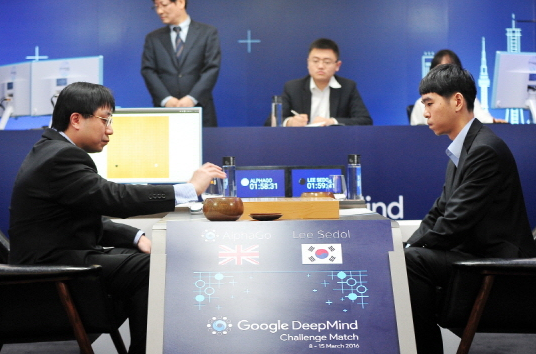
▲ Last March, Lee Se-dol 9-dan played a match against the artificial intelligence 'AlphaGo'. On the left is his stand-in, Aja Huang.
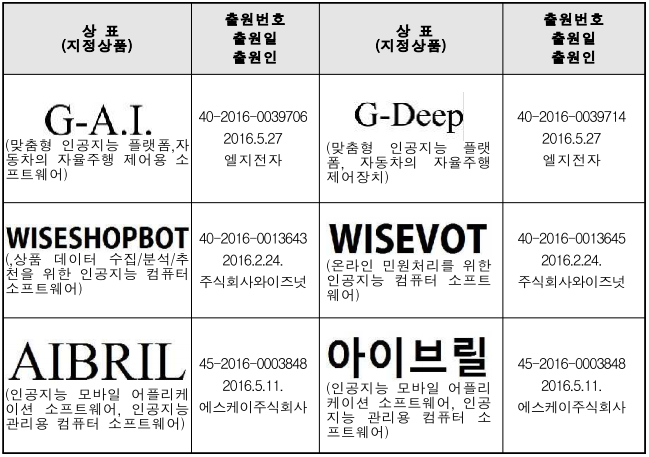
The company with the most trademark applications related to artificial intelligence is LG Electronics, with 15 applications, while tied for second place are Wisenut Co., Ltd. and SK Corporation, with 4 applications each.
From 2011 to July 2016, a total of 53 trademark applications related to artificial intelligence were filed, and 8 of them were registered. With many cases currently undergoing trademark examination, the number of registered trademarks related to artificial intelligence is expected to increase further in the future. The surge in trademark applications this year for AI businesses, which require significant capital, is attributed to the influence of technological advancements.
This is because, along with self-driving cars that Google is accelerating the commercialization of and 100% AI-powered vehicles without steering wheels from Tesla, BMW, and Ford, technology development for artificial intelligence is also gaining momentum in Korea, leading to trademark applications.
Artificial intelligence continues to receive steady attention in various broadcasts and media reports as a next-generation growth engine. It appears that following the emergence of Google's 'AlphaGo,' Korean companies and the public have begun to take an interest in AI, leading to trademark applications.
Choi Gyu-wan, Director of the Trademark and Design Examination Bureau at the Korean Intellectual Property Office, said, “When many companies invest large capital in the field of artificial intelligence, which AlphaGo created a boom, and plan to commercialize it, filing for a trademark to secure rights is the shortcut to protecting intellectual property rights.”
Comments
Related news
AI-related patents in the U.S. are nine times higher than those in Korea
According to the Korean Intellectual Property Office (Commissioner Choi Dong-gyou), an analysis of domestic artificial intelligence-related patent applications using natural language search methods reveals that over the past 10 years (2006-2015), patent applications totaled 2,638 cases, representing an average annual increase of approximately 5%. Natural language search is a search method that enables queries at the sentence level, utilizing search terms such as 'artificial intelligence, machine learning, artificial neural networks, deep learning, and decision-making'.
2016.03.21by 신윤오 기자
Will 'NUGU,' the conversational AI service, succeed in capturing the home market?
SK Telecom announced on the 31st that it has launched the conversational artificial intelligence service 'NUGU', thereby opening the 'era of AI democratization'. On this day, the company unveiled the voice recognition-based artificial intelligence service 'NUGU' and its dedicated device, and announced plans to co-evolve the artificial intelligence platform service together with customers and external developers. The artificial intelligence service 'NUGU' is a service wherein when customers speak to the dedicated device as if having a conversation, advanced voice recognition technology and an artificial intelligence engine identify and execute what the customer desires. The company explained that it launched the artificial intelligence service in preparation for the era of service convergence based on artificial intelligence technology.
2016.08.31by 신윤오 기자
We will intensively foster AI-based commercialization projects with significant industrial ripple effects.
The Artificial Intelligence Applied Industrialization Promotion Unit (co-chaired by Professor Lee Su-young of KAIST and Kim Young-sam, Director of System Industry Policy at the Ministry of Industry) held an Artificial Intelligence Applied Industrialization Forum on the 12th, inviting experts from industry, academia, and research institutions related to artificial intelligence (AI). The Artificial Intelligence Applied Industrialization Promotion Unit, which was launched in March, has gathered opinions from various sectors and identified technology development and commercialization projects (15 in total) with significant industrial ripple effects from AI utilization.
2016.09.12by 신윤오 기자

[e4ds Tech Day 2026 ⑨] Sim Sang-gyu, Autocrypt CTO: "In the Physical AI Era, Automotive Security Must Extend Beyond the Vehicle"
At e4ds Tech Day 2026, Sim Sang-gyu, CTO of Autocrypt, explained automotive cybersecurity strategies in the era of Physical AI and SDV (Software-Defined Vehicle). Automobiles are evolving as part of an ecosystem connected to AI, cloud, chargers, IoT, and robots, and he emphasized that the scope of security must expand beyond the vehicle interior to the entire connected environment. In particular, AI model tampering, adversarial attacks, OTA updates, and EV charger hacking were identified as major threats. He explained that response measures require zero trust, AI model integrity protection, intrusion detection, Security by Design and Default, and full lifecycle security management, and that proactive security system establishment beyond regulatory compliance is critical for securing future mobility competitiveness.
2026.10.12by 배종인 기자
NVIDIA to Invest $1 Billion in U.S. Science Over Next Five Years
NVIDIA has announced plans to invest $1 billion over the next five years to strengthen U.S. scientific and technological competitiveness. The company will enhance cutting-edge artificial intelligence research and development capabilities in key areas including quantum computing, healthcare, and energy security, while expanding support for higher education research institutions and cloud service providers. NVIDIA is participating as a major industry partner in the White House Office of Science and Technology Policy's Genesis Mission, and is promoting supercomputer construction in collaboration with national laboratories including Argonne and Los Alamos.
2026.10.12by 배종인 기자











