



KT Chairman Hwang Chang-kyu: "Aiming to be an intelligent network company, not merely a network infrastructure company"
 Published2016.09.21 17:20
Chairman Hwang Chang-kyu to deliver lecture at Harvard Memorial Hall on the 20th… 7th visit to Harvard
During a special lecture held at Harvard University, Chairman Hwang Chang-kyu explained the network innovation pursued by KT and emphasized the infinite possibilities that next-generation networks will create. In addition, KT hosted an exhibition event on the Harvard campus where visitors could enjoyably experience 5G, GiGA, and convergence technologies, receiving a highly positive response.
KT announced that Chairman Hwang Chang-kyu delivered a special lecture on the theme of "Power of the Network" at Harvard Memorial Hall in Boston, USA, on the 20th (local time). It also disclosed that KT's GiGAtopia strategy (KT's Forward Looking Strategy) is currently being pursued for inclusion as a case study at Harvard Business School (HBS).
This was Chairman Hwang Chang-kyu's second lecture at Harvard University, following his visit in 2005, and his seventh official visit to the university, including five case study presentations. In this lecture, Chairman Hwang presented the 'Intelligent Network' as a next-generation network.
An intelligent network refers to a network that goes beyond the level of transmitting information, such as voice and data, via wired or wireless networks to provide convergence solutions within the network itself. Based on high speed, vast capacity, and perfect connectivity, we aim to provide additional network-level services to make life safer and more convenient, and to create new opportunities in the industry.
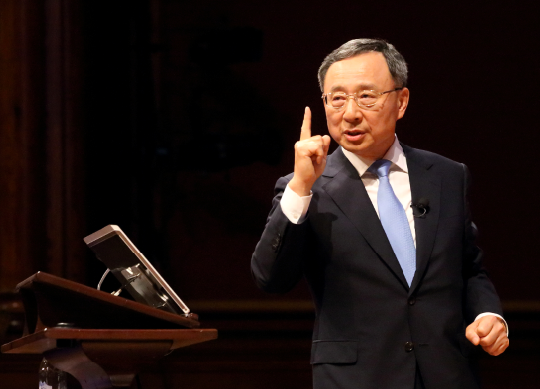
Chairman Hwang Chang-kyu pointed out that telecommunications operators worldwide are concerned that they might be relegated to 'Dumb Pipe' operators, merely providing network infrastructure. He explained that instead of looking into other fields to escape this 'Dumb Pipe' crisis, KT is pursuing innovation to enhance the inherent value of its network.
KT's network innovation is being pursued in four areas: Speed, Surveillance, Big Data, and Security. Chairman Hwang Chang-kyu cited "Giga Internet," which improved existing internet speeds tenfold, as an example of KT's speed innovation. KT's Giga Internet, which launched commercial services in the second half of 2014, has been well-received, achieving 2 million subscribers in less than two years.
At the time of its launch, there was skepticism questioning whether a faster internet service was necessary when current speeds were already sufficient. However, the remarkable speed of Giga Internet not only garnered high satisfaction from subscribers but also created a ripple effect, such as realizing gigabit speeds (Giga LTE) in wireless networks and providing clearer UHD video. Furthermore, it is expected to accelerate future services such as connected cars, holograms, and virtual reality (VR).
KT is sparing no effort to innovate the speed of wireless networks as well as wired networks. In March 2015, Chairman Hwang Chang-kyu garnered the consensus of telecommunications operators worldwide by presenting a vision of the future that 5G would create in a keynote speech titled '5G and Beyond, Accelerating the Future' at the Mobile World Congress (MWC) 2015. KT plans to maintain its global leadership in 5G through initiatives such as the world's first 5G pilot service at the 2018 PyeongChang Winter Olympics.
KT is making various attempts to enhance the 'safety monitoring' capabilities of its network. KT's 'GiGA Geo-fencing' provides customized services based on time, location, and situational data collected through positioning technology. While Google Maps is two-dimensional, GiGA Geo-fencing allows for the verification of three-dimensional information. Applying this to public safety is expected to make it easier for firefighters to rescue lives and for locating missing children in public facilities. KT utilizes various communication networks, including beacons, Wi-Fi, and LTE, for geo-fencing.
Solutions are also being developed to prepare for situations involving distress at sea. KT has extended maritime LTE coverage up to 200km without the need for shipboard repeaters by utilizing an Over-the-Horizon Antenna Array System. This means that LTE communication services can be provided in most of Korea's territorial waters, including Ulleungdo and Dokdo.
We are currently developing the 'IoT Life Jacket Marine,' which incorporates Internet of Things (IoT) technology into a jacket. This jacket provides solutions that enhance survival in maritime accidents, such as a lifebuoy function based on water pressure detection and the transmission of location and health information for those in distress.
Big data is an indispensable element for intelligent networks. This is because telecommunications operators possess vast amounts of user data and have solutions capable of analyzing it. The utilization of big data is even more prominent in the public sector. KT has achieved the feat of predicting the spread of avian influenza with over 90% accuracy. This solution can also be utilized to block the spread of other infectious diseases such as Ebola, MERS, and Zika.
At the UN Global Compact (UNGC) Leaders Summit 2016 held in New York last June, Chairman Hwang Chang-kyu proposed the 'Big Data Initiative on Disease Diffusion Mapping' to the United Nations and global telecommunications companies. To this end, KT expressed its intention to provide its ICT infrastructure capabilities as well as big data-related technologies and know-how.
Big data is expected to bring groundbreaking changes to the industrial sector as well. In a lecture at Harvard University, Chairman Hwang Chang-kyu introduced KT's world-first integrated energy solution, KT-MEG (Micro Energy Grid), and explained that applying KT-MEG to just 10% of domestic energy sites could reduce power generation equivalent to five nuclear power plants.
Intelligent networks can serve as an alternative to ever-evolving cyber attacks. As evidenced by pharming, relying solely on antivirus software has its limitations in dealing with sophisticated cyber attacks. No matter how many pharming sites are created or smishing attempts are made, they become useless if they are blocked at the source at the network level. KT's anti-pharming solution is expected to become a core service for financial institutions, trading sites, and electronic payment systems.
Protecting information from hacking is also important. KT is receiving favorable reviews for introducing LTE Enterprise, a dedicated LTE service that provides not only enhanced corporate security but also personal information protection. This dedicated LTE service is available not only to corporations but also to various institutions such as government agencies and universities. Chairman Hwang Chang-kyu explained that a dedicated LTE (LTE Harvard) service is available on the Harvard campus, categorized for students, faculty, and visitors.
Intelligent Networks, the Driving Force of the Next-Generation Industrial Revolution
Chairman Hwang Chang-kyu predicted that network innovation would bring about a "massive transformation" to the industrial paradigm. He forecasted that intelligent networks, connecting billions of devices, would create new value and lead the next-generation industrial revolution. He anticipated changes not only in industry but also in daily life, such as preventing the spread of infectious diseases.
KT introduced that it is pursuing 'GiGAtopia' based on an intelligent giga network. GiGAtopia refers to 'a world where humans and all things are connected through giga infrastructure, and where not only industry but also daily life is filled with vitality through convergence services.'
KT commercialized Giga Internet early in 2014 to realize Gigatopia. Furthermore, by establishing Giga Stories in areas such as Imjado, Daeseong-dong, Baengnyeongdo, and Cheonghak-dong, it comprehensively demonstrated how Gigatopia transforms life in remote islands and mountainous regions. Gigatopia serves as both a goal and a strategy for KT, acting as a foundation for pursuing network innovation.
Chairman Hwang Chang-gyu predicted that by 2020, network speeds would increase tenfold, and big data, safety monitoring, and security would also improve tenfold. In addition, just as the mobile era announced by Harvard University 11 years ago became a reality, high expectations were expressed for the future that the intelligent network announced by Harvard University this time will create.
Chairman Hwang Chang-kyu stated, “I anticipate that future network innovation will evolve beyond mere speed improvements to a model where networks combine with convergence solutions,” adding, “I am confident that a future centered on intelligent networks will bring about changes far more massive and extensive than the mobile era.”
'GiGAtopia' to be used as a textbook at Harvard Business School
KT's GiGAtopia strategy (KT's Forward Looking Strategy) has been listed as a case study by HBS and is scheduled to be used as a textbook starting next year. KT expects that if the GiGAtopia strategy is successfully listed as an HBS case study, the brand value of 'Korea Telecom' on the global stage will be significantly enhanced. In addition, separate from the GiGAtopia strategy, the listing of 'KT's new energy business' as an HBS case study will be pursued sometime next year.
KT held an exhibition titled the 'KT Board Game Special Event' at the Harvard Science Center on the 18th and 19th. The exhibition was designed to resemble a board game, allowing participants to naturally experience KT's 5G, GiGA, and convergence technologies while enjoying the game.
Exhibition participants showed great interest in VR content. In addition, KT's global talent recruitment briefing was held in one corner of the exhibition space. KT's global talent recruitment information session was held for students from not only Harvard but also the Massachusetts Institute of Technology (MIT), Boston University, and others.
Meanwhile, prior to his lecture at Harvard University, Chairman Hwang Chang-kyu attended the regular meeting of the Broadband Commission held in New York on the 18th and requested joint efforts from telecommunications operators worldwide to promote the 'Big Data Joint Task to Prevent the Spread of Infectious Diseases' proposed in his speech at the UNGC in June of this year.
For the success of the joint big data project proposed by Chairman Hwang Chang-kyu, organic cooperation among the UN, national governments, and telecommunications operators worldwide is necessary. Among these, the big data information possessed by telecommunications operators is considered an essential element.
At the meeting, Chairman Hwang Chang-kyu explained in detail the purpose and expected effects of the 'Big Data Joint Project for Preventing the Spread of Infectious Diseases.' In response, global telecommunications leaders, including Robert Kirkpatrick, Representative of the UN Global Pulse (UNGP), and Mats Granryd, Director General of the GSMA, expressed their agreement and emphasized close cooperation.
In addition, at this meeting, the Broadband Commission’s annual report, published on the 12th, was introduced, and KT’s Global Giga Island and the Internet of Things (LTE-M) were included as exemplary cases of broadband expansion.
Comments
Related news
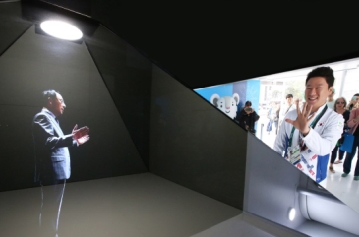
[Photo News] KT Chairman Hwang Chang-kyu congratulating athlete Jin Jong-oh with hologram technology
KT Chairman Hwang Chang-gyu delivered a congratulatory message via hologram video to athlete Jin Jong-oh (37, KT), who achieved an unprecedented three consecutive gold medals in Olympic shooting. KT announced that Chairman Hwang Chang-gyu made a surprise appearance as a hologram at the PyeongChang promotional pavilion in Rio de Janeiro, Brazil on the 12th (13th Korea time), congratulating Jin Jong-oh, who won the gold medal in the 50m pistol shooting event at the Rio Olympics. The 'Global Hologram' technology used to deliver this congratulatory message was produced at 40% of actual size, allowing the image to be viewed from four directions—front, back, left, and right. As a three-dimensional stereoscopic video, it provides the feeling of being right next to the recipient, even when the message is delivered from a distant location. Seoul and Rio de Janeiro, where the Olympics are taking place, are approximately 20,000 km apart.
2016.08.15by 홍보라 기자
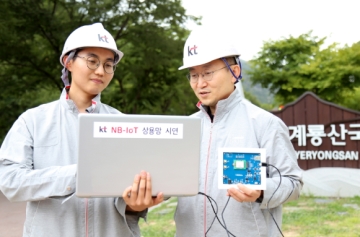
KT Succeeds in NB-IoT Communication Demonstration in LTE Commercial Network Environment
KT announced on the 31st that it has successfully demonstrated key NB-IoT technologies based on 3GPP standards in an LTE commercial network environment for the first time in the world in collaboration with Nokia. NB-IoT (Narrow Band IoT) is an IoT standard technology specialized for small data communication between remote, low-power consuming objects using a narrow 200 kHz bandwidth compared to existing mobile communication methods such as LTE and 3G. With very affordable module pricing, it is well-suited for various Internet of Small Things (IoST) services such as smart metering (remote meter reading) and smart street lights.
2016.08.31by 신윤오 기자
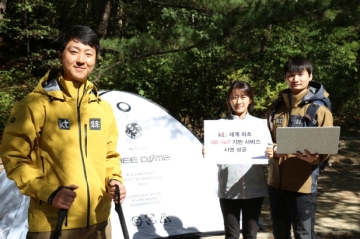
KT Successfully Demonstrates First NB-IoT Service on LTE Network
KT announced on the 20th that it had demonstrated various Internet of Things services applying NB-IoT technology on LTE commercial networks for the first time in the world, in collaboration with government agencies and domestic and international partners including the Daejeon Metropolitan City, Nokia, Colorong Industries Co., Ltd. FnC Division, and Intel. KT developed an 'IoT Safety Jacket (prototype)' in cooperation with Colorong Sports, an outdoor brand of Colorong Industries Co., Ltd. FnC Division, by mounting Intel's NB-IoT module on a hiking jacket, and demonstrated that Internet of Things services are possible with low power consumption and low data capacity even in emergency situations and on hiking trails with weak communication signal strength.
2016.09.20by 신윤오 기자
European Patent Applications Surpass 200,000 for the First Time… South Korea Maintains 5th Place, Led by Batteries and Telecommunications
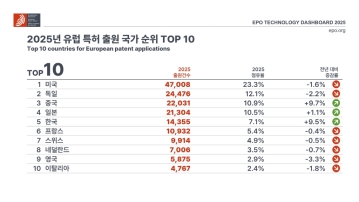
According to the European Patent Office (EPO)'s 'Technology Dashboard 2025', European patent applications last year reached 201,974, surpassing 200,000 for the first time. Korean companies and inventors filed 14,355 applications, representing a 9.5% increase from the previous year and maintaining 5th place by country. Battery, digital communication, and semiconductor technologies led the growth, with Samsung ranking as the top EPO applicant for the second consecutive year and LG reaching 3rd place. The presence of major domestic cities such as Seoul, Suwon, and Yongin was also confirmed. It was also revealed that Korea's European patent strategy is expanding beyond individual technologies to span the entire industry.
2026.03.24by 명세환 기자

SK Telecom First Applies AI-Based Network Operations at Gwanghwamun K-Pop Concert
SK Telecom announced that it applied an AI-based network operation system for the first time at a large-scale K-pop concert held in the Gwanghwamun area of Seoul on March 21st, managing communication quality throughout the event. Mobile data usage during the three hours before and after the concert reached 12.15TB, approximately doubling compared to the same time slot the previous weekend. SK Telecom monitored traffic using the AI system 'A-One' in five-minute and 50-meter units to respond to potential overload situations, while also operating temporary communication facilities and on-site personnel in parallel. This case is interpreted as confirmation of the practical applicability of AI-based autonomous network operation in an environment where demand from dense events and foreign users increases simultaneously.
2026.03.23by 명세환 기자











