



[Reporter's Notebook] What is 'Lora'? The war of nerves among the three telecommunications companies over the IoT communication network is accelerating
 Published2016.11.07 18:28
SK Telecom to launch hybrid IoT network led by 'LoRa'
It feels like competition among telecommunications companies is heating up again over dedicated network methods for the Internet of Things (IoT).
On the 3rd, KT and LG U+ suddenly announced that they would hold a joint press conference on IoT strategies. Although telecommunications companies have held their own press conferences on IoT, there have not been many cases where they have put joint cooperation at the forefront.
On this day, KT and LG Uplus announced that they will jointly promote NB-IoT commercialization in the first quarter of next year through active business cooperation and lead the Internet of Things market centered on 'NB-IoT' technology.
NB-IoT is a narrowband Internet of Things standard technology that supports data transmission speeds of 150kbps or less and long-distance services of 8km or more using the narrow band of a mobile communication network. It is evaluated as suitable for communication between objects located at a distance, such as gas and water metering and location tracking devices, while consuming little power.
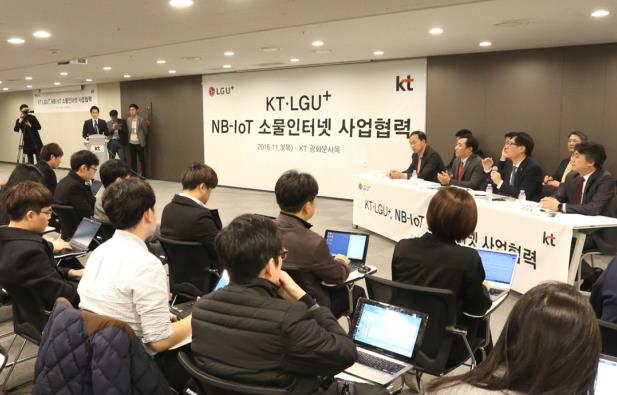
▲ KT and LG U+ announce business cooperation.
The two companies agreed to jointly promote early commercialization of NB-IoT networks, jointly source core IoT products such as chipsets, modules, eSims, and terminals, and jointly respond to activities of major domestic associations and global organizations. For example, in the case of early commercialization, it was announced that they plan to jointly promote NB-IoT commercialization in the first quarter of next year and complete construction of a nationwide network within the next year.
To this end, KT and LG U+ will likely make all-out efforts to create an IoT ecosystem centered around NB-IoT. KT has members of the GiGA IoT Alliance, and LG U+ also plans to attract partners.
NB-IoT is similar to 'LoRa (Long Range)' in that it is capable of low-power long-distance wireless communication, but unlike LoRa, which uses unlicensed frequencies, it is based on the LTE nationwide network, so it emphasizes that it provides dense coverage and stable service quality.
Unlicensed frequencies (Flexible Access Common Spectrum) are frequencies that can be used for general purposes without a specific purpose, such as WiFi. Anyone can provide services, but there is a possibility of interference with other technology frequencies in the same band, and network operation management is required according to separate network construction.
The one that is furious about this is SK Telecom, which launched the nationwide LoRa network service.
SK Telecom completed construction of the first hybrid IoT network in Korea at the end of June and is building an industrial ecosystem based on it. In particular, the LoRa Alliance, in which this company is actively participating, has approximately 400 companies participating, including network operators such as Comcast (US), Softbank (Japan), Orange (France), and Swisscom (S), as well as global system/equipment companies such as Cisco, IBM, and HP, expanding the global IoT ecosystem.
SK Telecom's One-sided Disparagement of LoRa Technology Reflects Impatience in Lagging IoT Investments
SK Telecom does not only have LoRa networks. Considering the characteristics of the IoT industry where data volume and speed are very diverse, it is operating a hybrid IoT network by commercializing the LoRa network nationwide separately from the LTE and LTE-M networks. It stated that it is maximizing network utilization efficiency by utilizing the optimal wireless network according to communication frequency, capacity, and purpose, such as utilizing the LoRa network, an IoT-only network, for services that send and receive small amounts of data intermittently, the LTE-M communication network for areas that require real-time control, and the LTE communication network for areas that require video such as CCTV.
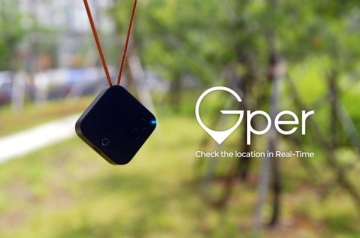
As of the end of October, we have distributed modules free of charge to approximately 500 companies, and we plan to distribute 100,000 modules within the year to provide more companies with the opportunity to participate in the IoT industry. Starting with the location tracker 'Gper' launched in early November, around 30 services based on the LoRa network are expected to be commercialized within the year.
SK Telecom stated its position regarding KT and LG Uplus’ mention of LoRa technology when announcing their joint NB-IoT collaboration, saying, “KT and LG Uplus’s unilateral claims about the competing technology, LoRa, that are not in line with the facts are not helpful not only to their own company but also to the development of the national industry.” It also said, “We deeply regret that these companies are unilaterally disparaging competing technologies without even announcing their own investment plans, which reflects their impatience for falling behind in IoT investment.”
As such, the war of nerves between telecommunications companies over IoT networks is expected to intensify as the full-scale IoT market approaches next year. As seen in the recent collaboration between KT and LG U+, collaboration and competition among the three telecommunications companies are expected to unfold in various ways. Of course, we should not repeat the practice of groundlessly disparaging the technology of competitors. What is important is the purpose of the IoT, where devices are connected to provide convenience in life, not the slander war between companies with difficult terms flying around. If we are not careful, only consumers who want cheap and convenient services will be harmed.
Comments
Related news
LTE-M or LoRa? The War to Build 'Commercial Networks' for the Internet of Things Within the Year
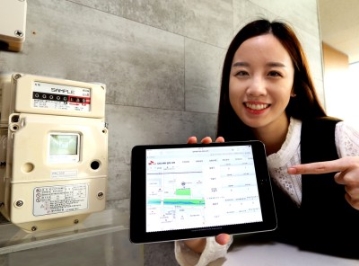
As IoT dedicated networks specialized for Internet of small Things (IoST) are being rapidly built, related IoT services are expanding accordingly. Internet of small Things (IoST) is a transmission technology characterized by low cost, low power consumption, and low capacity, capable of operating on batteries alone without requiring small data transfers and constant power supply. This is because not all things exchanging data through the internet necessarily require expensive ultra-high-speed networks. Accordingly, major domestic telecommunications providers are expanding their IoST network construction and successively launching IoT services based on these networks. IoT dedicated networks specialized for IoST initially highlighted LTE-M technology utilizing existing networks, but low-power long-distance communication technology (LPWA) for the IoT field is also gaining attention. LPWA technologies such as LoRa, NB-IoT, and SigFox are competing in this space.
2016.06.21by 신윤오 기자
SK Telecom Shares LoRa Commercialization and Service Development Know-how with Global Companies
SK Telecom will host the 6th LoRa Alliance Global Conference for the first time in Asia at the Sheraton Seoul Palace Gangnam Hotel over three days (October 11-13). Under the theme "Enabling Things To Have A Global Voice (Things Connected Globally through LoRa)," the conference will feature main sessions showcasing SK Telecom's LoRa network commercialization status across the nation as of late June, as well as the development progress of products and services. Korea's advanced IoT technology capabilities will be presented to member companies worldwide.
2016.10.12by 신윤오 기자
First service utilizing LoRa IoT dedicated network launched
SK Telecom has unveiled services utilizing its LoRa network, a dedicated IoT network that is uniquely constructed and operated as a nationwide network in Korea. SK Telecom has launched 'Gper,' a LoRa-based location tracking terminal, through Sparco, a positioning service startup. The company announced that the product has received strong response from both B2B markets such as daycare centers and individual consumers, nearly exhausting the first production batch of 2,000 units, and plans to move forward with second-round production.
2016.11.07by 김수지 기자
Korea Instrument, KOLAS Accredited Calibration Agency First to Simultaneously Acquire ISO/IEC 27,001·27,701
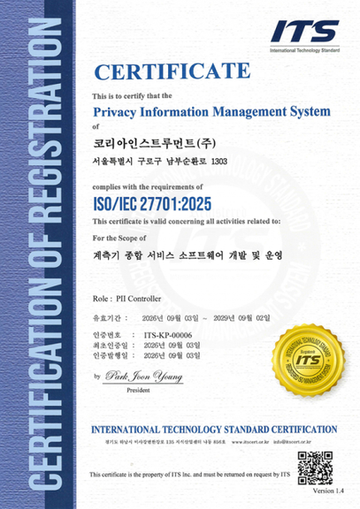
Korea Instrument has become the first among KOLAS accredited calibration agencies to simultaneously acquire ISO/IEC 27,001 and ISO/IEC 27,701 certifications. Through its proprietary platforms CWIZ Enterprise and CWIZ Partners, the company has embedded information security and personal data protection requirements across all business processes including customer information, equipment data, and calibration reports, with plans to continuously advance its management system through regular audits and security inspections.
2026.10.12by 배종인 기자
TeamViewer One, IT Incident Automation Workflow and Resolution Center Enhanced
TeamViewer has added IT incident automation capabilities and an advanced Resolution Center to its integrated digital workplace management platform 'TeamViewer ONE'. Recurrent service disruptions, configuration errors, and capacity shortages are automatically handled according to preset policies, and device status verification through script deployment can be managed in a unified interface, significantly reducing repetitive tasks for IT teams.
2026.10.12by 배종인 기자











