


[Reporter's Notebook] How Telecom Companies Approach the Industrial IoT Market
 Published2016.11.28 16:40
In fact, it is easy to overlook the fact that the industrial market in the Internet of Things (IoT) is several times larger than the home market we are familiar with.
This is likely why market research firms predict that the industrial IoT market will open up faster and on a larger scale. The industrial IoT market also occupies an important position in concepts such as Industry 4.0 and smart factories, which have recently been sweeping through the industrial sector.
Accordingly, global companies such as GE, Schneider, Emerson Process Management, and Honeywell, which have played a leading role in the industrial automation solution market, are preparing for Industry 4.0 by launching industrial IoT platforms.
Industrial IoT is used as a term to describe a situation where a single piece of equipment interacts and communicates with other equipment, objects, environments, and infrastructure. Such communication has generated a massive amount of data, and this data must undergo processing and analysis to produce meaningful results that can be reflected in management and control in order to contribute to efficient production activities.
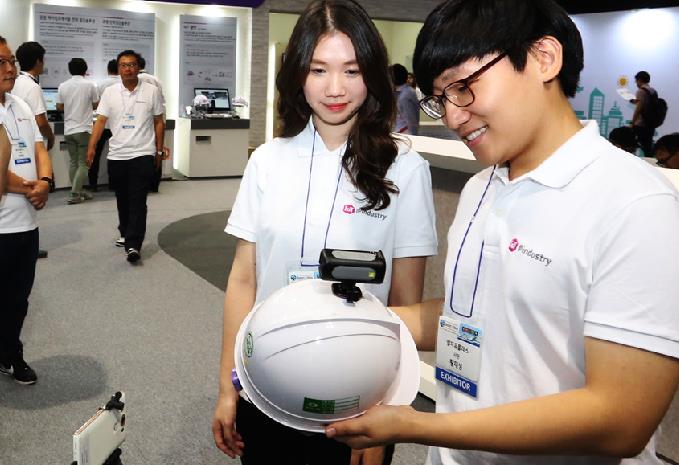
LG Uplus showcased a wide range of industrial IoT services at the 'Smart City Innovation Summit Asia 2016 (SCISA 2016)' held at KINTEX last September.
So, how are domestic telecommunications companies, currently engaged in fierce competition in the IoT industry, responding to the industrial Internet of Things market?
As mentioned earlier, global SI companies that hold a tight grip on the industrial infrastructure sector are also leading the industrial IoT market. This means there are clearly limitations to telecommunications companies penetrating this core market. In other words, the barriers are bound to be much higher than in the home sector.
First, telecommunications companies are taking different paths regarding communication methods. KT and LG Uplus have announced that they will lead the Internet of Things market centered on NB-IoT (NarrowBand-Internet of Things) technology. Based on high stability, the strategy is to utilize it in various ways, not only for Smart Cities such as smart streetlights and smart metering, but also in IoT fields for safety and environmental industries, such as detecting building anomalies and measuring fine dust.
These companies have identified utility sectors, such as remote metering, as the first projects to pursue through the construction of NB-IoT networks, and in the industrial IoT sector, they intend to approach it through logistics management such as cargo tracking, environmental management such as hazardous gas monitoring, and production efficiency improvements such as monitoring key facilities by building dedicated NB-IoT networks for enterprises.
Considering the characteristics of the IoT industry, where data volumes and speeds vary widely, SK Telecom has commercialized a LoRa network nationwide separately from its LTE and LTE-M networks and is operating a hybrid IoT network. This means utilizing the optimal wireless network according to communication frequency, capacity, and purpose, such as using the LoRa network, which is a dedicated IoT network, for services that intermittently exchange small amounts of data, the LTE-M network for areas requiring real-time control, and the LTE network for areas requiring video, such as CCTVs.
Let's take a closer look at LG Uplus's industrial IoT business. The company's strategy is to build a dedicated LTE network for corporate customers, thereby guaranteeing coverage compared to existing wireless networks such as Wi-Fi and strengthening data security. In short, with a strategy focused on security and safety, the company offers six major services. First, industrial live cameras allow users to monitor whether work is being done properly; smartphone walkie-talkies replace traditional, heavy, and unreliable walkie-talkies; and site access management provides services for managing hazardous areas. In addition, it enables the control of wireless remote equipment through measurement monitoring, the prevention of accidents within the factory through safe vehicle operation, and efficient logistics management through smart vehicle control.
SK Telecom also provides an integrated building management solution that utilizes sensors and tags to manage worker safety and facilities at manufacturing and construction sites, and announced its 'Smart Construction Solution' last October. Based on the IoT network and the IoT platform ThingPlug, this solution enables immediate response in the event of an accident by installing intelligent CCTVs, gas sensors, vibration sensors, and fire detection sensors on structures at construction sites. By having workers wear access cards or wristband-type smart tags to communicate organically with their surroundings, it allows for the integrated real-time management of various safety information, thereby reducing accidents. It appears that this solution can be directly applied to general manufacturing sites as well.
As such, telecommunications companies are concentrating their capabilities on industrial safety and security based on dedicated IoT networks. We should closely monitor the moves of these carriers as they expand their market share across various IoT sectors.
Comments
Related news
e4ds Regular Seminar and Industrial Internet of Things (IIoT) Innovation Day Successfully Held
This seminar, hosted by COEX and held in conjunction with the International Smart Factory Automation Exhibition (Automation World 2016), focuses on disseminating Industrial Internet of Things technology to the industry by providing the latest information in the Industrial IoT field spanning from semiconductors to communications, platforms, software, testing, and security.
2016.03.14by 명세환 기자
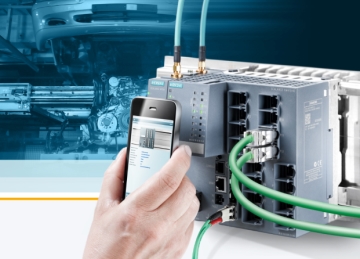
Smart factories become even smarter as ‘industrial Ethernet’ spreads rapidly
As smart factories have become a major issue following manufacturing innovation, interest in industrial network technologies has been growing. Regarding industrial network technology, industrial Ethernet is currently expanding rapidly in wired communication, while in the wireless communication field, technology based on 802.11 is mainly being utilized for monitoring purposes rather than control applications. First, in industrial wired communication, industrial Ethernet technology that takes into account the strengths of both existing Fieldbus and general Ethernet is spreading. Fieldbus is an industrial communication technology widely used because of its advantages in wiring convenience and small data processing capability, and above all, it is a proven technology in terms of cost competitiveness. However, it has drawbacks including insufficient communication media and compatibility, inability to respond to increasing application requirements, speed limitations (12~16Mbps), and weak implementation of redundancy functions.
2016.06.21by 신윤오 기자
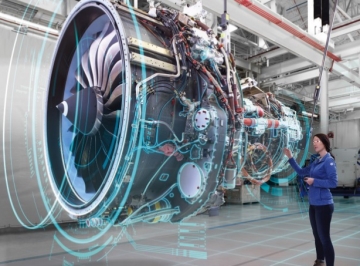
Korean-style Smart Factories to Drastically Transform Small and Medium-sized Manufacturing SMEs
The concept of Korean-style smart factories has been established as a form that integrates digitalization with IoT and CPS (cyber-physical systems)-based automation, and the outline of eight smart manufacturing technologies has also emerged. The public-private joint smart factory promotion team (headed by Park Jin-woo) has defined Korean-style smart factories as factories that integrate the entire process including planning, design, production, and distribution/sales—focused on innovation in small and medium-sized manufacturing—through ICT to produce customer-customized products with minimum cost and time. The core technologies of smart factories, which can be implemented in various forms depending on the degree of IT technology utilization and capabilities, are ▲smart application systems ▲scientific product and process technology design and development ▲intelligent control automation ▲IoT digital measurement and display ▲IoT-based smart construction method development, and others. The foundational technologies comprise ICT-based solutions including security, cloud services, and platforms.
2016.08.02by 신윤오 기자
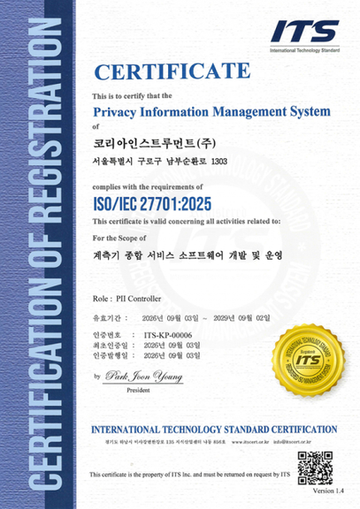
Korea Instrument, KOLAS Accredited Calibration Agency First to Simultaneously Acquire ISO/IEC 27,001·27,701
Korea Instrument has become the first among KOLAS accredited calibration agencies to simultaneously acquire ISO/IEC 27,001 and ISO/IEC 27,701 certifications. Through its proprietary platforms CWIZ Enterprise and CWIZ Partners, the company has embedded information security and personal data protection requirements across all business processes including customer information, equipment data, and calibration reports, with plans to continuously advance its management system through regular audits and security inspections.
2026.10.12by 배종인 기자
TeamViewer One, IT Incident Automation Workflow and Resolution Center Enhanced
TeamViewer has added IT incident automation capabilities and an advanced Resolution Center to its integrated digital workplace management platform 'TeamViewer ONE'. Recurrent service disruptions, configuration errors, and capacity shortages are automatically handled according to preset policies, and device status verification through script deployment can be managed in a unified interface, significantly reducing repetitive tasks for IT teams.
2026.10.12by 배종인 기자











