



Future products and services found in smart car, drone, and robot patents
 Published2016.12.19 15:21
Outlook for Promising Future Products Based on Patent Registrations in Various Countries Over the Past 5 Years
An analysis of patent application trends in representative future convergence industries, such as smart cars, drones, and robots, has revealed the outlines of products and services that are expected to emerge as promising in the future.
Smart cars, which refer to vehicles that are always connected to a network by integrating automotive and IT technologies, are characterized by products and services that contribute to user safety and convenience through enhanced connectivity between the interior and exterior of the vehicle. These include autonomous driving systems, Human Machine Interface (HMI) systems, sensing, accident prevention, and avoidance systems, and driver assistance and passenger support systems.
As the smart car market is a representative convergence-centered technology, joint development between industries is important. Starting with Audi in 2017, numerous automotive companies are planning to launch smart cars (autonomous vehicles) around the 2020s, and Samsung Electronics has secured comprehensive automotive electronics component solutions by recently acquiring the automotive electronics company Harman.
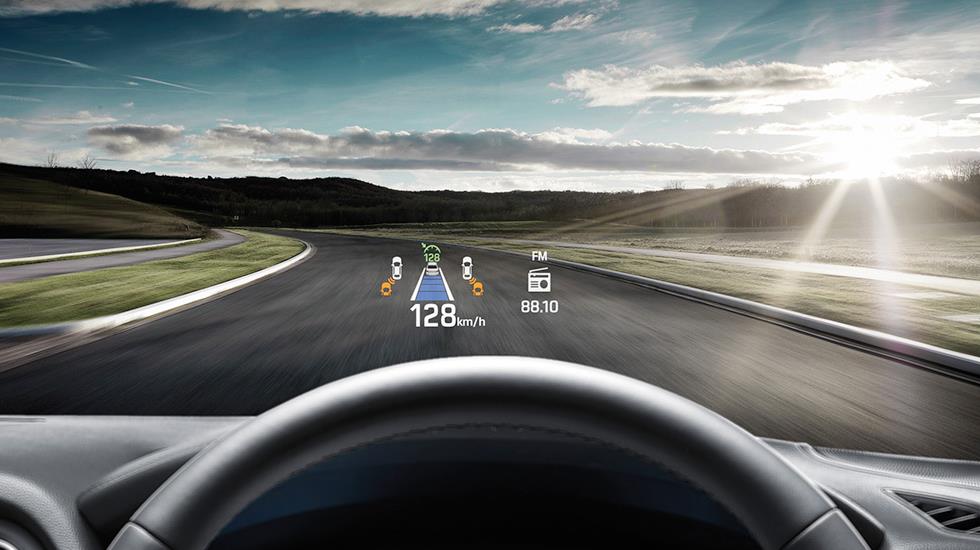
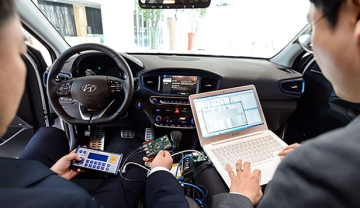
▲ Hyundai Motor Head-Up Display
According to the Korea Institute of Intellectual Property Strategy (KISTA), the country with the highest number of patents in the sensing field (total 5,948) was the smart car patent analysis (1995–present). Among these, the United States ranked first with 2,497 patents, followed by Japan (2,199 patents), Europe (661 patents), and Korea (591 patents). When comparing the patent share by applicant nationality and the share by sub-technology, Japan showed the highest share (39.6%), while Korea ranked fourth (18.9%), particularly leading in electrical and electronic architecture patents (33.5%).
In terms of market share by specific technology among major applicants, Toyota, Denso, and Honda focus on the sensing field, Nissan is strong in the driver assistance field, and Hyundai Motor Company focuses on damage mitigation, HMI, and driver assistance fields. Amidst this, the importance of HUD (Head-Up Display) technology is expected to increase as drivers require more information due to the advancement of smart cars.
Smart cars will be commercialized as information delivery tools with high safety and convenience.
Looking at the patent application trends of major applicants in the HUD field, Denso registered a patent for a 'Head Enhancement Display Device' technology in 2012 that prevents the blurring of a false image by controlling the diffraction width of a light beam through the surface of an optical element part in the screen part, and in 2013, registered a 'Head Enhancement Display Device' technology that suppresses the staining of light intensity projected onto the screen part and allows for a clearer image to be seen.
In 2012, following the technology regarding a method and device for providing augmented reality, Hyundai Motor Company registered a patent for a 'lane change information display device and method using a head-up display,' and in 2013, registered a patent for a head-up display device and method that can provide information to the driver by changing the position according to the distance of obstacles in front of the vehicle.
In response, KISTA PM Lee In-hee stated, “As current smart car head-up display technology is registered with patents focused on improving visibility and driver assistance/safety, there is a high possibility that it will be commercialized in the future as an information delivery tool with high safety and convenience.”
Drones have many patented technologies for information transmission displays and ground information management.
The unmanned aircraft industry, known as UAV (Unmanned Aerial Vehicle), UA (Unmanned Aircraft), or drone, is also growing. The global unmanned aerial vehicle market, which was valued at $5.2 billion in 2010, is expected to see its development budget alone increase to $21 billion by 2019.
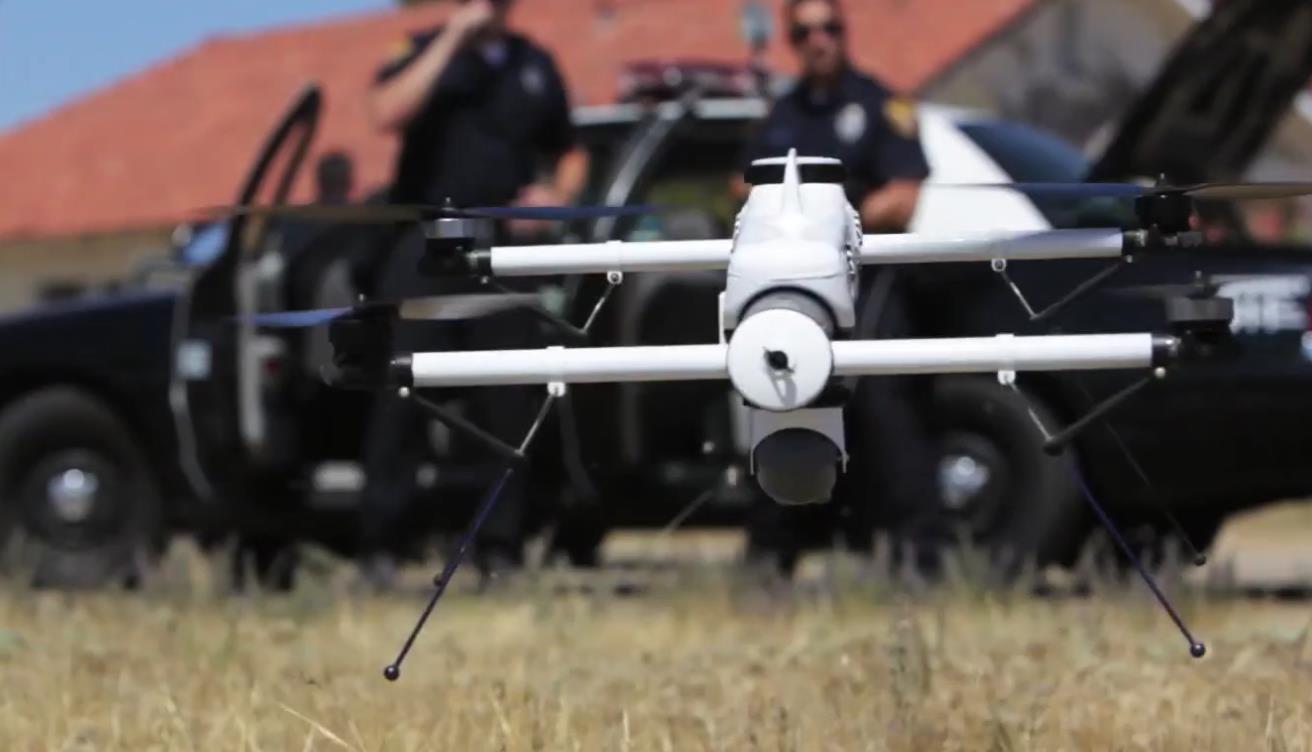
▲ AERO VIRONMENT Drone (YouTube screen)
Drones, evolving into practical robots, are breaking away from conventional frameworks and developing into future-oriented forms, such as carrying passengers and operating as unmanned systems. For instance, as they continue to evolve to become integrated into daily life through applications like police work and urban patrols, they are expected to be applied to various fields including photography/hobbies, precision agriculture, infrastructure management, parcel delivery, and cargo transport.
Looking at the number of UAV patents by country (from 1995 to recent filings), patents related to ground control and control systems accounted for the largest share (1,110 cases). This was followed by the United States (595 cases), followed by Korea (182 cases), Japan (182 cases), and Europe (151 cases). The patent share by applicant nationality was occupied by the United States (47.4%), Korea (17%), Japan (12.1%), and others.
Looking at the company's patent cases, Boeing, which currently possesses technology that measures location using multiple cameras and determines surrogate commands, is highly likely to release a survey drone product in one to two years that can control the drone to measure the diameter of a tree or obtain information and verify location using a sensor system, and in three to four years, introduce a product that enables real-time detection of objects by calculating continuous images.
Accordingly, the current autonomous flight system is expected to enable various drone services in the future through the convergence of technologies, based on information transmission display technology and patented ground information management technology.
Intelligent robots evolve into humanoid robots fused with artificial intelligence
"Intelligent robots," possessing autonomy based on perception, judgment, and movement, represent a convergence field within the living room that coexists in our living spaces. As the service robot market expands, the commercialization of intelligent robots is accelerating.
SoftBank’s Pepper, a leader in the intelligent robot market, was the first humanoid robot targeting the consumer market and signaled the opening of the era of cloud-connected robot assistants. Pepper, which went on sale in June 2015, can recognize and simulate human emotions thanks to its built-in 'emotion engine'. Recently, this robot, which works in home appliance stores and acts as a companion for elderly people living alone, is also working to enhance Pepper's artificial intelligence in partnership with IBM and Microsoft.
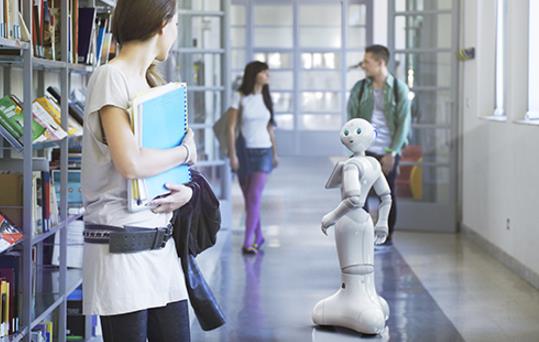
▲ SoftBank's Pepper homepage
Based on the number of patent applications for intelligent robots, the United States leads the market with 10,360 applications, accounting for 49% of the total. In terms of annual application trends, Korea has been filing the second-highest number of patent applications since 2009, following the United States, particularly driven by patents related to robot vacuum cleaners from Samsung Electronics and LG Electronics. Looking at the share by subcategory, the United States holds the highest share in personal robots (42.4%) and smart production systems (41.6%), while Japan holds the highest share in professional robots (31.3%).
Korea was found to have the smallest gap with leading countries in specialized robots (22.9%), while the gap was the widest in smart production systems (12.8%). An analysis of major applicants over the past five years revealed that Korea concentrated its patents on personal robots (such as cleaning robots from Samsung and LG), while in the specialized robot sector, Samsung Heavy Industries held the most patents related to inspection and maintenance robots. The United States showed strength in patents for smart production systems compared to other countries, while Japan demonstrated balanced development in both personal and specialized robots.
PM Lee In-hee predicted, “From a patent-based perspective, technology development is currently moving in the direction of improving the hardware and software levels of robots, while from a long-term future perspective, it is expected to evolve in the direction of enhancing robot autonomy through convergence with artificial intelligence.”
Comments
Related news
Running robot industry, crawling parts technology 'Localization rate less than 20%'
The domestic localization rate of components in the robotics sector, spurred by interest in artificial intelligence technology, has been below 50% according to statistics over the past three years, with major core components showing a localization rate of less than 20%. Robots are broadly categorized into industrial, professional service, and personal service robots. According to 2014 data, industrial robots accounted for 9.5B (64%), professional service robots for 3.6B (24%), and personal service robots for 1.7B (12%). The domestic component market for these robots reached a total sales volume of 396.2 billion won, representing 13.9% of total components; however, from an import perspective, 50.1% of components were found to be import-dependent. In other words, this means that half of the core components such as image sensors were imported and used. This aligns with the fact that there are not many domestic companies manufacturing core robot components, which are categorized into sensors, controllers, and actuators. When examining the technology level and localization rate for each component type, this situation becomes clearly evident.
2016.06.27by 신윤오 기자
Self-driving car patent applications are booming domestically, while overseas applications are plummeting.
According to the Korea Institute for Intellectual Property Strategy (KISTA), the leading autonomous vehicle countries—Japan, the United States, and Germany—hold an average of 41.8% of major market share, while Korea achieved only 7.9%. This is analyzed as being due to insufficient technology acquisition targeting overseas markets, given that Korea's autonomous vehicle development stage is still in its early phases. Overall patent applications related to autonomous vehicles have surged since 2002 as autonomous vehicle concept cars and R&D development plans have increased. Patent applications are primarily concentrated in the United States and Japan, with Japan focused mainly on a small number of completed vehicle manufacturers, while the United States showed diverse applicants including numerous component suppliers, internet companies, and completed vehicle manufacturers.
2016.09.05by 신윤오 기자
Autonomous vehicles, drones, healthcare... Ultimately, the key lies in the development of "smart sensors." Where are we now?
As emerging strategic industries such as future automobiles, healthcare, smart factories, robots, and drones have become hot issues, the importance of so-called 'smart sensors' is growing day by day. Smart sensors are sensors that have been given intelligence, referring to intelligent advanced sensors in the IT convergence era. As the types of sensors and their application objects have increased, the role of sensor hubs that can control sensors and collect data at low power consumption has also become increasingly important.
2016.10.10by 신윤오 기자

[e4ds Tech Day 2026 ⑨] Sim Sang-gyu, Autocrypt CTO: "In the Physical AI Era, Automotive Security Must Extend Beyond the Vehicle"
At e4ds Tech Day 2026, Sim Sang-gyu, CTO of Autocrypt, explained automotive cybersecurity strategies in the era of Physical AI and SDV (Software-Defined Vehicle). Automobiles are evolving as part of an ecosystem connected to AI, cloud, chargers, IoT, and robots, and he emphasized that the scope of security must expand beyond the vehicle interior to the entire connected environment. In particular, AI model tampering, adversarial attacks, OTA updates, and EV charger hacking were identified as major threats. He explained that response measures require zero trust, AI model integrity protection, intrusion detection, Security by Design and Default, and full lifecycle security management, and that proactive security system establishment beyond regulatory compliance is critical for securing future mobility competitiveness.
2026.10.12by 배종인 기자

Practical HIL Construction Strategy for Automotive and Off-Highway Controller Validation
As vehicle E/E architecture transitions to zonal structures and shifts to software-defined vehicles (SDV), the number of controllers (ECUs) requiring validation and software complexity are surging dramatically. Meanwhile, real vehicle testing cannot provide repeated verification under identical conditions and entails lead time and safety concerns. This white paper explains the principles of HIL (Hardware-in-the-Loop) validation and the structure of the NI platform composed of PXI, SLSC, and VeriStand, and through two actual implementation cases—Camera Record & Replay HIL for In-Cabin Monitoring Controller (ICMU) and Forklift Controller (VCU) HILS—describes how controller-level regression testing becomes possible. Additionally, it explicitly states application boundaries and limitations, such as lack of A2B support.
2026.10.12by 편집부











