



Why does Ethernet have to consume so much power?
 Published2017.02.03 13:42
“Why does Ethernet consume so much power?” is a question many people wonder about.
The rated active power of a 10/100Mbps Ethernet physical layer (PHY) transceiver ranges from 110mW to over 300mW, while a 10/100/1000Mbps Gigabit Ethernet PHY consumes 450mW to over 1,000mW of power. Often, the Ethernet PHY is one of the single most power-consuming components on a board and is a critical factor in evaluating the thermal budget of a closed system. There are various low-power modes that can be applied to Ethernet to reduce overall system power.
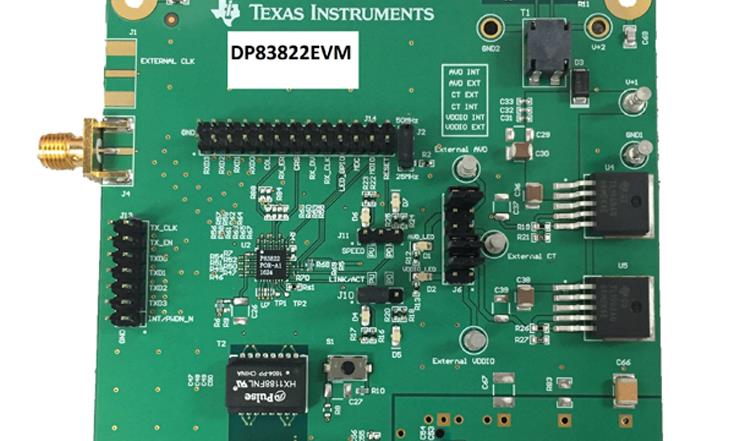
Then, is it possible to keep the system temperature low and reduce power costs? Let's take a look at two representative power saving techniques.
Energy Efficient Ethernet (EEE)
Energy-efficient Ethernet (EEE), defined in IEEE 802.3az, is a PHY and MAC (media access control) standard that eliminates standby signaling when channel usage is low. As shown in Figure 1, EEE implements a low-power mode in which the transmitter is disabled during 'quiet' times when there is no data to transmit, except for short refresh intervals. In this way, power is saved by eliminating the unnecessary continuous transmission of standby symbols through active links during quiet periods. The refresh interval ensures that the existence and timing of links within the PHY and between them remain valid.
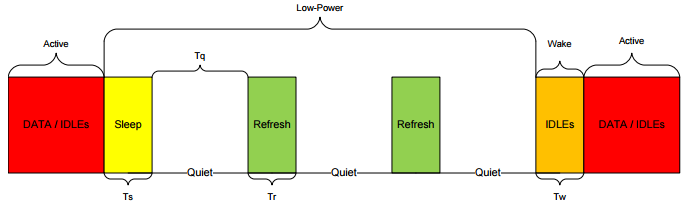
Figure 1. EEE state flow
If there is data to transmit, the MAC signal to the PHY terminates the EEE state, making the EEE mode transparent to the upper layers. The PHY exits low-power mode and transmits a standby state code group to call the far-end device out of low-power mode. More details about EEE can be found in the application note “DP83822 Energy Efficient Ethernet IEEE 802.3az”.
Wake on Land (WoL)
Wake-on-LAN (WoL) saves power by keeping the Ethernet PHY active but selectively lowering the power of the system's backend elements (processors, microcontrollers, ASICs, or other components). These backend elements become active when the Ethernet PHY receives a specific 'magic' packet.
WoL is a technique that can reduce overall system power while keeping Ethernet transceivers active when the system has a properly defined signal commanding operation. Various methods for implementing WoL can be found in the application note “DP83822 Wake-On-LAN”. Figure 2 shows a magic pattern structure in which the Ethernet PHY monitors incoming packets before sending a drive signal.
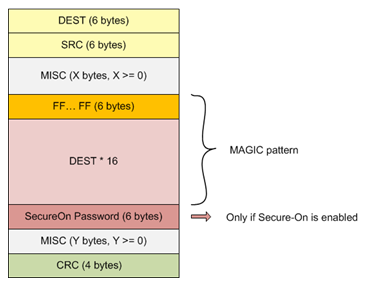
Figure 2. WoL Magic Packet Example
So far, we have looked at two methods to save power using the Ethernet PHY. Consider which method you plan to implement in your system. You can share your thoughts with engineers at the TI E2E™ Community Ethernet Forum.
Comments
Related news
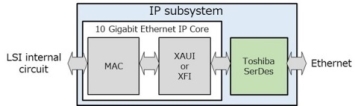
Toshiba Announces 10 Gigabit Ethernet IP Subsystem for Custom LSI Platforms
Toshiba Corporation's semiconductor and storage products company announced that it is providing an IP subsystem jointly developed with MoreThanIP, an advanced communication solutions provider. The solution comprises a 10-gigabit Ethernet MAC (media access controller), PCS (physical coding sublayer), and high-speed SerDes (Serializer Deserializer) on a custom LSI platform including ASIC and FFSA™.
2016.03.24by 명세환 기자

Smart factories become even smarter as ‘industrial Ethernet’ spreads rapidly
As smart factories have become a major issue following manufacturing innovation, interest in industrial network technologies has been growing. Regarding industrial network technology, industrial Ethernet is currently expanding rapidly in wired communication, while in the wireless communication field, technology based on 802.11 is mainly being utilized for monitoring purposes rather than control applications. First, in industrial wired communication, industrial Ethernet technology that takes into account the strengths of both existing Fieldbus and general Ethernet is spreading. Fieldbus is an industrial communication technology widely used because of its advantages in wiring convenience and small data processing capability, and above all, it is a proven technology in terms of cost competitiveness. However, it has drawbacks including insufficient communication media and compatibility, inability to respond to increasing application requirements, speed limitations (12~16Mbps), and weak implementation of redundancy functions.
2016.06.21by 신윤오 기자

Fairchild Strengthens MOSFET Technology for Ethernet Power Supply-Based IoT Products
Fairchild has advanced its GreenBridge™ Active Bridge Quad MOSFET technology with the FDMQ8205, the first product in the next-generation GreenBridge series for various power delivery devices (PD) powered over Ethernet (POE), including security cameras, wireless access points, LED lighting, and other applications. Designers can now leverage GreenBridge's best-in-class Rdson performance, ultra-compact form factor, and excellent thermal characteristics to reduce temperature and increase efficiency while reducing solution size.
2016.07.26by 신윤오 기자

Intel Unveils Next-Generation 'Core Ultra Series 3' and vPro Platform for Enterprise PCs
Intel has officially unveiled the "Intel Core Ultra Series 3" for next-generation enterprise PCs and the latest vPro platform, addressing a wide range of demands from enterprise notebooks to high-performance workstations.
2026.03.26by 배종인 기자

ROHM Launches ESD Protection Diode Compatible with High-Speed Interfaces of 10Gbps or Higher
Semiconductor specialist ROHM has developed the 'RESDxVx series' of ESD (electrostatic discharge) protection diodes capable of responding to next-generation high-speed data communication environments exceeding 10Gbps, simultaneously enhancing both signal quality maintenance required in high-speed interfaces and IC protection performance.
2026.03.26by 배종인 기자











