


3 Elements for Sustainable and Successful IoT
 Published2017.02.14 12:32
<Text: Infineon Technologies>
The Internet of Things (IoT) is emerging as the most important technology today. IoT will bring about a fundamental change in the way businesses and consumers interact with each other and with surrounding infrastructure. By using IoT, it has become possible to connect the physical world with the virtual world in ways that were previously impossible. Following this trend, embedded electronic systems, software, and sensors are being installed in all forms of physical “things,” ranging from places like people and cars to computers, home appliances, and machinery on production sites.
As a result, a completely new dimension of connectivity and intelligence has opened up, bringing about fundamental changes both socially and economically. By using IoT, defects can be predicted on production sites long before they occur, operational safety and convenience can be enhanced, and energy consumption in homes and offices can be significantly reduced. Innovative business models that enhance corporate competitiveness and enable new consumer experiences are emerging one after another across various market sectors.
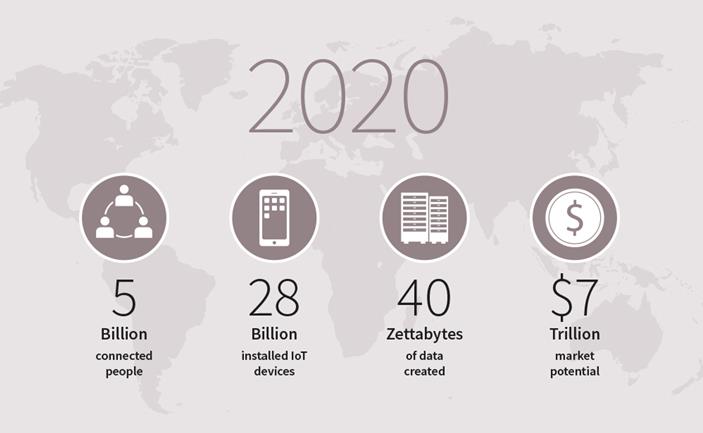
According to the UN/ITU Broadband Commission, 5 billion people will be connected to the Internet by 2020. Additionally, according to research by IDC (International Data Corporation), the installed base of IoT units and systems is expected to reach 28.1 billion by 2020, growing at a CAGR of 17.5%. Furthermore, the volume of data generated annually is projected to reach 40 zettabytes in 2020. Moreover, the global market size for IoT solutions is expected to grow at a CAGR of 20%, increasing from $1.9 trillion in 2013 to $7.1 trillion in 2020.
Business models that realize true customer value are needed for each industry sector
We are now witnessing the IoT becoming a reality. Every day, more objects are being connected via IoT, and companies are racing to release innovative IoT applications. However, IoT is still in a relatively early stage, and its true economic value has not yet been realized. To achieve sustainable success with IoT, business models that deliver genuine customer value are required across various industries.
To achieve this, a business model is required that is realistic, user-friendly, and delivers reliable performance and security. From a technical perspective, any IoT business model is based on the intelligent collection and interpretation of data. At the device level, intelligent objects are equipped with sensors, processors, security, and actuators to collect, analyze, structure, store, and take necessary actions on data. At the cloud level, information received from intelligent individual objects is aggregated. A series of applications are used to process the information according to its intended purpose.
For a technically successful IoT, the following three elements are required:
1. Intelligent, secure, and power-efficient device
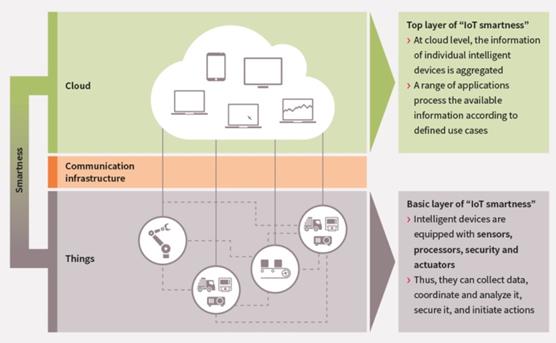
For a sustainable and successful IoT, “things” connected to the Internet must be made intelligent, secure, and power-efficient. Intelligent “things” provide necessary data and can take appropriate action regarding data received from internal and external sources. Furthermore, security is crucial for building trust for both businesses and consumers. By achieving security, systems can be protected from security attacks, and issues such as defects or data integrity degradation can be addressed, thereby safeguarding business models from significant financial losses.
Device protection, prevention of tampering and unauthorized manipulation, and protection of data and device integrity are all critical security issues. Furthermore, power efficiency is another important requirement to keep objects awake, interact with each other, and respond sensitively, because providing such “always-on” connectivity consumes significant power. To provide such a wide range of device connectivity, the necessary power must be produced, managed, and supplied in the most energy-efficient manner possible, and the performance of all networked devices must be optimized.
2. Quality at the level of individual elements
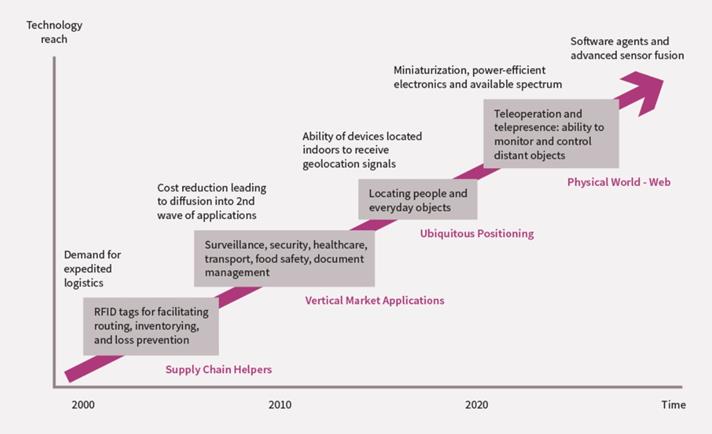
For IoT, integration is a paramount issue. By integrating hardware and software elements, intelligent, secure, and power-efficient devices can be realized. Through communication interfaces, integration can be extended beyond this. The quality of individual elements directly impacts the quality of the IoT solution in terms of ease of use, reliable performance, and security.
3. Seamless interaction along the entire IoT value chain
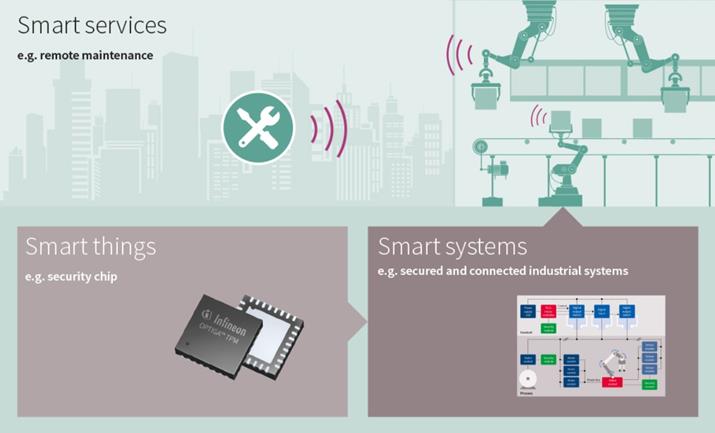
From a technical perspective, the third element for sustainable and successful IoT is enabling seamless interaction across all three dimensions of the IoT value chain. These three dimensions are intelligent things, intelligent systems, and intelligent services.
For example, in a smart factory environment (“Industry 4.0”), production and distribution systems can be automated by deploying smart devices such as RFID tags, PLCs, sensors, intelligent high-power modules, and industrial microcontrollers. The use of these systems has enabled a new level of intelligent services, such as machinery monitoring and maintaining itself, seamlessly tracking items, achieving just-in-time production, optimizing performance, and minimizing power consumption.
Semiconductors that play a pivotal role in IoT
IoT is not a standalone new market. Rather, it is a trend expected to bring fundamental changes to existing markets and business models. Based on an understanding of the whole system, Infineon helps customers transition digitally and further enhance their competitiveness. By using Infineon's semiconductors, intelligent, secure, and power-efficient IoT can be achieved.
Achieving IoT with superior intelligence, security, and power efficiency
Infineon possesses accumulated expertise in the field of IoT. Long before the term "IoT" emerged, Infineon conceived, developed, and brought IoT to reality. Many things that can be classified as "IoT" today—including industrial automation and robotics, electric and connected cars, smart homes, energy intelligence, and big data ICT infrastructure—were made possible using Infineon's technology.
Today, Infineon's semiconductors play a pivotal role in the IoT ecosystem. Sensors convert electronic impulses into data, actuators convert data into electronic impulses, microcontrollers control the entire system, security solutions protect device and data integrity, and smart power ICs manage the production, distribution, and consumption of energy.
How are Infineon products being used in major IoT applications?
smart cars
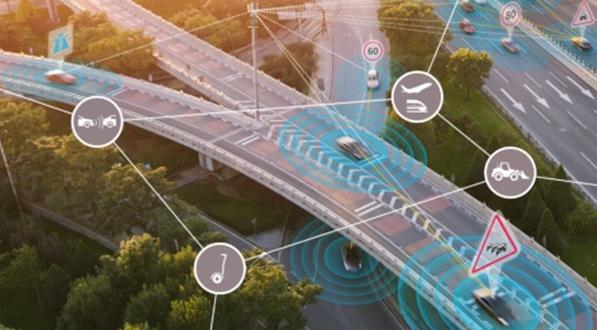
Today, hundreds of electronic control units and semiconductors are already being used in many cars. Semiconductor products such as microcontrollers, radar sensors, authentication devices, and power switches are used in various solutions to enhance the driving experience, including V2X communication, data integrity, and driver assistance for (semi)autonomous driving.
In addition, using semiconductors enables enhanced services such as paid usage, software-over-the-air (SOTA) maintenance, and advanced infotainment.
These sophisticated services are rapidly being used not only in passenger cars but also in commercial, agricultural, and construction vehicles (CAVs), ships, aircraft, trains, and two-wheeled vehicles such as scooters and electric bicycles.
Infineon, a leader in automotive semiconductors and automotive security and the world's number one company in power semiconductors and radar sensors, provides the technology and application know-how essential for making safer, more secure, and more efficient cars.
Advanced sensing technology
• Monitoring the vehicle's surroundings using radar sensors – based on this, advanced safety features (adaptive driving control, lane departure warning, collision avoidance, etc.) are enabled, thereby making autonomous driving possible.
• Motion control and driver monitoring using REAL3™ 3D image sensors
Application Control
• AURIX™ Microcontroller
• Achieves secure data transmission via automotive networks and meets stringent safety requirements
• Provides additional features such as enhanced Ethernet connectivity, real-time capabilities, and time synchronization, thereby achieving reliable telematics
Efficient power control
• The most efficient HEV powertrain solution using HybridPACK™ IGBT modules
Smart City and Energy
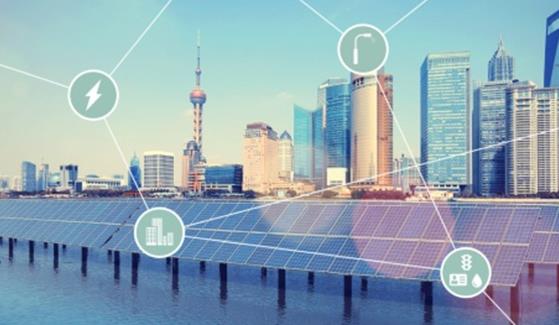
As urban populations continue to grow, government agencies are striving to make their megacities, infrastructure, and energy systems more intelligent, secure, and power-efficient. To achieve this, the use of embedded system intelligence and advanced ICT technologies is increasing. Infineon's semiconductors play a crucial role in enabling the achievement of these goals.
Examples of such solutions range from professional lighting systems using advanced LED technology to smart infrastructure and transportation systems utilizing environmental sensors and microcontrollers, as well as intelligent and secure smart building technologies.
Infineon also provides solutions for efficiently generating, storing, managing, and distributing energy. Infineon is trusted as a company that provides the essential technologies and application know-how to make cities more intelligent, eco-friendly, and livable.
Advanced sensing technology
• Motion detection using radar sensors enables extremely efficient lighting control (indoor and outdoor).
• Innovative voice-controlled IoT applications are possible by using silicon microphones.
Application Control
• Use XMC™ microcontrollers for control, communication, and sensor management in various building automation applications
Efficient power management
• Power ICs and modules
• Establish reliable and highly efficient energy infrastructure
• Building Energy Management and Building Automation
Trusted security
• Achieve secure communication and trusted computing with critical energy infrastructure by using OPTIGA™ products
• Secure electronic payment is possible during EV charging using chip card ICs.
• Secure connection via GSM, GPRS, EDGE, UMTS, and LTE is possible using an M2M SIM.
Smart Industry and Business
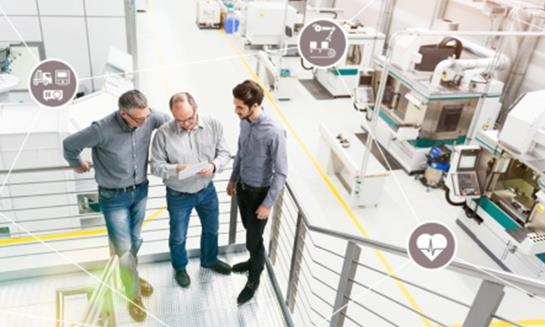
rulerSmart factories utilizing fairy tales and robots are likely the field that best demonstrates the utility of IoT. More intelligence is also being implemented in the mining industry, payment, logistics, and medical equipment. Microelectronics is the core technology that enables IoT in these fields.
Infineon's industrial sensors, microcontrollers, power modules, switches, and sector-specific security chips achieve outstanding responsiveness, optimal system control and integrity, and ultimately superior power efficiency in networked, extremely demanding manufacturing environments.
In addition, Infineon has accumulated extensive experience and expertise in the field of industrial automation to provide industrial-grade IoT semiconductor solutions and offers a variety of proven reference designs to enable the rapid development of simple, efficient, and reliable automation designs.
Many customers are already choosing Infineon as the company that can provide the technology and application know-how essential to realize Industry 4.0, known as the Fourth Industrial Revolution, and achieve sustainable success.
Advanced sensing technology
• Measures speed, position, angle, and pressure using Hall sensors and pressure sensors
Application Control
• Use XMC™ microcontrollers in factory automation applications
Smart Power Management
• Achieve high quality and reliability in creative IoT systems by using the intelligent power module MIPAQ™ Pro.
• CoolSIC™ power semiconductors based on silicon carbide technology achieve previously impossible efficiencies with superior power density and form factor, which are critical requirements for industrial IoT applications.
• Power ICs that achieve efficient power management with industrial controllers and smart robots
Trusted security
• Achieve IP protection, secure communication, authentication, and trusted computing for major industrial applications by using OPTIGA™ products
• Cellular wireless connectivity using M2M SIM
• Intelligent asset tracking (smart manufacturing) is possible using NFC tags
Smart Home and Consumer

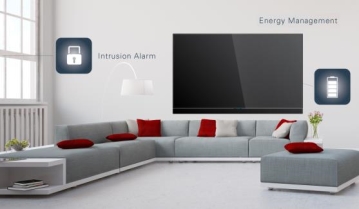
Smart consumer devices include a wide variety of items, ranging from smartphones, tablets, and PCs to new forms of intelligent consumer devices such as smartwatches, game consoles, and wearables. Smart homes have enabled an increasingly diverse range of intelligent functions, such as automation, in-home energy management, security and safety, and intelligent personal lighting.
Infineon's enhanced semiconductor solutions play a key role in providing connectivity to smart homes and devices. Infineon offers a comprehensive range of electronic components for smart home and consumer product manufacturers. By using these solutions, personal IoT can be made more intelligent, secure, and power-efficient. Infineon provides the essential technologies and application know-how to design smart homes, advanced home appliances, and next-generation consumer devices.
Advanced sensing technology
• Motion control is possible by using the REAL3™ 3D image sensor (Smart TV, etc.)
• Achieving a new level of accuracy in wearable and IoT devices by using barometric pressure sensors
Application Control
• By using XMC™ microcontrollers, control, communication, and sensor management are possible for various smart home applications, such as lighting.
Smart Power Management
• Power management IC for smart high-power density chargers
Trusted security
• Securely connect intelligent objects to a smart home environment by using OPTIGA™ Trust products
• Achieve secure communication, for example, for Home Energy Management Systems (HEMS) by using OPTIGA™ products
• Mobile payment service using an NFC security controller
Smart Information and Communication Technology (ICT)
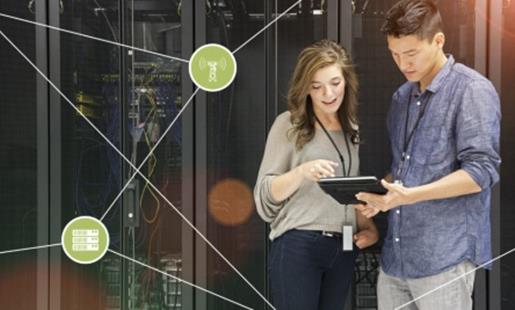
All IoT solutions and services are implemented on the foundation of smart ICT infrastructure. As IoT becomes increasingly widespread, meeting the explosive growth in data volume, higher transmission speeds, and increased data storage and processing demands has become a critical challenge for ICT operators.
Advanced ICT contributes to reducing overall exhaust emissions by enabling new eco-friendly solutions, such as smart cars, smart buildings, and smart factories. Infineon, a leader in smart ICT network technology and semiconductor solutions for servers and data centers, helps customers achieve their goals for energy efficiency, security, and reliability. Furthermore, having led and innovated in Trusted Computing, Infineon provides a variety of standards-based, certified security solutions for networking equipment such as routers and gateways.
In addition, Infineon, the No. 1 power semiconductor company, provides a comprehensive range of advanced power semiconductor products to achieve excellent PUE (power usage efficiency) and DCIE (data center infrastructure efficiency). It also provides RF power devices required for future communication networks.
Smart Power Management
• Power management IC for smart high-density chargers
• Achieve reliable UPS (uninterruptible power supply) and maximum efficiency by using IGBT power modules and drivers
Trusted security
• Use OPTIGA™ products as trust anchors for interaction between devices and networks
Other technologies that enable IoT
• Utilizing RF chipsets enables Gigabit wireless backhaul solutions, thereby laying the foundation for 5G

Comments
Related news

Korea Airports Corporation Adopts Infineon Security Solutions for Airport Access Control Systems
Airports around the world are places that require the highest level of security. Korea Airports Corporation (KAC) has introduced a new solution based on the CIPURSE™ security standard to strengthen its airport access control system for employees. Infineon Technologies (Korea CEO Lee Seung-soo) supplies security chips for electronic access control cards issued to airport employees. This new system is already in use at 3 of the 14 civilian airports operated by KAC, and is planned to be additionally deployed at other airports in the future.
2016.08.17by 신윤오 기자
Infineon Launches Surface Mount Radar Motion Detection Module Operating in 24GHz Band
Infineon Technologies (Korea CEO Lee Seung-soo) and InnoSenT announced the launch of a surface mountable radar (SMR) motion detection module operating in the 24GHz ISM band. InnoSenT's SMR series, which adopts Infineon's latest 24GHz transceiver MMIC, BGT24LTR11, provides an easy-to-implement radar solution achieving low power consumption and superior functionality.
2016.11.24by 신윤오 기자

Infineon Supports Global Standards for Electric Vehicles
Infineon is participating in CharIN (Charging Interface Initiative e.V.), an international electric vehicle charging association that supports global standardization of hybrid and electric vehicle charging infrastructure. CharIN's objective is to develop, establish, and promote global standards for charging systems for all types of battery-powered electric vehicles. It is composed of major automotive manufacturers as founding members.
2017.02.01by 김지혜 기자
Camera for Both Humans and Machines: ST BrightSense 5MP Dual Shutter Image Sensor
Video consumed by humans and imagery analyzed by machines impose different requirements on the sensor in terms of shutter method and wavelength band. Until now, sensors had to be separated or supplemented with companion chips and high-performance processors, and this cost and complexity became a bottleneck in vision system design. The ST BrightSense next-generation 5MP image sensor (VD5943, VD1943, VB5943, VB1943) with 2.25 µm pixels supports both global and rolling shutters, and through on-chip staggered HDR (up to 100 dB), on-chip RGB-IR separation and 5MP NIR smart upscaling, and frame-by-frame context switching, absorbs both requirements internally at the sensor level. This white paper describes the rationale, choices, trade-offs, and results of each design decision based on presentation slides and technical Q&A, and specifies application boundaries. The product is scheduled for mass production in February 2026, and evaluation and sampling are currently available.
2026.10.13by 편집부

AI-based Universal Robots Automation Solution
In manufacturing environments where declining labor populations overlap with frequent production item changes, existing programming-based robot automation requires reconfiguration from weeks to several months each time product models change. This white paper takes this flexibility gap as its starting point and synthesizes, based on webinar presentation materials and technical Q&A, what collaborative robots gain and forfeit compared to industrial robots, why process automation is transitioning from rule-based to learning-based (4th generation) approaches, and how Universal Robots' hardware, software, and partner ecosystem implement this. Additionally, it clarifies the application boundaries and limitations, including that AI Accelerator is still at the development kit stage.
2026.10.13by 편집부











