



Gil Hospital, which adopted Watson, says, “Humans have started to trust artificial intelligence.”
 Published2017.02.21 10:53
Patients Also Experience 'Cultural Shock' from Receiving Watson Treatment Reports
What if a patient chose IBM's AI Watson over a human doctor for diagnosis and prescription? One media outlet reported on this outcome as if it were a 'victory' for artificial intelligence.
In response, Lee Eon, Director of the AI-based Precision Medicine Promotion Team at Gachon University Gil Medical Center (Professor of Neurosurgery), emphasized, “While there may be some exaggeration, the important point is that people have developed trust in artificial intelligence, whether consciously or unconsciously. This is a very important signal,” adding, “The river that artificial intelligence must cross is gaining human trust. The fact that a patient changed their mind and decided to follow Watson’s treatment method is no ordinary event.”
Gachon University Gil Medical Center caused a sensation last December by introducing Watson and implementing it into actual medical practice. Prior to that, public interest in artificial intelligence (AI) had already risen in March due to the "Go match of the century" between AI (AlphaGo) and Lee Sedol. Director Ian emphasized once again that the fact that a patient receiving treatment at the hospital chose Watson's prescription was "a seemingly insignificant but important event."
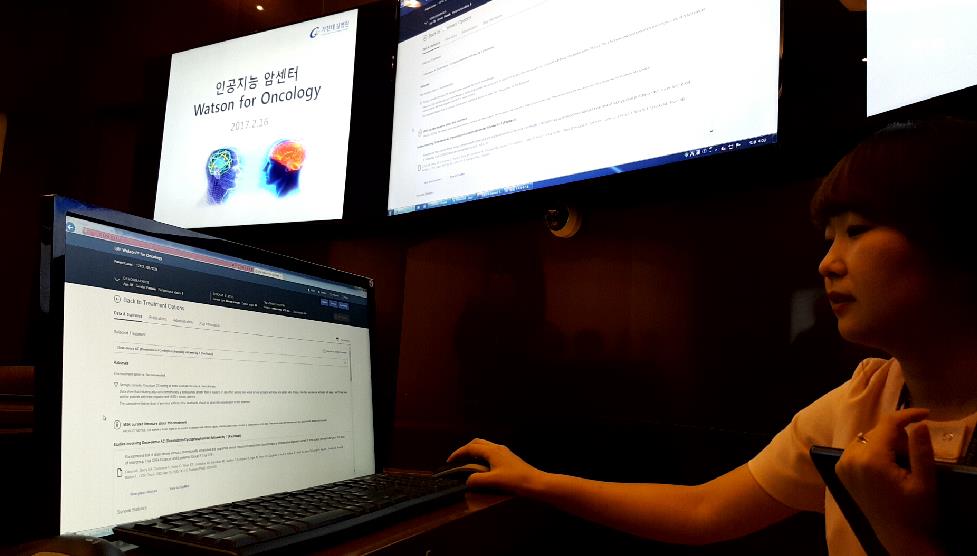
An official from Gachon University Gil Medical Center is inputting patient information into the AI-based Watson platform.
Of course, there are still limitations on patient choice regarding AI prescriptions. This applies only when the AI prescription chosen by the patient is not significantly different from the doctor's prescription, as in the case of Gil Medical Center. In other words, if the AI prescription is too absurd or differs significantly from the doctor's diagnosis, the final decision is made by the doctor. Doctors have the right to reject Watson's judgment, as the authority to choose the treatment method for the patient rests with the doctor.
Furthermore, patients are also experiencing a "cultural shock" distinct from the past as they encounter artificial intelligence. In the past, the process was one-way; doctors would simply recommend a treatment based on test results, and that was the end of it. Now, however, patients can receive reports from Watson. This has enabled two-way communication between doctors and patients regarding medical prescriptions. Another aspect of the AI era is the creation of an environment where doctors are compelled to conduct research more diligently.
Ian, Director of Gil Medical Center, assessed that they are seeing significant effects from artificial intelligence while experiencing 'important events and shocks' in the short period of less than three months since the introduction of Watson. Director Lee had to go through numerous twists and turns to introduce artificial intelligence that, despite its limited experience, has begun to earn human trust.
A doctor is not AlphaGo's Aja Huang, who places Go stones exactly as instructed.
IBM’s Watson, trained at the Memorial Sloan Kettering Cancer Center (MSKCC), presented its results at the 2014 American Association for Cancer Research, and upon seeing this, Dr. Ian decided to introduce it to the hospital. However, this was not merely a matter of adopting a diagnostic program. As Director Lee mentioned, it faced strong opposition from doctors, and above all, the key challenge was persuading the hospital’s top decision-maker.
“Money wasn’t the issue. Introducing artificial intelligence was a matter of ‘changing culture’ and ‘changing the rules of the game,’ so the resistance from doctors was tremendous. I had to convince the top decision-makers first, and since I needed to understand it myself to do so, I had to go to IBM after work to study on my own,” he recalled.
However, the process of persuading the public made rapid progress due to an unexpected event. It was the Go match between Lee Sedol and AlphaGo that significantly broadened the entire nation's understanding of artificial intelligence. This event served as a catalyst for the rapid introduction of Watson. Until then, most doctors had strong resistance to the idea of having to follow a computer's decisions when treating patients, and it is said that this barrier did not seem likely to be easily broken down. Behind this, there was also a sense of anxiety that doctors might lose their standing if the era of artificial intelligence arrived sooner than expected.
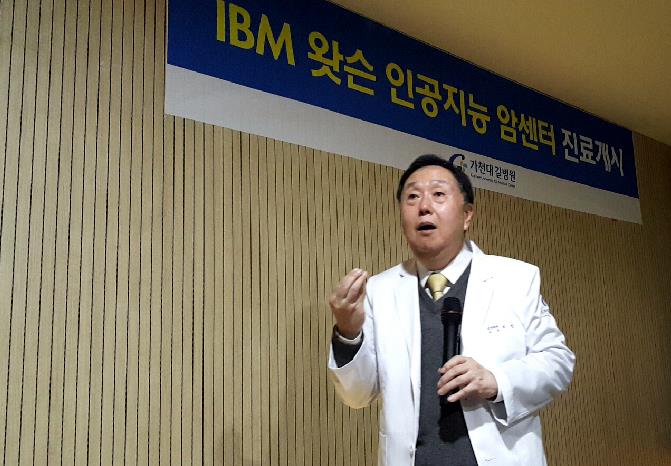
Lee Eon, Director of the AI-based Precision Medicine Promotion Team at Gachon University Gil Medical Center (Professor of Neurosurgery)
In response, Director Lee firmly states, "A doctor is by no means someone who places Go stones exactly as instructed, like AlphaGo's Dr. Aja Huang. A doctor can never be like that."
He states that one must first understand the era in which artificial intelligence like Watson has become necessary. He refers to a reality where data and medical knowledge are pouring out to the point where a single doctor can barely handle them. In an era advocating for precision medicine, diagnosis and treatment must be focused on the individual; however, he questions how one can make decisions by referencing such a vast amount of information in a time when consultations typically last only three minutes. Ultimately, Director Lee concluded that collaboration with artificial intelligence is inevitable.
“Not a competition between humans and machines, but a showdown between doctors using artificial intelligence and those who do not”
The point is to leave what humans can do well to humans, and what computers can do well to computers. It is about humans and computers collaborating to maximize human capabilities and handle the immense tasks of this world (processing information); it is not about humans and machines competing against each other. If there is a competition, it is a showdown between doctors who collaborate with and effectively manage artificial intelligence and those who do not.
Director Lee, who has been fighting against the stereotypes of traditional doctors, is now realizing yet another wall in the face of regulations and laws. To enable Watson to prescribe treatment, data such as the patient's personal details, biopsy results, surgery history, chemotherapy treatment, and the presence or absence of metastasis must be entered into the program one by one, and results are obtained through a connected IBM cloud server. The reason for entering data piece by piece rather than allowing the program to read the entire chart at once is due to current regulations. Since it is impossible to regulate everything from the start, the instruction is to input and send only the necessary data for now. Although regulations were slightly relaxed late last year, he says he has not yet received a response from the government regarding a method that would allow the cloud to read charts as they are.
Late last year, in order to improve the business environment, reduce costs, and strengthen the competitiveness of domestic cloud service providers, the government revised its previous stance that "prior consent for personal information is mandatory when storing customer personal information in overseas information systems" and announced that "if customer personal information is merely stored in overseas information systems, the procedure for prior consent may be omitted by notifying the privacy policy in advance through the company's website, etc." Nevertheless, regarding the government's atmosphere of loosening regulations in line with the recent trend of emphasizing the Fourth Industrial Revolution, Director Lee stated, "Things have improved a lot now," but added that there will be much to consider regarding the dilemma between personal information protection and the Fourth Industrial Revolution in the future.
We will create a Korean version of Watson based on Korean data
Gachon University Gil Medical Center, which is the first in Korea to provide medical services utilizing IBM’s artificial intelligence ‘Watson’, plans to expand its scope beyond cancer treatment to include hypertension, diabetes, and intractable neurological diseases, and actively participate in precision medicine and artificial intelligence, which are the nine key tasks of the government-led National Science and Technology Strategy Council.
Gil Medical Center, which plans to link big data and life cycle data held by the Health Insurance Review & Assessment Service and the National Health Insurance Service, envisions a Korean version of Watson based on accumulated Korean data in the future. Although it will need to be discussed with IBM, the plan is to separately develop an artificial intelligence that incorporates Korean data.
However, there is still a long way to go. The introduction of artificial intelligence does not mean that Gil Medical Center will immediately surpass the so-called "Big 4" hospitals in Seoul. There are also numerous challenges to overcome, such as addressing the prejudices and anxieties of the majority of doctors. Director Ian’s words regarding the reason for undertaking such difficult work are profound.
The goal is to provide the best information through the AI Watson. The importance of this can be seen by looking at our reality. In particular, regarding cancer, 70% of patients and 90% of medical expenses are concentrated in the "Big 4" hospitals. The polarization of healthcare is growing day by day. Even within the Big 4, there are doctors who attract a large number of patients. Considering that these doctors see hundreds of patients a day, one can only wonder how precise the medical care is truly being provided. We need a form of medical democratization. Through artificial intelligence, a high level of standardization must be achieved nationwide to reduce enormous unnecessary costs.
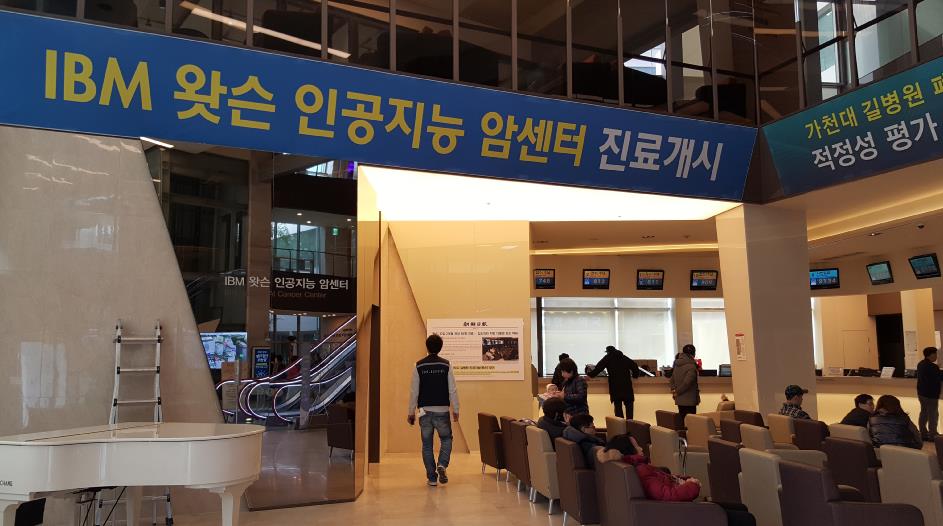
▣ Top 6 Frequently Asked Questions at Gil Hospital, Which Adopted Watson
Q1. What is the reason Gil Hospital introduced this before the so-called Big 4 hospitals?
To beat the so-called "Big 4" hospitals—large university hospitals boasting history and tradition, and hospitals branded by conglomerates—it is not simply a matter of seeing a large number of patients or spending a lot on advertising. The reason patients flock to specific hospitals lies in the trust built up over such a long period of time. This leads to many problems, so what is the solution? Unless we shake up the "board of the game," we cannot catch up. We are that desperate, whereas the Big 4 are not as desperate. It is crucial to establish the perception that we are a hospital that excels at treating cancer using artificial intelligence. I believe we have seized the opportunity well. Such an opportunity comes only once every few decades, and it has aligned perfectly with the current situation.
Q2 Was there any opposition to the introduction of Watson?
Needless to say, there was opposition. We debated fiercely. We even held a heated discussion in front of the top decision-maker. After many twists and turns, we finally decided to proceed. Doctors are also fully aware that the adoption of artificial intelligence is the trend of the times. While people generally agree in principle, there are ultimately many overlaps with their own interests. The vested interests, in particular, do not want the status quo to be shaken. Doctors' attitudes have changed since the introduction of AI. Perhaps due to being conscious of the AI, they prepare well for patient consultations. That in itself is beneficial for patients.
Q3 Who bears the ultimate responsibility?
There is no need to even ask. The doctor takes responsibility. Recently, someone who drove against the flow of traffic blamed the navigation system, but just because of that, it is not something that can be held responsible for. The doctor is the primary entity responsible for the patient's treatment.
Q4. Watson was developed for Americans; is there any problem with applying it directly to Koreans?
It is a frustrating situation. The trend in healthcare is toward tailoring to the individual. Restrictions based on specific regions or countries disappeared long ago. Only personalized care exists. Databases serve as the foundation for this from the start. Furthermore, I believe that genomic information is fundamentally underlying it. However, dietary habits remain a concern. Therefore, the next step we are preparing is localization. We aim to build a localization database tailored to East Asia at a minimum. Once this is done, we will be able to compare the opinions of doctors, the original Watson, and the localized Watson.
Q5 Is Watson a medical device or not?
The argument that it is a non-medical device points out that it is merely a tool to assist in diagnosis and is sometimes used only within the hospital rather than on patients, and that the scope of data usage is fluid and frequently updated, making uniform designation difficult. The argument that it is a medical device implies that, as it uses patient information, it has a significant impact on health and requires systematic management including verification of safety, efficacy, and reliability. It must be designated as a medical device for the purpose of patient treatment, excluding use by the general public or within hospitals, and if designated as a medical device, it can be reflected in the reimbursement rate and receive government support.
The Ministry of Health and Welfare concluded that Watson should be viewed as a concept of a more advanced medical textbook, similar in nature to how doctors refer to relevant books and papers when making diagnoses and prescribing medications. In other words, since it is not a medical device or equipment, it does not require authorization, and because it is not classified as a new medical technology, the Ministry determined that there is no problem with using Watson under the Medical Service Act.
However, the government's current stance is that rendering and reading charts as they are, inputting images directly as data, and inputting genomic data are classified as medical devices. This is because such actions can have a decisive impact on a doctor's diagnosis. The dilemma, however, lies in the fact that this is a cloud service. Since it is constantly updated in real time, there has not yet been a definitive answer regarding the question of whether real-time approval is required. If these regulations are not lifted, artificial intelligence and the Fourth Industrial Revolution will remain distant goals.
Q6 Does a divine move exist?
Is a "divine move" truly possible? A divine move can occur. Whether it is a divine move or whatever, it is right that the human doctor ultimately bears the responsibility. If we look at the evolutionary process of cancer cells, it is similar to how Darwin's species evolve. Cancer cells also evolve. If a cancer cell moves to a different location, it becomes a completely different type of cancer. If cancer is treated and shows a temporary effect, the cancer responds differently in the meantime. Humans cannot respond to every single instance. Cancer and humans are just like a game of chess or Go. It has been difficult until now, but Watson will finally become a good coach and mercenary and play a role in blocking how the cancer will metastasize.
Comments 3
3 Comments:
Related news
[Reporter's Notebook] What will IBM Watson, which is also teaching Korean, do?
Interest in Watson continued at the IBM Connect 2016 event held on the 12th of last week, themed "A New Era of Thinking." The event, which demonstrated how IBM's Cognitive Business is being implemented across all domains including Watson, cloud, analytics, security, and IT infrastructure, drew approximately 1,500 industry professionals who showed considerable interest.
2016.05.16by 신윤오 기자
[Reporter's Notebook] Will 2017 Be the Year of Multi-Platform and Artificial Intelligence Competition?
It has truly been an eventful year. While it may not compare to the current political situation, the IT industry has been equally turbulent. There is a reason I say this. We often divide events and circumstances into before and after based on certain pivotal moments, or use them to demarcate eras. For example, we might divide popular culture into before and after "Seo Taiji," or divide film into movies featuring actor Lee Kyung-young (or Oh Dal-su?) and those without. I believe such reference points hold value not in terms of historical evaluation or objective statistics, but in the level of consensus that many people recognize.
2016.12.19by 신윤오 기자

NVIDIA Joins Tokyo Institute of Technology in AI Supercomputer Development
The new TSUBAME3.0 system currently under development at Tokyo Institute of Technology is predicted to deliver more than twice the performance compared to the existing TSUBAME2.5. By utilizing Tesla P100 GPUs based on NVIDIA's Pascal architecture, which provide nearly triple improved efficiency, the new system is expected to reach double-precision arithmetic performance of 12.2 petaflops and is anticipated to rank in the top 10 in the TOP500 supercomputer rankings announced in November.
2017.02.20by 서아람 기자
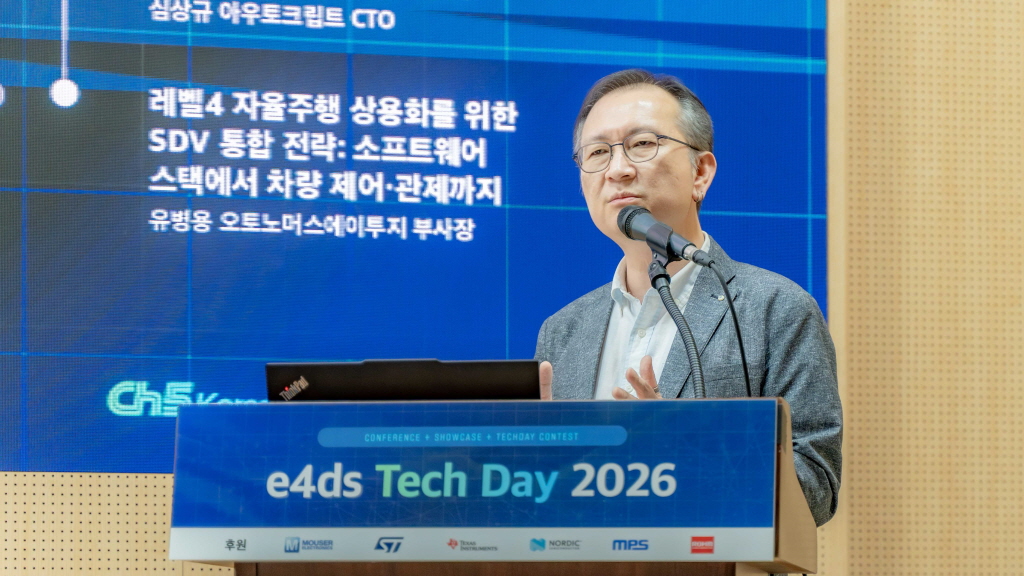
[e4ds Tech Day 2026 ⑨] Sim Sang-gyu, Autocrypt CTO: "In the Physical AI Era, Automotive Security Must Extend Beyond the Vehicle"
At e4ds Tech Day 2026, Sim Sang-gyu, CTO of Autocrypt, explained automotive cybersecurity strategies in the era of Physical AI and SDV (Software-Defined Vehicle). Automobiles are evolving as part of an ecosystem connected to AI, cloud, chargers, IoT, and robots, and he emphasized that the scope of security must expand beyond the vehicle interior to the entire connected environment. In particular, AI model tampering, adversarial attacks, OTA updates, and EV charger hacking were identified as major threats. He explained that response measures require zero trust, AI model integrity protection, intrusion detection, Security by Design and Default, and full lifecycle security management, and that proactive security system establishment beyond regulatory compliance is critical for securing future mobility competitiveness.
2026.10.12by 배종인 기자

NVIDIA to Invest $1 Billion in U.S. Science Over Next Five Years
NVIDIA has announced plans to invest $1 billion over the next five years to strengthen U.S. scientific and technological competitiveness. The company will enhance cutting-edge artificial intelligence research and development capabilities in key areas including quantum computing, healthcare, and energy security, while expanding support for higher education research institutions and cloud service providers. NVIDIA is participating as a major industry partner in the White House Office of Science and Technology Policy's Genesis Mission, and is promoting supercomputer construction in collaboration with national laboratories including Argonne and Los Alamos.
2026.10.12by 배종인 기자












빨리 확산하기 위해서는 로컬리제이션이 필요하겠네요
이러다 집에서도 진단받을 날도 올듯. 주말에 병원 걱정안해도 되겠네..ㅎㅎ
와 정말... 의료 분야까지 AI가 적용되는군요. AI가 진찰하고, 로봇이 수술하는 시대가 올듯... 근데 정보가 미국으로 갈텐데.. 그런 부분이 고민이 될것 같긴하네요. 글 잘읽었습니다. ^^