



Xilinx’s strength in design flexibility continues in the 5G wireless market
 Published2017.02.23 14:48
50–75% reduction in power and footprint by eliminating discrete components such as converters
Xilinx's moves to address the 5G wireless communications market do not seem strange given the design flexibility it has demonstrated in the FPGA field.
Xilinx demonstrated this once again by announcing an RFSoC that integrates RF-grade analog technology into a 16nm all-programmable MPSoC. This is because scalability and flexibility have become essential elements in the 5G market, where there is a need to provide multi-mode support at significantly higher sample rates than before.
This company has raised its sample rate to the gigahertz level, targeting the telecommunications market. They have released a true base station-class product capable of responding to the 5G market. To this end, the new all-programmable RFSoC has reduced power and footprint by 50-75% in 5G massive MIMO and millimeter-wave wireless backhaul applications.
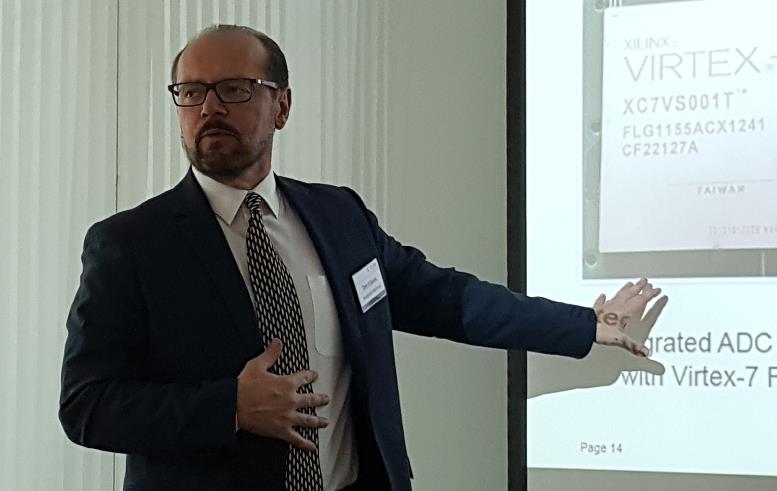
Tim Erjavec, Vice President of FPGA Platform Marketing
Tim Erjavec, Vice President of FPGA Platform Marketing who visited Korea, said, “It is very important that Xilinx has secured programmability in all areas, including ADCs and DACs, through this product,” adding, “Another advantage is that power consumption has been reduced and the footprint significantly decreased by adopting this technology, and without addressing these issues, it would be impossible to introduce and deploy 5G.”
Programmability means that parameters can be adjusted, and the bandwidth can also be changed within the limits supported by the sample rate. This is what distinguishes it from analog devices that are adjusted to the bandwidth. The fact that an RFSoC can support multi-band means that when converting from digital to analog, the higher the final digital sample rate, the wider the bandwidth that can be covered becomes. This is also the reason why programmability and flexibility emerge in the digital domain.
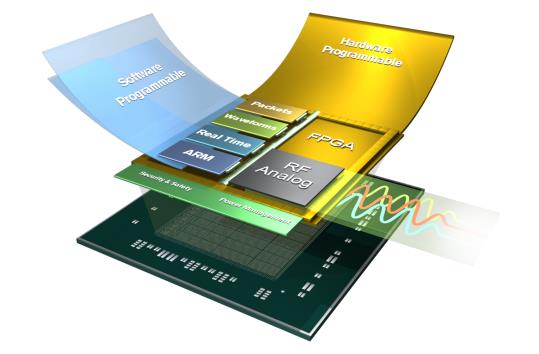
Since announcing the Vertex 7 test device in 2012, Xilinx, which has been developing analog integration technology, has also paid close attention to ensuring reliability associated with analog integration. This means that while developing RF SoCs, the company prioritized building a robust and stable system.
Vice President Tim Elyaback emphasized, “With the integration of analog and digital, we designed it so that all existing analog stabilization functions, such as calibration, can be utilized in the digital realm.” Having secured robust system design technology through the long-term development of complex analog circuits, this robust design technology has also been applied to this RFSoC.
Xilinx's RFSoC solution targets the RRU/Massive MIMO active antenna array market. The goal is to support 5G customers in commercializing highly differentiated, large-scale Massive-MIMO and millimeter wave backhaul systems.
Comments
Related news
Intel's influence is limited in hyperscale data centers, Xilinx FPGAs are superior
Xilinx announced last month a new technology that enables cloud service providers to rapidly develop and deploy accelerated platforms. Through a reconfigurable acceleration stack powered by FPGAs designed for cloud-scale applications, it can deliver more than 40 times greater computing efficiency compared to x86 server CPUs, and the company emphasized that it provides up to 6 times greater computing efficiency compared to competing FPGA vendors.
2016.12.09by 신윤오 기자

Xilinx Showcases ADAS and Autonomous Driving Solutions at Japan Auto Parts Expo
Xilinx Korea will showcase advanced driver assistance systems (ADAS) and autonomous driving (AD) solutions at the International Automotive Electronics Expo (CAR-ELE Japan) being held in Tokyo. Xilinx will also demonstrate machine learning, computer vision, and sensor fusion-related demos on Zynq SoC and Zynq UltraScale MPSoC devices.
2017.01.19by 김지혜 기자
Xilinx Showcases High-Bandwidth Video Processing Solutions at ISE 2017
Xilinx will showcase Pro AV solutions with Any-to-Any connectivity capability at ISE (Integrated Systems Europe) 2017, held at Amsterdam RAI. The high-bandwidth video processing and compression demonstrations presented by Xilinx and its alliance members are focused on differentiation.
2017.02.03by 김지혜 기자

Intel Unveils Next-Generation 'Core Ultra Series 3' and vPro Platform for Enterprise PCs
Intel has officially unveiled the "Intel Core Ultra Series 3" for next-generation enterprise PCs and the latest vPro platform, addressing a wide range of demands from enterprise notebooks to high-performance workstations.
2026.03.26by 배종인 기자

ROHM Launches ESD Protection Diode Compatible with High-Speed Interfaces of 10Gbps or Higher
Semiconductor specialist ROHM has developed the 'RESDxVx series' of ESD (electrostatic discharge) protection diodes capable of responding to next-generation high-speed data communication environments exceeding 10Gbps, simultaneously enhancing both signal quality maintenance required in high-speed interfaces and IC protection performance.
2026.03.26by 배종인 기자











