


Samsung Electronics Sees Q1 Operating Earnings Jump Thanks to Strong Memory and Display Markets
 Published2017.04.27 15:31
Possibility of increased 3D NAND supply in the second half, intensifying smartphone competition expected
Samsung Electronics announced first-quarter 2017 results with consolidated revenue of 50.55 trillion won and operating profit of 9.90 trillion won.
First-quarter performance was driven by strong performance in the components business, resulting from robust memory and display prices and expanded sales of premium products. In particular, operating profit increased by 3.2 trillion won compared to the same period last year, and the operating profit margin rose from 13.4% to 19.6%.
The components business saw a significant increase in performance driven by strong memory prices, expanded sales of premium products such as high-capacity enterprise SSDs, increased sales of APs for flagship smartphones and diversification of applications, strong LCD panel prices and expanded sales of high-value-added products, and increased sales of flexible OLEDs.
In the case of the set business, operating profit decreased year-on-year due to a decline in flagship smartphone sales and strong TV panel prices.

Meanwhile, Harman's performance was also reflected in these results. The scale is not large as it reflects only performance results from March 11, when the acquisition process was completed. Starting from the second quarter, the plan is to provide Harman's revenue and operating profit separately.
In the second quarter, the company's overall performance is expected to grow as semiconductor performance continues to improve and wireless business performance improves, such as through expanded sales of the Galaxy S8.
In the components sector, strong demand for high-capacity and high-value-added memory is expected to continue, and in the System LSI sector, performance is anticipated to improve due to increased supply of 10nm APs and DDIs. For OLED, the company plans to maintain increased sales and solid profits by actively responding to demand for flexible products from major clients and external clients.
The set business is expected to see improved performance driven by the global expansion of Galaxy S8 sales, increased sales of new products such as QLED TVs, and the peak season effect for air conditioners.
Set business focuses on maintaining profitability by strengthening product leadership
This year, Samsung Electronics expects year-over-year earnings growth driven by its components business, fueled by the continued robust memory market and increased OLED supply; meanwhile, the company plans to focus on maintaining profitability in its set business by strengthening product leadership, such as by expanding sales of flagship products.
However, in the second half of the year, there is a possibility of increased 3D NAND supply in the memory business, and in the OLED business, there is also a persistent risk of intensified competition with LTPS (low-temperature polysilicon) LCDs for mid-to-low-end OLEDs. Competition in the wireless business is also expected to intensify in the second half of the year due to the launch of new products in the industry.
In the mid-to-long term, amidst rapid changes in the IT industry such as the rise of IoT, AI, and automotive electronics, demand for high-performance and low-power chipsets like memory, SoC, and sensors within the components business is expected to surge, along with the expansion of demand for flexible OLEDs.
The set business is also expected to see the expansion of new business opportunities as the market shifts toward software and connectivity, such as cloud, AI, and smart homes.
Execution of 9.8 trillion won in facility investment, 5.0 trillion won in semiconductors and 4.2 trillion won in displays
To respond to these changes, it is essential to strengthen competitiveness through strategic investments and M&A aimed at securing advanced technologies and discovering new growth engines. However, difficulties are also anticipated in mid-to-long-term business strategies due to uncertainties in the domestic and international business environment.
9.8 trillion won in capital investment was executed in the first quarter, of which 5.0 trillion won was invested in semiconductors and 4.2 trillion won in displays.
Although this year's facility investment plan has not yet been finalized, investment is expected to increase significantly compared to last year, centered on V-NAND, System LSI, and OLED.
Comments
Related news
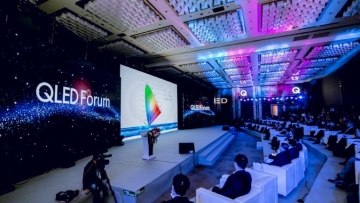
Samsung Electronics Declares Expansion of QLED TV Market at 'QLED International Forum'
Samsung Electronics is joining hands with TV manufacturers, distributors, and academia to substantially expand the quantum dot-based QLED TV market, a next-generation display material. On the 13th, Samsung Electronics participated in the 'QLED International Forum' hosted by the China Electronics Chambers of Commerce (CECC) at the Yanchih Lake International Convention Center in Beijing, China. The event, held under the title 'The Light of QLED Illuminates the World,' was attended by approximately 300 people, including TV manufacturers such as Samsung Electronics, Hisense, and TCL, Chinese government agencies, academia, major distributors Gome and Suning, and JD.com, the largest e-commerce company.
2017.04.17by 김지혜 기자
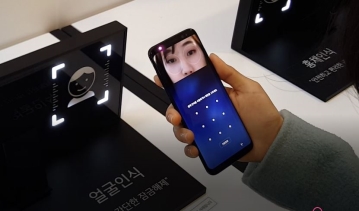
[Just Try It] The Galaxy S8 with AI, I Tried Talking to It
The S8 manufacturer said, "We fired it like ceramic pottery." This was mentioned in the context of conducting over 100,000 tests to avoid repeating mistakes from the previous Note 7. Samsung Electronics held a media day on the 13th at its Seocho headquarters and formally introduced the Galaxy S8. On that day, Samsung announced Korean advance sales of 728,000 units. More than 700,000 people who had already marked their interest got to see the 'Galaxy S8' in person. Infinity Display "Wow, it was fired like ceramic pottery." The fine appearance draws admiration—smooth curves flow naturally. The display is 18% larger than the previous model, but the bezel-less design fits comfortably in the hand. The Galaxy S8 is 5.8 inches, and the S8 Plus is 6.2 inches. The Midnight Black S8 with the screen off reminds one of LG's Chocolate phone, which sold 20 million units about ten years ago. With an 18.5 to 9 aspect ratio, the screen fills 80% of the display. We played a video. The screen extending even to the curves held the eye. "Should we try touching it?" We pressed this and that. There is no home button. The menu, home, and back functions have moved into the display screen. When we thought our hand couldn't reach, we quickly pressed the home button three times and one-handed mode activated.
2017.04.17by 김자영 기자
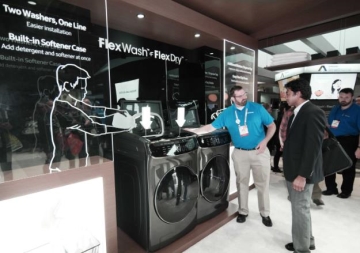
Samsung Electronics Ranks First in Brand Market Share in U.S. Home Appliance Market in First Quarter of This Year
Samsung Electronics secured the top market share by brand in the world's largest U.S. home appliance market during the first quarter of this year. Market research firm Traqline announced that Samsung Electronics recorded the No. 1 position in the major U.S. home appliance market with a 19.2% market share in the first quarter of 2017. Based on sales, this represents an increase of 4.5 percentage points compared to the first quarter of the previous year. Traqline publishes quarterly market share by brand by aggregating major home appliances in the U.S. market, including refrigerators, washing machines, ovens, microwaves, and dishwashers.
2017.04.25by 김지혜 기자

Intel Unveils Next-Generation 'Core Ultra Series 3' and vPro Platform for Enterprise PCs
Intel has officially unveiled the "Intel Core Ultra Series 3" for next-generation enterprise PCs and the latest vPro platform, addressing a wide range of demands from enterprise notebooks to high-performance workstations.
2026.03.26by 배종인 기자

ROHM Launches ESD Protection Diode Compatible with High-Speed Interfaces of 10Gbps or Higher
Semiconductor specialist ROHM has developed the 'RESDxVx series' of ESD (electrostatic discharge) protection diodes capable of responding to next-generation high-speed data communication environments exceeding 10Gbps, simultaneously enhancing both signal quality maintenance required in high-speed interfaces and IC protection performance.
2026.03.26by 배종인 기자











