



[Critical IT Scene] Intel Unveils Silicon Valley Autonomous Driving Lab
 Published2017.05.08 12:58
Support for sensing, in-vehicle computing, and cloud technologies and services
Intel has unveiled its Advanced Vehicle Lab.
The institute was established to expand the boundaries of autonomous vehicles and future transportation, providing insight into cutting-edge research and development.
This unveiling, made at Intel's first-ever autonomous driving workshop in San Jose, California, brings Intel's research lab to Silicon Valley, joining labs in Arizona, Germany, and Oregon.
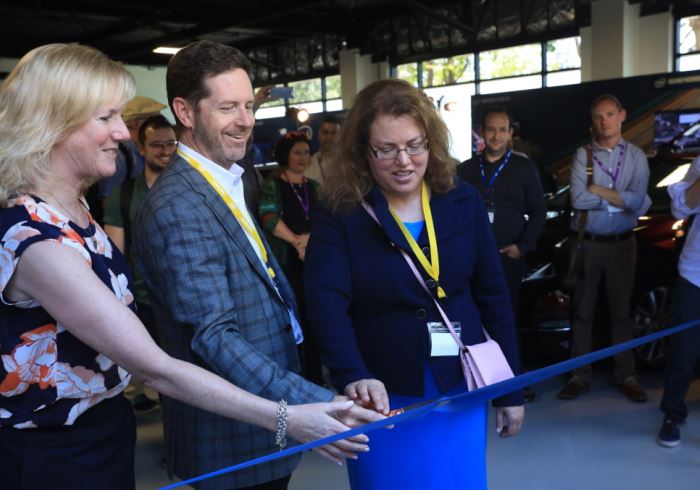
Intel's Silicon Valley lab was established to identify and better understand the diverse needs of the autonomous driving industry and future transportation, including sensing, in-vehicle computing, artificial intelligence, and connectivity technologies, as well as supporting cloud technologies and services.
Self-driving cars operate based on information collected through cameras, LIDAR, RADAR, and other sensors, and are expected to produce about 4 terabytes of data every 90 minutes. Processing, managing, storing, analyzing, and understanding data is one of the biggest challenges facing the autonomous driving industry.
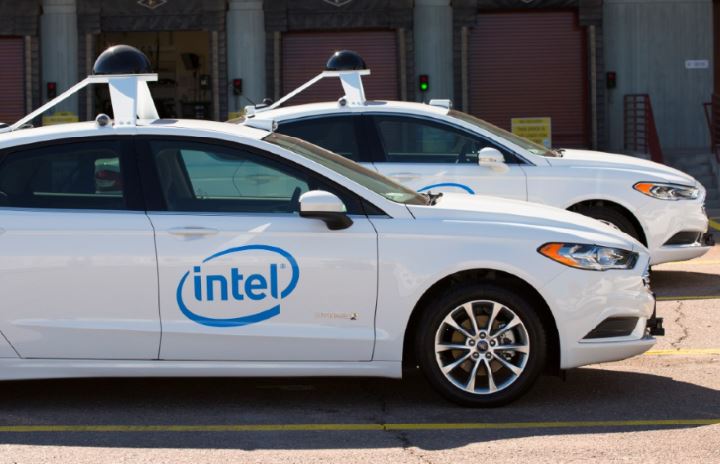
Intel's Autonomous Driving Lab collaborates with customers and partners to develop new ways to solve data-driven challenges across the vehicle, network, and data center. Engineers at the lab use a variety of tools to test and advance these areas. These tools include Intel-based computing systems, a variety of sensors for data collection, autonomous test vehicles capable of real-world testing, vehicles and teams from Intel-collaborating partners, and dedicated autonomous vehicle data centers.
Intel Senior Vice President Doug Davis said in the session, “I believe only Intel can fully solve the data challenge,” adding, “That’s why I postponed my retirement.”
Comments
Related news

Intel to Test Approximately 40 Autonomous Vehicles on Real Roads in Second Half of This Year
Intel, BMW, and Mobileye announced that approximately 40 autonomous vehicles will appear on actual roads by the second half of 2017, thereby revealing the achievements the three companies have accomplished toward fully autonomous driving. During a panel discussion held at a joint press conference at CES, the three companies explained in detail the cutting-edge technologies from Intel and Mobileye incorporated in the BMW 7 Series through a global pilot period starting in the United States and Europe.
2017.01.06by 김수지 기자
Intel Announces 5G Modem for Autonomous Driving Connectivity
Intel has announced the addition of a 5G modem to its 5G product portfolio. This modem is equipped with a baseband chip that supports both sub-6 GHz spectrum and millimeter wave (mmWave), the high-frequency band, enabling 5G spectrum trial service implementation anywhere in the world. It enables gigabit-class throughput with ultra-wideband operation and ultra-low latency, and combines Intel's sub-6 GHz 5G RFIC (Radio Frequency Integrated Circuit) and 28 GHz 5G RFIC to support all major 5G candidate bands globally.
2017.01.09by 김지혜 기자
Samsung Finally Surpasses Intel, Will It Become the World's No. 1 Semiconductor?
Samsung Electronics is expected to become the world's leading semiconductor company. IC Insights has issued a forecast that Samsung is likely to surpass Intel and rise to the position of the world's number-one semiconductor company based on second-quarter results. If this occurs, it would mean Intel relinquishing its top position for the first time in 24 years.
2017.05.02by 신윤오 기자

[e4ds Tech Day 2026 ⑨] Sim Sang-gyu, Autocrypt CTO: "In the Physical AI Era, Automotive Security Must Extend Beyond the Vehicle"
At e4ds Tech Day 2026, Sim Sang-gyu, CTO of Autocrypt, explained automotive cybersecurity strategies in the era of Physical AI and SDV (Software-Defined Vehicle). Automobiles are evolving as part of an ecosystem connected to AI, cloud, chargers, IoT, and robots, and he emphasized that the scope of security must expand beyond the vehicle interior to the entire connected environment. In particular, AI model tampering, adversarial attacks, OTA updates, and EV charger hacking were identified as major threats. He explained that response measures require zero trust, AI model integrity protection, intrusion detection, Security by Design and Default, and full lifecycle security management, and that proactive security system establishment beyond regulatory compliance is critical for securing future mobility competitiveness.
2026.10.12by 배종인 기자

Practical HIL Construction Strategy for Automotive and Off-Highway Controller Validation
As vehicle E/E architecture transitions to zonal structures and shifts to software-defined vehicles (SDV), the number of controllers (ECUs) requiring validation and software complexity are surging dramatically. Meanwhile, real vehicle testing cannot provide repeated verification under identical conditions and entails lead time and safety concerns. This white paper explains the principles of HIL (Hardware-in-the-Loop) validation and the structure of the NI platform composed of PXI, SLSC, and VeriStand, and through two actual implementation cases—Camera Record & Replay HIL for In-Cabin Monitoring Controller (ICMU) and Forklift Controller (VCU) HILS—describes how controller-level regression testing becomes possible. Additionally, it explicitly states application boundaries and limitations, such as lack of A2B support.
2026.10.12by 편집부











