



[Reporter's Notebook] How Nvidia Became a Leading AI Company
 Published2017.05.30 06:12
It has become common sense that you need to use a good GPU as much as you use a good CPU, and NVIDIA, the maker of the representative GPU, has also become engraved in people's minds.
But now, NVIDIA has become one of the most talked-about companies in artificial intelligence (AI), a future technology trend. At this point, people are left with both questions and surprise. NVIDIA, a company that used to make PC graphics card chipsets, is now a leading company in the AI field? How, and when did that happen?
When did NVIDIA first realize that GPUs, which were originally intended to simply assist CPUs in multimedia tasks like gaming and video editing, could become a key player in AI? Mark Hamilton, vice president of solutions architecture and engineering at NVIDIA, says it was 11 years ago when NVIDIA first shipped CUDA, a parallel computing architecture that improves computing performance based on GPUs. He says that realizing that GPUs could run general-purpose programs, not just graphics codecs, was the first time NVIDIA realized it needed to expand beyond its role as a graphics card manufacturer and into the AI field.
However, it was around 2012 that I became truly confident that we would become an AI company. Geoffrey Hinton, a computer scientist at the University of Toronto, demonstrated outstanding image recognition technology by combining GPU and AI technologies at the ImageNet competition, a computer science event. That same year, Google, in collaboration with Stanford Professor Andrew Ng, conducted a project to identify all objects on YouTube, once again demonstrating the power of GPU-based AI. In the 2013 ImageNet competition, 300 out of 400 participating companies used GPU technology, and in the 2014 competition, all 400 participating companies used GPU technology, proving the power of GPU-based deep learning.
GPUs excel at deep learning compared to CPUs due to their different computational methods. Deep learning, which requires the simultaneous processing of massive amounts of information, is advantageous on GPUs, which contain hundreds or thousands of cores, compared to CPUs, which rely on serial processing.
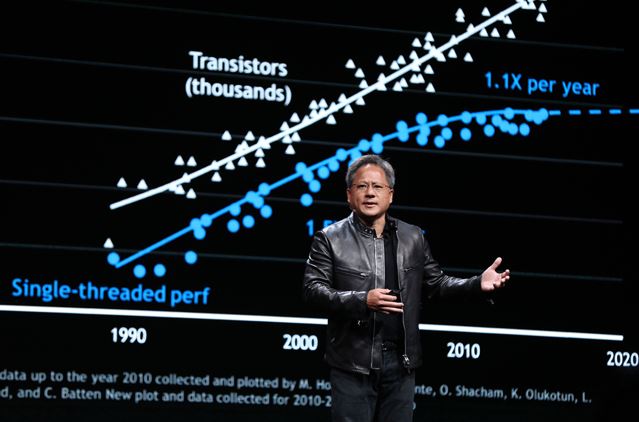
In an era where computing power increases by 500% every year, CPUs can't keep up.
It is not unrelated that NVIDIA CEO Jensen Huang declared at the NVIDIA GPU Technology Conference (GTC) held on the 10th that “Moore’s Law,” which has been synonymous with increasing integration for decades, should now be applied to GPUs. In his keynote speech, CEO Jensen Huang said, “The advancement of GPU performance redefines Moore’s Law. That is why we exist: to find the path forward after Moore’s Law.”
CPU performance is only increasing by about 10% per year, making Moore's Law seem meaningless. In this era of computing power increasing by 500% every year, a huge gap is emerging, and the explanation is that GPUs can fill that gap.
This doesn't mean NVIDIA wants to compete with CPUs by promoting GPUs. GPUs are, after all, accelerators and always perform best when paired with CPUs. Vice President Mark Hamilton emphasized that NVIDIA's success in the AI field and its yearly performance improvements stem from its position as an AI computing company that integrates hardware and software, rather than simply providing GPU chips.
So, NVIDIA wants to call itself "a platform company enabling GPU-based accelerator computing." As if to prove this point, NVIDIA emphasizes that it invests in "just one" area: GPU computing, specifically accelerator computing, and seems to believe that this can enhance AI capabilities.
Last year alone, $5 billion was reportedly invested in AI startups. Now, the world is talking about AI convergence, as if it began and will end with AI. It's unclear whether NVIDIA's GPU computing will become the core of AI, or whether another chip or software-based technology will become the key. One important point is that GPU-based computing power is currently maximizing AI capabilities, and NVIDIA is at the center of this.
Comments
Related news
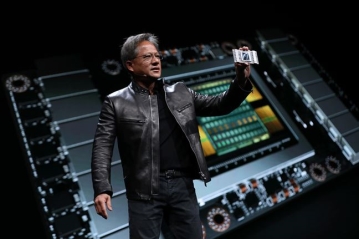
[Decisive IT Scene] "The New 'Moore's Law' is in GPU Computing Power"
Jensen Huang, founder and CEO of NVIDIA, made this declaration during the keynote speech at the NVIDIA GPU Technology Conference (GTC) held at the McEnery Convention Center in San Jose, California, USA from the 8th to the 10th local time. On this day, CEO Jensen Huang introduced various technologies leading the future of artificial intelligence, including Volta, a new GPU architecture delivering 5x performance improvement compared to the previous generation.
2017.05.15by 신윤오 기자
NVIDIA Actively Supports Promising AI Startups with GPUs, Prize Money, and More
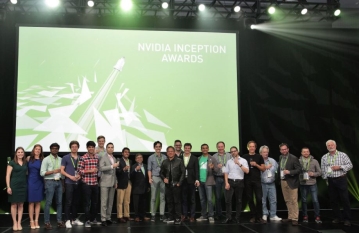
Through the Inception Awards ceremony at Nvidia's GPU Technology Conference (GTC), six startups that showcased ideas leveraging artificial intelligence were selected and awarded a total of $1.5 million in prize money. This awards ceremony marks the first event of Nvidia's Inception virtual accelerator program, through which Nvidia currently provides various resources including GPUs and networking support to 1,300 artificial intelligence startups worldwide. The selection of award winners included Nvidia CEO Jensen Huang as well as executives from Goldman Sachs, Fidelity Investments, SoftBank, Microsoft, and Coatue Management serving as judges. Based on presentations by 14 finalist teams at the final round held in San Francisco last month, the judges selected first and second place teams in three categories: ▲Most Promising Emerging Company ▲Most Innovative Company ▲Best Social Innovation Company.
2017.05.15by 김자영 기자
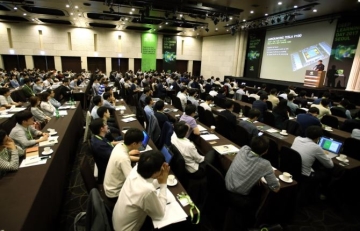
Over 400 people flocked to NVIDIA's Deep Learning Day, demonstrating a surge of interest in AI.
Nvidia (CEO Jensen Huang) held the "NVIDIA DEEP LEARNING DAY 2017 SEOUL" at EL Tower in Yangjae-dong, Seoul on May 25th, successfully concluding the event with the attendance of over 400 domestic software developers, big data experts, and IT industry professionals, the company announced.
2017.05.26by 신윤오 기자

[e4ds Tech Day 2026 ⑨] Sim Sang-gyu, Autocrypt CTO: "In the Physical AI Era, Automotive Security Must Extend Beyond the Vehicle"
At e4ds Tech Day 2026, Sim Sang-gyu, CTO of Autocrypt, explained automotive cybersecurity strategies in the era of Physical AI and SDV (Software-Defined Vehicle). Automobiles are evolving as part of an ecosystem connected to AI, cloud, chargers, IoT, and robots, and he emphasized that the scope of security must expand beyond the vehicle interior to the entire connected environment. In particular, AI model tampering, adversarial attacks, OTA updates, and EV charger hacking were identified as major threats. He explained that response measures require zero trust, AI model integrity protection, intrusion detection, Security by Design and Default, and full lifecycle security management, and that proactive security system establishment beyond regulatory compliance is critical for securing future mobility competitiveness.
2026.10.12by 배종인 기자
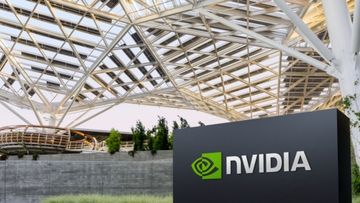
NVIDIA to Invest $1 Billion in U.S. Science Over Next Five Years
NVIDIA has announced plans to invest $1 billion over the next five years to strengthen U.S. scientific and technological competitiveness. The company will enhance cutting-edge artificial intelligence research and development capabilities in key areas including quantum computing, healthcare, and energy security, while expanding support for higher education research institutions and cloud service providers. NVIDIA is participating as a major industry partner in the White House Office of Science and Technology Policy's Genesis Mission, and is promoting supercomputer construction in collaboration with national laboratories including Argonne and Los Alamos.
2026.10.12by 배종인 기자











