



[Talking about Industrial IoT ①] GE Interview: "Industrial IoT, Like Saving Electricity, Must Start with Purpose"
 Published2017.07.17 14:33
The commonly referred to industrial IoT encompasses the concept of the Industrial Internet, which emerged as a counterpoint to the consumer Internet. The Internet of Things encompassed connections between computers and people, but this concept alone couldn't explain everything needed in industry. Ultimately, the question of how to connect machines and people led to the Industrial Internet. GE (General Electric) established the concept of the Industrial Internet early on, transforming it into a tangible solution as it evolved into a digital enterprise. Kim Sung-jin, Managing Director of GE Digital, emphasizes, "Getting started now is the first step toward the Industrial IoT." We heard from Managing Director Kim, who emphasizes that the connection must extend beyond devices to include people, to discuss GE's Industrial Internet.
Implementing industrial IoT has become an inevitable choice for manufacturing. What should be done and how?
Let me explain GE's three-step approach to industrial IoT: GET CONNECTED, GET INSIGHTS, and GET OPTIMIZED. "GET CONNECTED" involves first connecting all machines and equipment, then digitizing and retrieving data. Surprisingly, many companies haven't even achieved this yet. Next is "GET INSIGHTS," which involves analysis and prediction. Based on the collected data, they conduct enhanced analysis and forecast the future. The final step is called "GET OPTIMIZED," or optimization. This is where you gather, analyze, and predict data, and then take action to generate results that will improve your business.
-If you could give specific examples for each stage.
In reality, "GET CONNECTED" often doesn't work well. While large companies are doing well, most other companies have individual facilities, with few connecting and operating them. Furthermore, aging facilities make it difficult to extract data, hindering connectivity. "GET INSIGHTS" can be applied to chemical companies, for example. Chemical companies, where facilities are crucial, begin by properly monitoring data from those facilities. This allows them to analyze processes and predict when each facility might fail.

Building an industrial IoT system isn't something a single company can accomplish. That's why building an ecosystem is so crucial.
Yes. Especially in IoT, the ecosystem is paramount. It's not something a single company can handle. For example, in some cases, data can be collected from PLCs or controllers, while in others, sensors must be directly installed. This requires sensor companies, and SI companies to actually connect. Furthermore, for large or remote areas, a connectivity partner is crucial. GE collaborates with sensor and SI companies, has partnerships with global telecommunications companies, and has also partnered with global consulting firms. It's safe to say that GE has partnerships across all sectors.
-How did GE leverage partnerships in the cases it built?
Even when GE was working on a project last year, it wasn't done alone. There were companies that built the system and companies that supplied the sensors. This also included domestic partners. For example, some people think that GE's industrial IoT platform, Predix, is all there is to the industrial Internet, but that's not the case. For example, much needs to be done at the device level, or edge level, and manufacturing sites often require on-premise databases. Not all data needs to be uploaded to the cloud. There are partners that build industrial databases, and there are domestic companies that develop Predix apps.
"You have to start with a tangible goal
"It doesn't end with hesitation in the introduction review"
I agree that we need to build industrial IoT, but it doesn't seem to be spreading quickly in Korea. What do you think is the reason?
The most important reason is that we don't seem to understand the purpose of introducing the Industrial Internet. The Fourth Industrial Revolution is a time for innovation, and everyone believes it's an opportunity for innovation. The problem is that because they're being told to embrace it, they start exploring related technologies. But they start to question what they'll gain from it. This leads to hesitation. For example, they might say, "I need a new business model, but my current database won't allow me to do that, so let's start with that," or, "We'll focus on improving productivity." Some projects have broader scopes, but if they start with, "We actually want to save electricity," then their goal becomes tangible. For example, there was a company that worked with GE on an energy management project. They analyzed data coming from refrigerators and air conditioners, installed sensors in areas where data wasn't available, and analyzed the data to optimize energy savings. With a clear goal like this, they can then adopt all the relevant technologies. But if they simply say, "We need a smart factory," or "The CEO says so," they end up drifting through the review phase.
-Before introducing industrial IoT, it seems very important to first have a clear sense of purpose for the business.
A sense of purpose in the impact on your business is crucial. For example, if you spend a lot of money on maintenance, you can accurately analyze the data and cut unnecessary costs. That's why we always start with this question for companies: Let's work together to identify the desired outcome.
-So, what should companies start doing right now?
First, they need to 'GET CONNECTED'. They need to know what to do. There are quite a few companies that start this way. We believe they can gain insights we don't yet know about. One Korean company, whose name I can't reveal, thought, "We want to gather data first." They purchased an industrial database from us and stored it there for two years. This year, they began a project to analyze this data. These companies start with the belief that by gathering this much data, they can further optimize their existing areas, since they're new to the field.

-How much productivity improvement do companies experience by adopting industrial IoT solutions?
Now, about six months after implementing Predix, it's not perfect, but it's reportedly showing results. In particular, a Brazilian steel company that implemented a failure prediction solution identified two equipment locations at risk of failure. Had they failed to predict these failures, they would have incurred significant losses. Furthermore, Korean companies aren't just deploying Predix; they also have on-premise systems for data collection. GE is adopting both. Currently, the majority of its on-premise customers are still using the solution.
-How is the supply of Predix in Korea going?
The number of companies supplying Predix isn't yet in the double digits. This is because they only began in earnest last year. While last year was a cautious pilot phase, this year, more and more companies are moving towards full implementation. While all solutions built on Predix will be integrated, many still insist on on-premises deployment. In such cases, I believe customers should be given a choice.
"The experience and know-how accumulated through manufacturing is the source,
"Excellent data collection and analysis capabilities at the device level"
Besides GE, there are many companies that provide industrial IoT solutions. What makes GE different from these companies?
GE is a company with a strong presence in the manufacturing industry. Because of its extensive experience and expertise, these are embedded into its platform. First, its strength lies in its "Get Connected" strategy. While other companies' platforms focus on the cloud itself, GE recognizes the critical importance of the edge in industrial applications. Predix software components can be installed on machine sensors, controllers, and gateways. Simply install them and they collect data and send it to the cloud. Companies that started out with an IT foundation are inherently weak in this area. GE has actually created a digital twin (a virtual digital asset that corresponds to a physical asset) and integrated it into its platform. For example, when analyzing the lifespan of an industrial compressor, certain sensors must be included due to their design characteristics, and the corresponding algorithms will vary depending on the equipment. GE has developed these specifics. GE also excels in industrial analytics. Its industrial data scientists are continuously adding analytical modules to Predix. These modules aren't built from the basic platform or from statistical modules available from IT companies; rather, GE has developed a dedicated analytics module specifically for industrial use. The ability to predict when a rotating system will "die" is difficult to achieve without industry expertise.
-What is your outlook for the industrial IoT market?
Overseas global companies are eager to get started quickly, even on a small scale, and see results. Domestic companies are spending too much time focusing on perfect planning. Industrial IoT deployments require rapid execution. While planning was crucial in the past, industrial IoT has a shorter cycle and is inherently a different business. On the positive side, while last year was all about planning, this year, many companies are moving forward with implementation. I believe this year will be the first year of implementation.
GE calls itself a digital industrial company. What is its vision for the future?
The term "digital industrial company" carries significant implications. The experience itself can be applied without compromise. While we have strengths in operational technology (OT), going forward, software-based digital innovation is essential. To achieve this, GE has invested heavily and secured human resources over the past several years. GE's goal is a model that effectively integrates OT and IT.
Comments
Related news
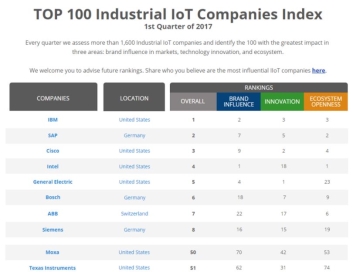
Moxa Named a Global Top 50 Industrial IoT Company
International consulting firm IoTOne's online survey results have selected Moxa as one of the world's top 50 industrial IoT companies. Through these results, Moxa has demonstrated leading capabilities in the transition to industrial IoT, and has been recognized for its efforts in driving change in the continuous development of IP-based networking technologies and applications. IoTOne (www.iotone.com) is an international consulting firm with expertise in IoT-related intelligence and marketing services, conducting a quarterly online survey titled "Top 100 Industrial IoT Companies."[1] This survey evaluates over 1,600 industrial IoT companies and selects the 100 most influential companies across three categories: "Brand Influence in the Market," "Technology Innovation," and "Ecosystem Environment." In results announced in March, Moxa was particularly recognized in the "Brand Influence" and "Ecosystem Environment" categories and was selected as a top 50 company. The top five companies selected were IBM, SAP, Cisco, Intel, and GE.
2017.05.11by 김자영 기자
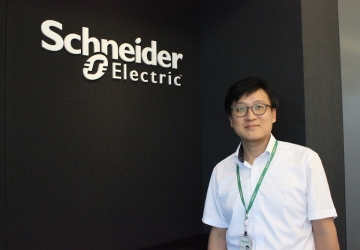
[Talking about Industrial IoT ②] Schneider: "Augmented reality that identifies defects by simply holding it up is the evolution of IIoT."
The Fourth Industrial Revolution is said to be an opportunity to achieve manufacturing innovation. Opportunity belongs to those who are prepared, yet there are still those who view it with suspicion rather than seizing it. We asked Jung Seong-yeop, Team Leader of the Automation Business Division at Schneider Electric (hereafter: Jung), and Noh Geun-bae, Team Leader of Software Channel Business (hereafter: Noh). Kim: You mention innovation, but how does adopting 'Industrial IoT' improve things? Jung: In Korea, people tend to just do what the government or their superiors tell them to do, so this sense of thirst continues to persist. And people mainly talk about revolution, but Schneider calls it evolution. It's not that something entirely new is created, but rather that productivity increases, electricity costs decrease, data becomes easier to view, downtime is reduced, and more aspects become automated.
2017.07.31by 김자영 기자
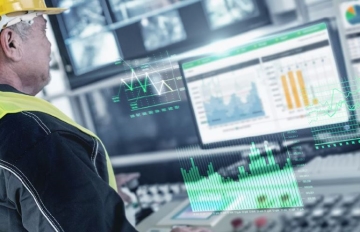
[Talking about Industrial IoT ②] “Schneider is the true IIoT specialist company with 20 years of development experience”
Schneider Electric has been preparing for the Fourth Industrial Revolution early on. Since 1997, the company has implemented factories connected through Ethernet communication, even before standards were established, and has been supplying solutions incorporating Industrial Internet of Things. This is the background behind Schneider, commonly known only as an electrical and energy-related company, currently generating 45% of its revenue from Internet of Things-related products. Founded in France in 1836, Schneider Electric is a global energy management and automation specialist that provides comprehensive solutions ranging from simple switches to complex operational systems.
2017.07.31by 신윤오 기자
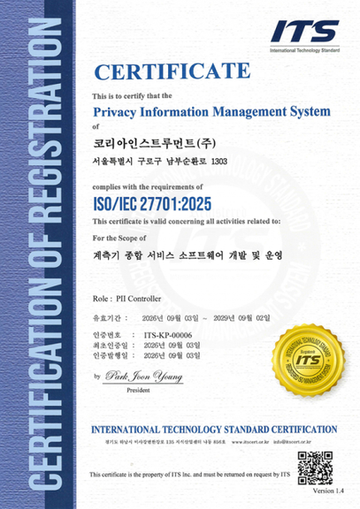
Korea Instrument, KOLAS Accredited Calibration Agency First to Simultaneously Acquire ISO/IEC 27,001·27,701
Korea Instrument has become the first among KOLAS accredited calibration agencies to simultaneously acquire ISO/IEC 27,001 and ISO/IEC 27,701 certifications. Through its proprietary platforms CWIZ Enterprise and CWIZ Partners, the company has embedded information security and personal data protection requirements across all business processes including customer information, equipment data, and calibration reports, with plans to continuously advance its management system through regular audits and security inspections.
2026.10.12by 배종인 기자
TeamViewer One, IT Incident Automation Workflow and Resolution Center Enhanced
TeamViewer has added IT incident automation capabilities and an advanced Resolution Center to its integrated digital workplace management platform 'TeamViewer ONE'. Recurrent service disruptions, configuration errors, and capacity shortages are automatically handled according to preset policies, and device status verification through script deployment can be managed in a unified interface, significantly reducing repetitive tasks for IT teams.
2026.10.12by 배종인 기자











