



Intel Provides Security and Agility with 'Xeon Processors'
 Published2017.07.17 18:44
Suitable for environments with increasing workloads, such as AI and cloud.
The era has arrived where everything from artificial intelligence data to data from numerous IoT devices is connected to the cloud. Intel, which has played a pivotal role in the cloud market moving toward a hybrid form beyond public and private, has unveiled its next-generation processor products.
Intel Korea held a launch event for the 'Xeon Scalable Processor' at the Conrad Hotel in Yeouido on the 17th.
Na Seung-ju, Senior Vice President and General Manager of Sales for Intel Data Center Group Korea, said, “With the new mesh architecture core, we have resolved the issue of reduced efficiency in the existing ring architecture as the number of cores increased and improved transmission speeds. In server platforms that use many cores, all cores utilize memory and IO simultaneously.”
Intel Xeon Scalable processors are specially designed for data centers and network infrastructure and demonstrate an average performance improvement of 1.65 times compared to the previous generation. It includes existing workloads, cloud computing, high-performance computing, and artificial intelligence.
By increasing FLOPS (Floating-point Operations per second) by up to 2x with Intel AVX512 and integrated Intel Omni-Path architecture ports, it provides improvements in computational power, I/O flexibility, and memory bandwidth.
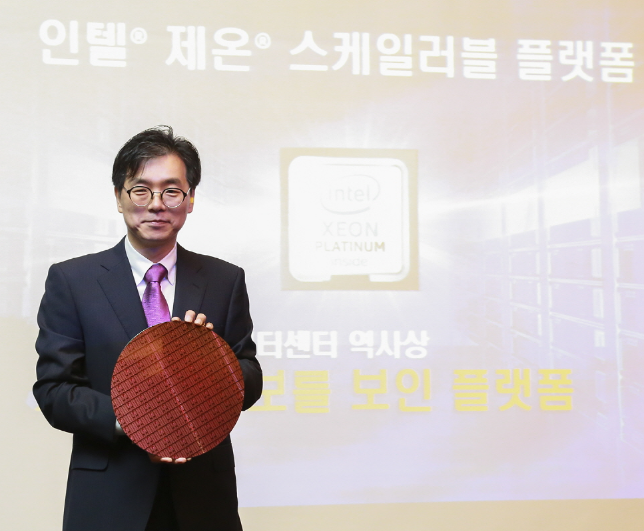
Yoon Ha-ryong, a senior researcher at Samsung Electronics’ Memory Business Division who is collaborating with Intel on the memory sector prior to the official launch, stated, “As the number of memory channel slots increased from four to six, memory performance improved and speed increased,” adding, “In terms of memory utilization performance, it improved by 65%, and actual computational performance also improved by 63%.” He further explained that high capacity can be used without performance degradation, allowing the speed required by the industry to be met.
Regarding data security, Executive Director Na stated, “There is almost no overhead in encrypting data.” He explained, "With key protection technology, it is stored separately in hardware rather than in memory or storage accessible to everyone."
In addition, it was stated that with enhanced virtualization performance, it is ideal for data centers that dynamically self-provision resources in on-premises, network, and cloud forms.
Executive Director Na emphasized, “We can build the most agile and scalable artificial intelligence platform using VMD (Volume Management Device), a volume management technology. Inference requires processing a large amount of data in real time, and since Xeon is connected closest to the backbone, it improves training time by 113 times. This can shorten a process that would take days to just a few hours.”
Intel Xeon Scalable processors are receiving widespread support from various companies including Amazon, AT&T, BBVA, Google, Microsoft, Montefiore, Technicolor, and Telefónica.
Comments
Related news

[Critical IT Scene] Intel Unveils Silicon Valley Autonomous Driving Lab
Intel has unveiled its Advanced Vehicle Lab. The lab was established to expand the boundaries of autonomous vehicles and future transportation, and to provide insights into the latest research and development. Through Intel's inaugural autonomous driving workshop held in San Jose, California, Intel now has research facilities in Silicon Valley in addition to Arizona, Germany, and Oregon. Intel's Silicon Valley lab was established to identify and better understand diverse requirements related to the autonomous driving industry and future transportation. The research includes sensing, in-vehicle computing, artificial intelligence, and connectivity technologies, as well as support for cloud technologies and services.
2017.05.08by 신윤오 기자
Why Intel Declared the Evolution of HPC at the Supercomputing Conference
Intel participated in the 2017 International Supercomputing Conference (ISC) and communicated that HPC systems must evolve to enable new levels of performance, scalability, memory, bandwidth, and I/O capabilities to handle diverse workloads. Additionally, Intel discussed how users can achieve unprecedented value through new approaches to HPC system design and flexible implementation models. Through ISC 17, Intel revealed recent achievements that can further advance HPC systems and deliver new experiences to supercomputing users. Intel announced improvements in per-core performance and other enhancements with the upcoming Intel Xeon Processor Scalable Family and explained how these improvements can support a broad range of workloads. The Intel Xeon Processor Scalable Family integrates Intel Advanced Vector Extensions 512 (Intel AVX-512), delivering a 2x peak FLOPs (floating-point operations) improvement per clock cycle to provide the necessary performance boost in demanding and stressful usage scenarios.1 Combined with improvements in cores, cache, and memory, Intel Advanced Vector Extensions 512 delivers up to 2.27x improved performance compared to the currently deployed Intel Xeon Processor E5 v4 (codename Broadwell), and provides up to 8.2x more double-precision gigaflops per second compared to the Intel Xeon Processor E5 Family four years after deployment. Additionally, the Intel Xeon Processor Scalable Family, combined with high-bandwidth and low-latency fabric for performance optimization, the Intel Omni-Path Architecture (Intel OPA), provides the performance required to handle today's HPC workloads and the capability to scale to tens of thousands of nodes while enabling TCO reduction benefits.
2017.06.20by 김자영 기자
ASUS Unveils Motherboard Series Based on Intel X299 Chipset
ASUS is unveiling a new flagship mainboard lineup based on X299 that supports Intel Core X-Series (Core Extreme Processors) in the domestic market. ASUS's new X299 mainboard series is designed based on the Intel X299 chipset that fully supports Intel's Core X-Series processors announced in May.
2017.07.04by 김자영 기자
.jpg)
SalePoint Signs Multi-Year Partnership Agreement with AWS… Promoting Identity Security that Integrates Even AI Agents
Sailpoint has entered into a multi-year strategic partnership agreement with AWS and is moving forward with establishing an integrated governance system that manages both human and non-human identities together. The plan is to consistently manage access permissions in an environment where AI agents are increasing as work execution entities, while applying the principle of least privilege and automated policy enforcement. The two companies plan to jointly expand capabilities to manage the identities of various entities, including AI agents, within a single layer in the AWS environment. This collaboration is interpreted as a move to design security and governance together in corporate environments where AI adoption is expanding.
2026.03.26by 배종인 기자
.png)
Databricks Unveils Open AI Security Monitoring 'Lakewatch'
Databricks entered the security market on March 24 by unveiling LakeWatch, an open-source agentic SIEM. The core functionality of this product is to integrate and analyze security, IT, and business data in a single environment to support AI-based threat detection and investigation. The company explained that it reduces the limitations of existing security operations centers, which have had to forgo some data due to high cost structures, and enables large-scale data analysis and automation based on open formats and ecosystems. LakeWatch is currently offered as a private preview, with Adobe and Dropbox mentioned as early customers. Databricks also announced an expanded partnership with Anthropic as well as the acquisition of Antimatter and SiftD.ai.
2026.03.26by 배종인 기자











