



Jobs will find talent with advanced data-driven matching technology
 Published2017.07.20 09:43
The partnership between humans and machines will be reshaped by artificial intelligence, virtual and augmented reality, etc.
In the future, based on advanced IT environments and artificial intelligence, a closer and more immersive relationship will be formed between machines and humans.
According to the report 'Realizing 2030, The Next Era of Human-Machine Partnerships' released by Dell Technologies (Chairman and CEO Michael Dell), by 2030, all companies and public institutions will transform into technology-driven organizations based on digital technology, and humans are expected to evolve into 'Digital Conductors' who coordinate and oversee various technologies, including AI. Furthermore, it was predicted that with advanced data-driven matching technology, jobs would find talent rather than people finding jobs, and people would become accustomed to continuous yet immediate learning to keep up with the tremendous evolution of technology.
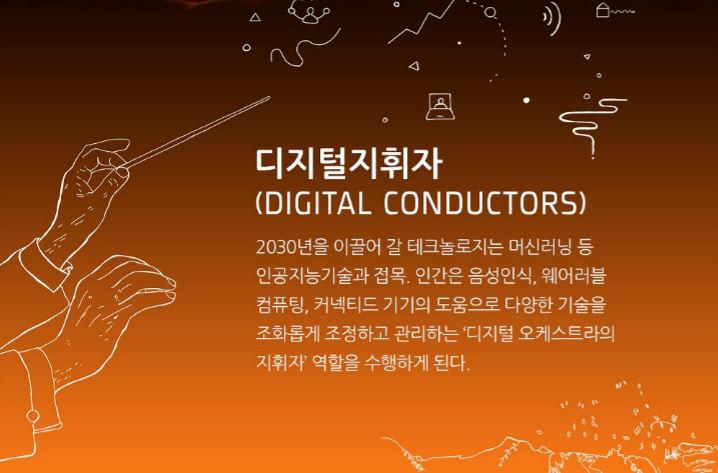
Commissioned by Dell Technologies and conducted by the U.S. Institute for the Future (IFTF) in collaboration with various global experts including IT professionals, academics, and entrepreneurs, this study forecasts how emerging technologies such as artificial intelligence (AI), robotics, virtual reality (VR), augmented reality (AR), and cloud computing will transform human life over the next decade. It also provides insights into how consumers and businesses can flexibly prepare for these changes.
According to research by the IFTF, the relationship between humans and machines is entering a new phase. Supported by enhanced efficiency and potential, this is expected to act as a catalyst for transcending human limitations. The impact of these changes on individuals and organizations can be broadly categorized into three areas. First, it is predicted that technology will help us execute and manage our daily lives in a better way, while humans will assume the role of a "digital conductor" overseeing these technologies. Additionally, with the advent of advanced data-driven matching technologies, the most suitable talent for specific tasks will be directly identified, regardless of region, country, or gender. Finally, whenever technology evolves rapidly and new industries emerge, people must acquire new technologies 'immediately' and 'continuously'.
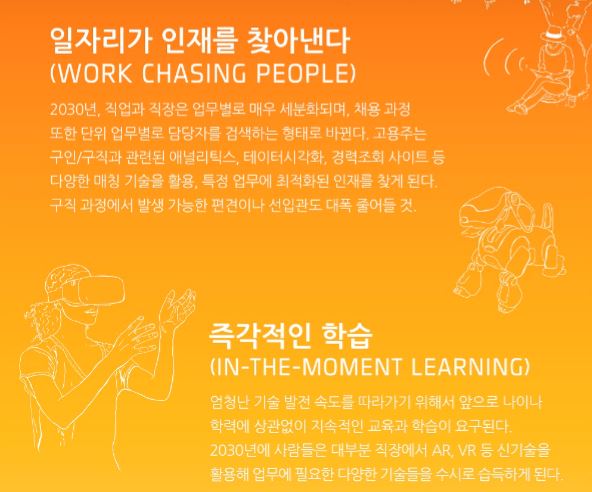
In particular, this study noted that human dependence on technology evolves into a stage of true partnership, and that technological advancements do not lead to machines or computers replacing humans, but merely change the methods of recruitment and job seeking. It predicted that as machine learning technology develops, companies and organizations will search for the skills and capabilities of individuals distributed globally to efficiently identify the talent best suited for each task and assign them work. In other words, future jobs will not be confined to belonging to a specific organization or the concept of a 'workplace,' but will transform into a concept of a 'continuum of segmented tasks.'
AI assistants are evolving into customized, integrated services.
There are further changes that the new partnership between humans and machines will bring in 2030. Machines will enhance productivity based on the high performance and maximized automation of future computing, while humans will generate new opportunities across industries by adding creativity, passion, and an entrepreneurial spirit. AI assistants in 2030 will evolve into personalized and integrated services. Self-predicting and highly automated AI assistants will support human lives to an incomparable degree compared to the present.
About 85% of jobs in 2030 do not yet exist. The pace of change is so rapid that people learn about these changes immediately by utilizing new technologies such as virtual reality (VR) and augmented reality (AR), and the ability to acquire and utilize knowledge becomes more valuable than knowledge itself.
According to the 'Digital Transformation Index' released by Dell Technologies last October, 52% of decision-makers in 16 countries worldwide reported experiencing significant disruption due to the advancement of digital technology. Additionally, it was found that approximately 50% of companies anticipate that their current workplace will become obsolete or fall behind within the next three to five years.
Comments
Related news
Artificial intelligence technology is moving in the direction of resolving life's inconveniences
How will artificial intelligence technology truly change the direction of our lives? As artificial intelligence draws closer than expected, an opportunity has been created to discuss how it is being utilized and how it will transform our daily lives. Under the auspices of the Information and Communications Technology Promotion Center (IITP), the seminar was held on the 11th at the Korea Chamber of Commerce and Industry International Conference Hall with attendance of approximately 900 people from government, academia, and industry. "Microsoft's artificial intelligence philosophy is the democratization of intelligence," said Lee Dong-beom, architect at Microsoft, adding that the company aims for artificial intelligence created by anyone, not just data scientists. Microsoft revealed that since last year, it has integrated reporting organizations and consolidated AI scientists into one organization to achieve organizational integration for AI democratization.<
2017.07.11by 김지혜 기자

KETI to Develop Korean-Style AI with Carnegie Mellon University
The Electronics and Telecommunications Research Institute (KETI) has announced that it will jointly develop next-generation AI technology with Carnegie Mellon University (hereinafter CMU), the top-ranked university in the United States for computer science and artificial intelligence. A joint research agreement on socially cognitive-based AI technology was signed at CMU's campus in Pittsburgh, USA. The focus is on digital companion technology. Whereas Watson or robo-advisors are AI limited to specific domains, digital companion technology is lifestyle-integrated AI that provides necessary services to users in their daily lives. The core lies in technology that recognizes situations, context, and emotions through adaptive machine learning, grasps user intent, and autonomously provides situation-tailored interactions—a distinction from existing digital assistant technology that completes assigned tasks, such as playing specific music.
2017.07.14by 김지혜 기자
Samsung Electronics Expands Premium Market Through Mass Production of D-RAM for AI Systems
Samsung Electronics is rapidly increasing production volumes of 8GB High Bandwidth Memory (HBM2) D-RAM, expanding supply not only to the supercomputer (HPC) market but also to network and graphics card markets. Samsung Electronics began mass production of 8GB HBM2 D-RAM in June of last year, pioneering the memory market for supercomputers utilized in artificial intelligence (AI) services, and has subsequently expanded the application scope of premium D-RAM to the existing high-end graphics card market.
2017.07.19by 김자영 기자

[e4ds Tech Day 2026 ⑨] Sim Sang-gyu, Autocrypt CTO: "In the Physical AI Era, Automotive Security Must Extend Beyond the Vehicle"
At e4ds Tech Day 2026, Sim Sang-gyu, CTO of Autocrypt, explained automotive cybersecurity strategies in the era of Physical AI and SDV (Software-Defined Vehicle). Automobiles are evolving as part of an ecosystem connected to AI, cloud, chargers, IoT, and robots, and he emphasized that the scope of security must expand beyond the vehicle interior to the entire connected environment. In particular, AI model tampering, adversarial attacks, OTA updates, and EV charger hacking were identified as major threats. He explained that response measures require zero trust, AI model integrity protection, intrusion detection, Security by Design and Default, and full lifecycle security management, and that proactive security system establishment beyond regulatory compliance is critical for securing future mobility competitiveness.
2026.10.12by 배종인 기자
NVIDIA to Invest $1 Billion in U.S. Science Over Next Five Years
NVIDIA has announced plans to invest $1 billion over the next five years to strengthen U.S. scientific and technological competitiveness. The company will enhance cutting-edge artificial intelligence research and development capabilities in key areas including quantum computing, healthcare, and energy security, while expanding support for higher education research institutions and cloud service providers. NVIDIA is participating as a major industry partner in the White House Office of Science and Technology Policy's Genesis Mission, and is promoting supercomputer construction in collaboration with national laboratories including Argonne and Los Alamos.
2026.10.12by 배종인 기자











