


Samsung SDS Leads Innovation in ‘Smart Logistics’ Based on AI and Blockchain
 Published2018.03.12 17:44
We are rapidly transitioning to a platform business.
Samsung SDS announced that it is expanding its smart logistics business by linking artificial intelligence (AI) and blockchain to its logistics platform, ‘Cello.’
The solutions introduced by Samsung SDS on this day are Cello BPO, Cello PLUS, and Cello SQUARE. Cello BPO, which adds consulting, demand/supply planning, and SCM (supply management chain) optimization functions to the traditional 3PL system, is a 4PL service. Kim Hyung-tae, head of the logistics business division (vice president), explained, “There have been requests from customers to improve logistics processing. Accordingly, we are providing 4PL by combining outsourcing plus information systems and consulting capabilities.”
Cello Plus, a smart logistics solution, is in version 5 and integrates big data, IoT, artificial intelligence, and blockchain to provide real-time visibility within the supply chain, increase reliability with secure transaction records, and derive insights from logistics data. Cello Square, an e-commerce service targeting small and medium-sized businesses, is planning to launch a pilot version 3.0 this month and launch the service in June.
On this day, Samsung SDS announced the results of applying its own artificial intelligence-based big data analysis platform, 'Brightics AI', to the stores of a European electronics distribution company over the past year and a half. It was explained that the sales forecast accuracy of Brightics AI was improved by more than 25% points compared to the sales demand predicted by existing experienced salespeople.
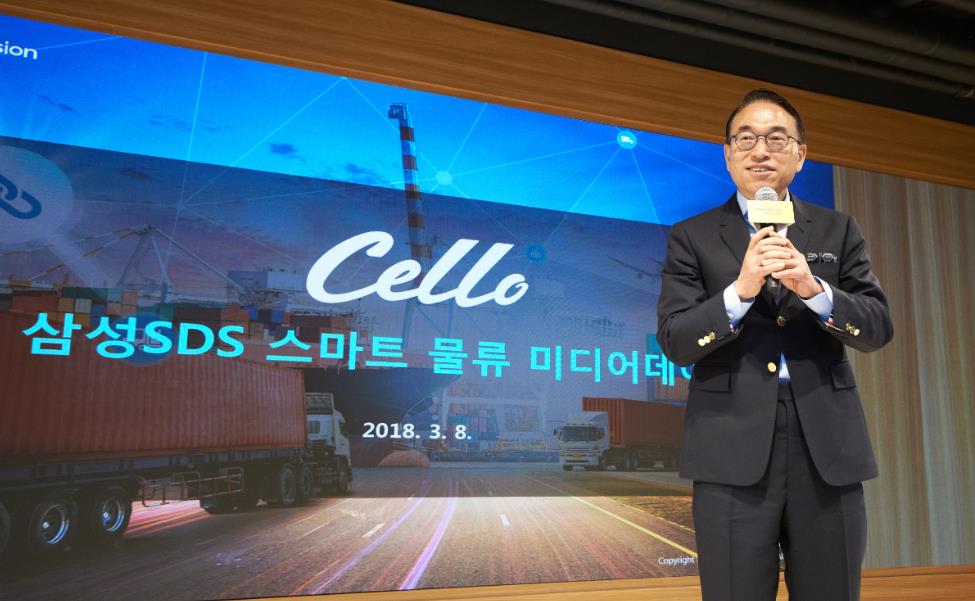
Lim Ik-soon, head of the strategic business team (deputy manager), said, “The key is to basically predict sales and manage inventory,” and introduced it as “a logistics service that builds a fulfillment center capable of integrated management through sales volume prediction, and enables direct home delivery from the fulfillment center when inventory is insufficient.”
Samsung SDS has been incorporating blockchain into its logistics services since 2018, taking advantage of blockchain’s tamper-proof, reliable, and easy information sharing capabilities. The purpose of the ‘Distribution History Management System’ is to transparently share all information on the production and distribution process from receipt to processing, packaging, and sales.
We introduced a pilot case of 'Samjin Fish Cake' that is applying the distribution history management system. In the case of fresh food, information on the origin, production date, and expiration date are necessary for food safety. Jang In-su, head of the Cello Platform Team (Senior Managing Director), explained, "We have been managing data in the past. However, our goal is to provide the information that companies and consumers want through blockchain. We also want to increase high interconnection compatibility and compatibility with other industries."
He continued, “We started forming a shipping logistics blockchain consortium last year, and currently 38 member companies are participating. “This year, we plan to expand our business to include proof of origin, distribution history management, trade finance, visibility, and data sharing,” he said.
Hong Won-pyo, CEO of Samsung SDS, said, “The issue with blockchain-related platforms is how many practical cases they can secure and how much their utility can be verified through them,” and added, “Our strength is that we are advancing Cello by incorporating new technologies such as blockchain and AI. We are quickly changing to focus on platform businesses.”
Meanwhile, Samsung SDS also held the 'Cello Conference 2018' on the same day, where people from various industries including logistics, manufacturing, and distribution attended to share smart logistics innovation cases and trends.
Comments
Related news
Samsung SDS's Q4 sales were driven by smart factory solutions and logistics BPO.
Samsung SDS announced its fourth quarter results and provisional 2017 performance, reporting 2017 revenue of 9.299 trillion won and operating profit of 731.6 billion won. This represents a 13.7% increase in revenue and 16.7% increase in operating profit compared to 2016. The company stated that growth was driven by the solutions/cloud segment and logistics BPO (Business Process Outsourcing) business. For the fourth quarter, revenue increased 6.8% sequentially from the third quarter to 2.467 trillion won, while operating profit increased 7.4% to 206.5 billion won.
2018.02.05by 김지혜 기자

Samsung SDS Breaks Ground on 'Data Center' for High-Efficiency Services
Samsung SDS Builds Data Center 5.5 Times the Size of a Soccer Field in Chuncheon To be operated as SDDC, expected completion in second half of next year Samsung SDS held a groundbreaking ceremony for the Chuncheon Data Center in Chiljeon-dong, Chuncheon City, with key executives including Samsung SDS CEO Hong Won-pyo in attendance, accelerating its cloud business initiatives. The Chuncheon Data Center is an energy-efficient data center scheduled for completion in the second half of next year and will be constructed on a 39,780㎡ site—5.5 times the size of a soccer field—with a 2-story above-ground structure. The Chuncheon Data Center will serve to enhance financial services while functioning as a cloud data center for high-efficiency services such as AI and big data. Upon completion of the Chuncheon Data Center, Samsung SDS will strengthen domestic data center competitiveness alongside existing overseas data centers in the United States, Germany, India, and Brazil, thereby establishing a complete infrastructure for its cloud business. The Chuncheon Data Center will be operated as SDDC (Software Defined Data Center), a next-generation data center technology in which IT resources such as servers, storage, and network are virtualized and automatically integrated and managed through software. Samsung SDS is concentrating its efforts on cultivating cloud business by securing cutting-edge cloud technologies through strategic partnerships with leading cloud companies including Amazon, Microsoft, Oracle, Verto Stream, and Spot Inst. Samsung SDS CEO Hong Won-pyo emphasized that "the Chuncheon Data Center will become an eco-friendly data center equipped with the best cloud business competitiveness in both domestic and international markets in terms of system performance and efficiency."
2018.02.07by 김지혜 기자
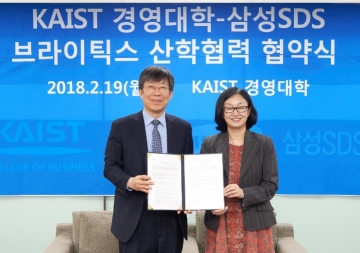
Samsung SDS and KAIST Sign Agreement for Joint Research on Big Data Analysis Technology
Samsung SDS has signed an industry-academia partnership agreement with KAIST's School of Business for activating big data analytics technology education and conducting joint research. This agreement is part of Samsung SDS's industry-academia linkage program called "Brightics Academy," and follows previous agreements with Sungkyunkwan University, Hanyang University, and Seoul National University last year, making this the fourth such partnership.
2018.02.19by 김지혜 기자

The financial services industry is the most active in adopting hybrid cloud.
Nutanix announced the cloud adoption status and outlook for the financial services industry through its Enterprise Cloud Index report. According to a survey of current hybrid cloud adoption rates by industry, the financial services industry's hybrid cloud adoption rate was 21%, which was higher than the industry average of 18.5%. Financial services companies are facing the challenge of providing differentiated experiences to customers through methods such as leveraging emerging technologies like blockchain, while simultaneously simplifying operations.
2019.04.02by 이수민 기자

IBM Blockchain World Wire… Real-time global financial payment network expands to over 50 countries worldwide
IBM announced on the 19th the expansion of IBM Blockchain World Wire, a real-time global financial settlement network for financial institutions. World Wire was developed to accelerate and optimize foreign exchange transactions and cross-border payment and remittance speeds. Additionally, it integrates payment message transmission, clearing, and settlement procedures into a single network while supporting network participants in selecting various types of digital assets for settlement. Starting from the 19th, the payment service area will be expanded to 72 countries, including 47 global currencies and 44 financial endpoints. Busan Bank became the first domestic bank to join World Wire.
2019.03.19by 이수민 기자











