



KT, “Socioeconomic Value of 5G to Reach 47.8 Trillion Won by 2030”
 Published2018.07.10 06:55
By 2030, 5G will generate a socioeconomic value of at least 47.8 trillion won... equivalent to 2.1% of GDP
KT (Chairman Hwang Chang-gyu, www.kt.com) announced on the 9th that it has published a report titled 'Analysis of Socioeconomic Impact of 5G,' which analyzes major industrial and environmental changes resulting from the introduction of 5G and the socioeconomic value provided by 5G, ahead of the commercialization of 5G next March.
This report published by the KT Economic and Management Research Institute analyzed the socioeconomic value of 5G for the first time in Korea. It is significant in that it quantifies not just the profits of network operators, but also the benefits in industrial sectors provided to enterprises, consumers, and third-party operators in each 5G-related industry, as well as the benefits enjoyed by society and citizens due to the efficiency improvement and increased convenience of the infrastructure environment.
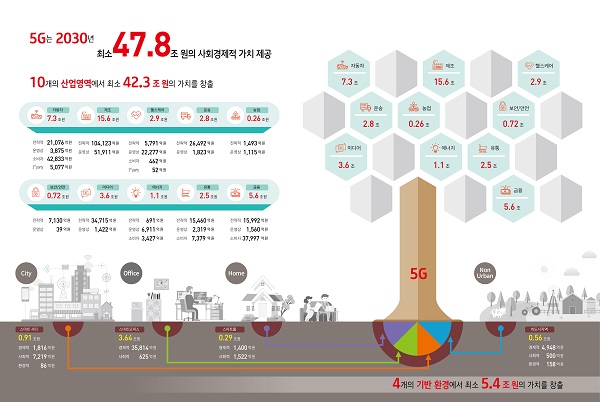
The socioeconomic value of 5G in 2030 is 47.8 trillion won
In particular, it analyzes strategic, operational, and consumer benefits in 10 major 5G industrial sectors, including automotive, manufacturing, healthcare, transportation, agriculture, security/safety, media, energy, distribution, and finance, and analyzes social, economic, and environmental benefits in 4 infrastructure environments, including smart cities, non-urban areas, smart homes, and smart offices.
According to the report, the socioeconomic value provided by 5G to 10 industries and 4 infrastructure environments will reach at least 30.3235 trillion won in 2025 and at least 47.7527 trillion won in 2030. This is approximately 2% of the projected Gross Domestic Product (GDP) for those years. Furthermore, since this estimate focuses on quantifiable benefits centered on visible services, even greater socioeconomic effects can be expected when considering newly emerging services.
In particular, among the 10 industries, the automotive industry is projected to generate 3.3 trillion won in socioeconomic value in 2025 and 7.2 trillion won in 2030 due to factors such as the increase in telematics value. KT has predicted how the automotive industry will change with the introduction of 5G by showcasing 5G cooperative swarm autonomous driving services with ultra-low latency and ultra-connectivity characteristics at the PyeongChang Olympics and the Pangyo Autonomous Driving Demonstration Complex.
In addition, the media industry predicted that the immersive media market, including VR and AR, would grow rapidly as 5G enables ultra-high-capacity transmission processing. Accordingly, the media industry estimates that socioeconomic value will reach 2.5 trillion won in 2025 and 3.6 trillion won in 2030.
In addition, it was estimated that 5G would generate at least 42 trillion 343.9 billion won in socioeconomic effects across 10 industrial sectors by 2030, including healthcare (2.9 trillion won), transportation (2.8 trillion won), agriculture (0.26 trillion won), security/safety (0.72 trillion won), energy (1.1 trillion won), retail (2.5 trillion won), and finance (5.6 trillion won).
In addition to the industrial sector, it was projected that 5G would provide at least 5.4087 trillion won in economic, social, and environmental benefits by 2030 to the infrastructure environments in which we live, including cities, non-urban areas, homes, and offices. While the industrial sector focuses on market expansion and reduced operating costs, the benefits for the infrastructure environments were measured in terms of reduced social costs, such as decreased crime rates, reduced carbon dioxide emissions, and reduced travel time.
In addition to the numerical analysis of socioeconomic effects, the report 'Analysis of the Socioeconomic Impact of 5G' includes interviews with industry experts, such as global consulting firms like McKinsey and Arthur D. Little, professors from major universities, and technology specialists. Furthermore, it provides not only the 5G services currently being pursued by KT but also various 5G use cases from overseas telecommunications companies and ICT firms, offering directions for the evolution of industry-specific services following the introduction of 5G. In addition, we have made an effort to include all major research results related to 5G, such as summarizing key references related to 5G and providing links to the original texts.
Kim Hee-soo, Executive Vice President and Head of the KT Economic and Management Research Institute, said, “Just like other core foundational technologies (GPTs) at the top, such as electricity, computers, and the steam engine, 5G will combine with core technologies of the Fourth Industrial Revolution, such as AI and big data, to drive innovation and evolution across society and the economy.” He added, “I hope this report published by the KT Economic and Management Research Institute will serve as a guide for understanding the characteristics of 5G as an intelligent network distinct from existing networks, as well as the direction of service evolution across various industries.”

Comments
Related news
NXP Announces RF Front-End Solutions for 5G Implementation
Multiple output solutions for addressing power amplifier integration, board space reduction, true footprint between transformers, and pin compatibility issues
2018.06.14by 명세환 기자
KT Completes 3GPP 5G Standard, Ready for 5G Commercialization
The 28 GHz band, one of Korea's domestic 5G frequency bands, has been officially recognized as the world's first 5G millimeter wave standard band, with plans to showcase the world's first 5G commercial service in March 2019.
2018.06.15by 명세환 기자
KT Leads SME Ecosystem Revitalization with Open 5G Standards
Open 5G networks, unlike closed existing wireless networks that used dedicated base station equipment, enable interoperability between equipment from different manufacturers through open interfaces, thereby providing an environment where small and medium-sized enterprises can easily develop network equipment.
2018.06.28by 명세환 기자
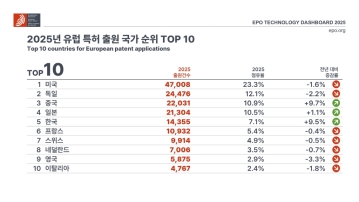
European Patent Applications Surpass 200,000 for the First Time… South Korea Maintains 5th Place, Led by Batteries and Telecommunications
According to the European Patent Office (EPO)'s 'Technology Dashboard 2025', European patent applications last year reached 201,974, surpassing 200,000 for the first time. Korean companies and inventors filed 14,355 applications, representing a 9.5% increase from the previous year and maintaining 5th place by country. Battery, digital communication, and semiconductor technologies led the growth, with Samsung ranking as the top EPO applicant for the second consecutive year and LG reaching 3rd place. The presence of major domestic cities such as Seoul, Suwon, and Yongin was also confirmed. It was also revealed that Korea's European patent strategy is expanding beyond individual technologies to span the entire industry.
2026.03.24by 명세환 기자
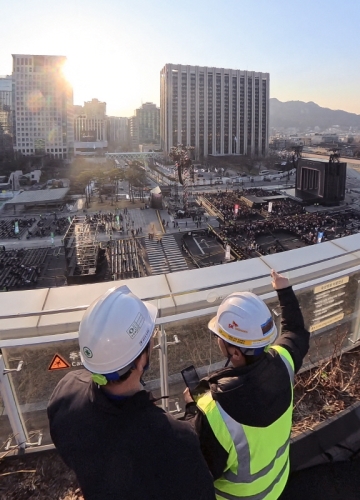
SK Telecom First Applies AI-Based Network Operations at Gwanghwamun K-Pop Concert
SK Telecom announced that it applied an AI-based network operation system for the first time at a large-scale K-pop concert held in the Gwanghwamun area of Seoul on March 21st, managing communication quality throughout the event. Mobile data usage during the three hours before and after the concert reached 12.15TB, approximately doubling compared to the same time slot the previous weekend. SK Telecom monitored traffic using the AI system 'A-One' in five-minute and 50-meter units to respond to potential overload situations, while also operating temporary communication facilities and on-site personnel in parallel. This case is interpreted as confirmation of the practical applicability of AI-based autonomous network operation in an environment where demand from dense events and foreign users increases simultaneously.
2026.03.23by 명세환 기자











