This page was machine-translated and may differ from the original. View original
Revisiting “5G,” the Core Infrastructure of the Fourth Industrial Revolution Era

5G Leads the Intelligence of the Fourth Industrial Revolution
Ultra-high speed, low latency, ultra-connectivity 5G, going beyond mobile
KT is making multifaceted efforts to commercialize 5G for the first time in the world in March 2019. It is expected that 5G will be commercialized in most developed countries worldwide, as well as in China, by 2020. At this juncture, with 5G commercialization not far off, we examine the role 5G plays in various industrial sectors and the conditions that must be met to fulfill that role.
5G, the core of the Fourth Industrial Revolution era 
The Fourth Industrial Revolution is realized through intelligence.
If past industrial revolutions were achieved through mechanization, industrialization, and informatization, the Fourth Industrial Revolution will be achieved through intelligence. The Fourth Industrial Revolution is an intelligence revolution based on hyper-connectivity, triggered by digital technology. Once the Fourth Industrial Revolution is completed, innovative changes will occur across national systems, industries, society, and the overall quality of life.
The Fourth Industrial Revolution will change the industrial structure. To win the competition, one must now be able to process more data faster and simultaneously than others. Furthermore, competition will be centered around platforms.
The employment structure will also change. Simple, repetitive tasks will be automated, while the value of creative and emotional work will rise. However, there will not be only positive changes. While there is optimism that human life will become easier, pessimism is simultaneously being raised that only a tiny minority will be able to enjoy the benefits of the revolution.
What is certain is that the Fourth Industrial Revolution will change human life in one way or another, and failure to do so will result in inability to survive. So, what should be done to effectively respond to the Fourth Industrial Revolution? We must stay true to the basics. In other words, we must adequately prepare for the commercialization of 5G. 5G is the foundation upon which the Fourth Industrial Revolution is realized. Without 5G, the Fourth Industrial Revolution cannot be achieved.
Features of 5G and Frequency Bands
The characteristics of 5G are 'ultra-high speed', 'low latency', and 'ultra-connectivity'.
5G is an ultra-high-speed mobile communication technology that is faster than the previous generation. It enables 4K and 8K UHD broadcasting and processes large amounts of data to smoothly implement VR and AR. 5G processes data ranging from 100 Mbps to a maximum of 20 Gbps per user, which is 20 times higher than LTE (4G).
The latency of 5G is extremely short. While LTE has a latency of 10ms, 5G has a latency of 1ms, which is 10 times shorter. Communication that takes place in near real-time can even transmit tactile sensations, remotely control robots in real time, and effectively control autonomous vehicles and drones.
5G can connect numerous devices simultaneously. While LTE connects up to 100,000 devices per square kilometer, 5G can connect up to 1 million devices.
These three characteristics of 5G have opened a new path for communication distinct from previous generations. While mobile communication up to LTE focused on human-to-human communication, 5G focuses on communication between humans and objects, and between objects. With the advent of communication with objects, mobile communications is no longer confined solely to the industry. This is because a foundation has been established for convergence with other industries. 
5G Frequency Auction Results
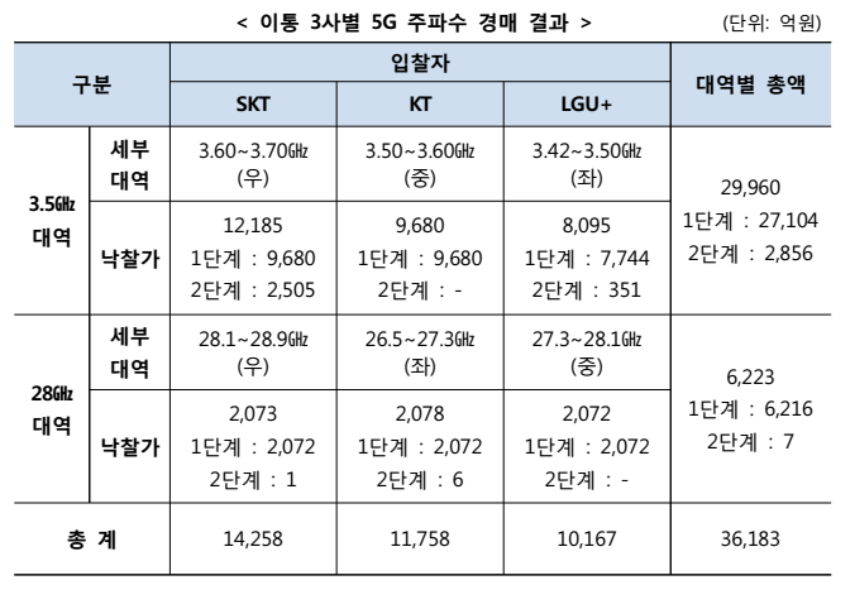
Last December, 3GPP, a technical cooperation organization for mobile telecommunications standardization that establishes international standards for wireless communication, selected the 3.5GHz and bands above 24GHz as 5G frequencies, along with the existing LTE bands. To achieve the world's first 5G commercialization, the Korean government allocated 5G frequencies early last June. As a result of the frequency auctions held by the three mobile carriers, the winning bids for the 3.5GHz band were at least four times and up to six times higher than those for the bands above 24GHz. This indicates that the 3.5GHz band is considered the core band for 5G.
The future direction of 5G
The International Telecommunication Union (ITU) predicted 5G services in three service scenarios of ultra-high speed, low latency, and ultra-connectivity, and presented eight key performance indicators related to this. ▲Maximum transmission speed (10~50 Gbits/s) ▲User perceived transmission speed (100 Mbit/s~1 Gbit/s) ▲Frequency efficiency (5 times that of IMT-Advanced) ▲High-speed mobility (500 km/h) ▲Transmission delay (1 ms) ▲Maximum number of connected devices (106~107 per km² ) ▲Energy efficiency (50~100 times that of IMT-Advanced) ▲Data processing capacity per area (1~10 TB/s/km² or 10 Tbps/Km).
These performance indicators consist of core 5G technologies such as mmWAVE, small cells, massive MIMO, beamforming, and full duplex. The 5G requirements desired by the industry vary depending on the characteristics of the industry. Therefore, devices and services must be developed by focusing on the 5G technologies required by specific industries.
This year, the Ministry of Science and ICT is promoting 5G convergence service pilot projects. The purpose is to reduce private investment risks and identify areas for regulatory improvement. The Ministry will invest 170 billion won by 2020 to enable the entire industry to discover new growth engines based on 5G. Furthermore, it will develop and demonstrate technologies and services in collaboration with demand agencies across five fields: smart transportation, smart cities, smart factories, disaster safety, and immersive media.
Points to Note for 5G Device Development 
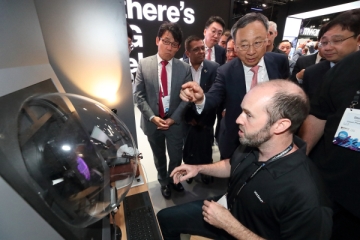
SK Telecom Holobox
Home routers/5G routers (Customer Premises Equipment, CPE) are still large due to issues such as overheating, but recently, there has been an increase in cases where these 5G routers are sold combined with AI speakers. SK Telecom's 'HoloBox' is a prime example.
Immersive Media Services / Low Latency: In order for users to enjoy AR and VR-based immersive media services, low latency of approximately 5ms for visual information and 1ms for tactile information must be achieved. Additionally, to provide stable immersive media services, a bandwidth of about 90Mbps per person is required. Related products are still limited to the level of glasses. Representative examples include Intel's smart glasses 'Vaunt', Microsoft's 'HoloLens', and Google's 'Daydream'.
Video-based real-time city monitoring service / Approximately 5.5 Mbps of bandwidth is required to transmit a single Full HD video at 30 fps. For unit video transmission and management, support for a maximum transmission speed of approximately 50 Gbps and a user transmission speed of 1 Gbps or more is required.
For unmanned smart manufacturing plant operation services/ precise motion control of production line robots and logistics robots, it is necessary to satisfy a latency of less than 1ms and packet reliability of more than 99%. To manage production equipment and related sensors in multiple factories via wireless communication, hyper-connectivity performance is required to manage more than 106 terminals per km without traffic.
For on-demand autonomous driving traffic services, cooperative driving, and remote driving in dense environments such as urban areas, a transmission rate of over 25Gbps, a latency of less than 2ms, and precise location analysis of less than 0.1m are required. In the case of LTE V2X technology, the transmission rate was 1Gbps, the latency was 100ms, and the location analysis error was 50m, which was at a level where practical use was impossible. Going forward, it is necessary to provide a comprehensive range of information, including the surrounding environment, vehicle status, and infotainment, through the integration of ADAS equipment and mobile phones. 
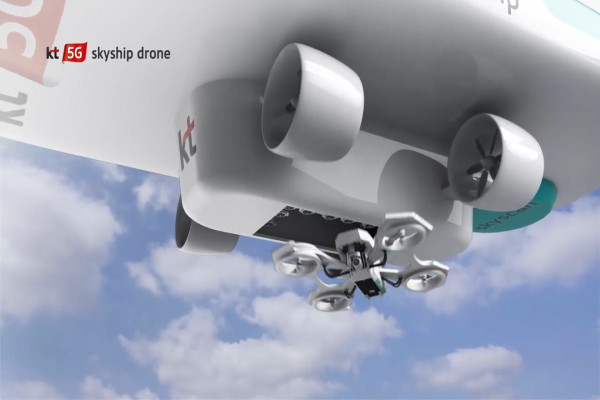
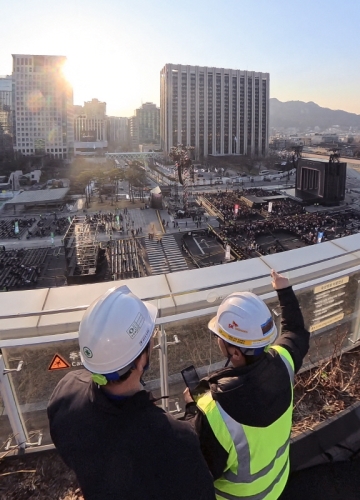
KT Disaster Response 5G Drone
Disaster Response Services / mMTC and URLLC are required to control the scene in real time using various sensors, such as building fire sensors, wearable device sensors, and smart textile sensors. Fire departments, police, and medical institutions use multiple radios (UHF) and terminals (TRS) for smooth rescue operations, but problems often arise due to radio interference and radio channel congestion. 5G is necessary to guarantee the communication network performance required for disaster response. Furthermore, there is increasing demand for and ongoing development of smart helmets that transmit disaster situation video in real time, smart fire suits that assess the status of disaster situations, and wearable robots that provide physical information to firefighters.
Beyond smartphones
Even if 5G is commercialized, LTE and 3G will not be replaced by 5G all at once. Regions where 5G commercialization is scheduled within one to two years are limited to South Korea, China, Japan, North America, and the EU. LTE, 3G, and even 2G will coexist with 5G for a long time. This is because 5G differs from previous generations in its uses and capabilities.
The biggest difference between 5G and the previous generation is that 5G is not tied to mobile phones alone. The development of LTE was driven by the rapid growth of smartphones and YouTube. Therefore, it is true that its direction of development was constrained by smartphones. However, the ultra-high speed, low latency, and ultra-connectivity characteristics of 5G enable things that were impossible with existing LTE. Smartphones are already an inseparable part of our lives. However, the future of 5G lies elsewhere.
Ultra-high speed, low latency, ultra-connectivity 5G, going beyond mobile
KT is making multifaceted efforts to commercialize 5G for the first time in the world in March 2019. It is expected that 5G will be commercialized in most developed countries worldwide, as well as in China, by 2020. At this juncture, with 5G commercialization not far off, we examine the role 5G plays in various industrial sectors and the conditions that must be met to fulfill that role.
5G, the core of the Fourth Industrial Revolution era

The Fourth Industrial Revolution is realized through intelligence.
If past industrial revolutions were achieved through mechanization, industrialization, and informatization, the Fourth Industrial Revolution will be achieved through intelligence. The Fourth Industrial Revolution is an intelligence revolution based on hyper-connectivity, triggered by digital technology. Once the Fourth Industrial Revolution is completed, innovative changes will occur across national systems, industries, society, and the overall quality of life.
The Fourth Industrial Revolution will change the industrial structure. To win the competition, one must now be able to process more data faster and simultaneously than others. Furthermore, competition will be centered around platforms.
The employment structure will also change. Simple, repetitive tasks will be automated, while the value of creative and emotional work will rise. However, there will not be only positive changes. While there is optimism that human life will become easier, pessimism is simultaneously being raised that only a tiny minority will be able to enjoy the benefits of the revolution.
What is certain is that the Fourth Industrial Revolution will change human life in one way or another, and failure to do so will result in inability to survive. So, what should be done to effectively respond to the Fourth Industrial Revolution? We must stay true to the basics. In other words, we must adequately prepare for the commercialization of 5G. 5G is the foundation upon which the Fourth Industrial Revolution is realized. Without 5G, the Fourth Industrial Revolution cannot be achieved.
Features of 5G and Frequency Bands
The characteristics of 5G are 'ultra-high speed', 'low latency', and 'ultra-connectivity'.
5G is an ultra-high-speed mobile communication technology that is faster than the previous generation. It enables 4K and 8K UHD broadcasting and processes large amounts of data to smoothly implement VR and AR. 5G processes data ranging from 100 Mbps to a maximum of 20 Gbps per user, which is 20 times higher than LTE (4G).
The latency of 5G is extremely short. While LTE has a latency of 10ms, 5G has a latency of 1ms, which is 10 times shorter. Communication that takes place in near real-time can even transmit tactile sensations, remotely control robots in real time, and effectively control autonomous vehicles and drones.
5G can connect numerous devices simultaneously. While LTE connects up to 100,000 devices per square kilometer, 5G can connect up to 1 million devices.
These three characteristics of 5G have opened a new path for communication distinct from previous generations. While mobile communication up to LTE focused on human-to-human communication, 5G focuses on communication between humans and objects, and between objects. With the advent of communication with objects, mobile communications is no longer confined solely to the industry. This is because a foundation has been established for convergence with other industries.

5G Frequency Auction Results
Last December, 3GPP, a technical cooperation organization for mobile telecommunications standardization that establishes international standards for wireless communication, selected the 3.5GHz and bands above 24GHz as 5G frequencies, along with the existing LTE bands. To achieve the world's first 5G commercialization, the Korean government allocated 5G frequencies early last June. As a result of the frequency auctions held by the three mobile carriers, the winning bids for the 3.5GHz band were at least four times and up to six times higher than those for the bands above 24GHz. This indicates that the 3.5GHz band is considered the core band for 5G.
The future direction of 5G
The International Telecommunication Union (ITU) predicted 5G services in three service scenarios of ultra-high speed, low latency, and ultra-connectivity, and presented eight key performance indicators related to this. ▲Maximum transmission speed (10~50 Gbits/s) ▲User perceived transmission speed (100 Mbit/s~1 Gbit/s) ▲Frequency efficiency (5 times that of IMT-Advanced) ▲High-speed mobility (500 km/h) ▲Transmission delay (1 ms) ▲Maximum number of connected devices (106~107 per km² ) ▲Energy efficiency (50~100 times that of IMT-Advanced) ▲Data processing capacity per area (1~10 TB/s/km² or 10 Tbps/Km).
These performance indicators consist of core 5G technologies such as mmWAVE, small cells, massive MIMO, beamforming, and full duplex. The 5G requirements desired by the industry vary depending on the characteristics of the industry. Therefore, devices and services must be developed by focusing on the 5G technologies required by specific industries.
This year, the Ministry of Science and ICT is promoting 5G convergence service pilot projects. The purpose is to reduce private investment risks and identify areas for regulatory improvement. The Ministry will invest 170 billion won by 2020 to enable the entire industry to discover new growth engines based on 5G. Furthermore, it will develop and demonstrate technologies and services in collaboration with demand agencies across five fields: smart transportation, smart cities, smart factories, disaster safety, and immersive media.
Points to Note for 5G Device Development

SK Telecom Holobox
Home routers/5G routers (Customer Premises Equipment, CPE) are still large due to issues such as overheating, but recently, there has been an increase in cases where these 5G routers are sold combined with AI speakers. SK Telecom's 'HoloBox' is a prime example.
Immersive Media Services / Low Latency: In order for users to enjoy AR and VR-based immersive media services, low latency of approximately 5ms for visual information and 1ms for tactile information must be achieved. Additionally, to provide stable immersive media services, a bandwidth of about 90Mbps per person is required. Related products are still limited to the level of glasses. Representative examples include Intel's smart glasses 'Vaunt', Microsoft's 'HoloLens', and Google's 'Daydream'.
Video-based real-time city monitoring service / Approximately 5.5 Mbps of bandwidth is required to transmit a single Full HD video at 30 fps. For unit video transmission and management, support for a maximum transmission speed of approximately 50 Gbps and a user transmission speed of 1 Gbps or more is required.
For unmanned smart manufacturing plant operation services/ precise motion control of production line robots and logistics robots, it is necessary to satisfy a latency of less than 1ms and packet reliability of more than 99%. To manage production equipment and related sensors in multiple factories via wireless communication, hyper-connectivity performance is required to manage more than 106 terminals per km without traffic.
For on-demand autonomous driving traffic services, cooperative driving, and remote driving in dense environments such as urban areas, a transmission rate of over 25Gbps, a latency of less than 2ms, and precise location analysis of less than 0.1m are required. In the case of LTE V2X technology, the transmission rate was 1Gbps, the latency was 100ms, and the location analysis error was 50m, which was at a level where practical use was impossible. Going forward, it is necessary to provide a comprehensive range of information, including the surrounding environment, vehicle status, and infotainment, through the integration of ADAS equipment and mobile phones.

KT Disaster Response 5G Drone
Disaster Response Services / mMTC and URLLC are required to control the scene in real time using various sensors, such as building fire sensors, wearable device sensors, and smart textile sensors. Fire departments, police, and medical institutions use multiple radios (UHF) and terminals (TRS) for smooth rescue operations, but problems often arise due to radio interference and radio channel congestion. 5G is necessary to guarantee the communication network performance required for disaster response. Furthermore, there is increasing demand for and ongoing development of smart helmets that transmit disaster situation video in real time, smart fire suits that assess the status of disaster situations, and wearable robots that provide physical information to firefighters.
Beyond smartphones
Even if 5G is commercialized, LTE and 3G will not be replaced by 5G all at once. Regions where 5G commercialization is scheduled within one to two years are limited to South Korea, China, Japan, North America, and the EU. LTE, 3G, and even 2G will coexist with 5G for a long time. This is because 5G differs from previous generations in its uses and capabilities.
The biggest difference between 5G and the previous generation is that 5G is not tied to mobile phones alone. The development of LTE was driven by the rapid growth of smartphones and YouTube. Therefore, it is true that its direction of development was constrained by smartphones. However, the ultra-high speed, low latency, and ultra-connectivity characteristics of 5G enable things that were impossible with existing LTE. Smartphones are already an inseparable part of our lives. However, the future of 5G lies elsewhere.
본 기사에 대한 정정·반론·추후보도 청구는 보도 청구 안내를, 그간 게재된 보도문은 정정·반론보도 모아보기를 참고해 주세요.