


The purpose of using AI appears to be to save time and money.
 Published2018.09.24 07:01
52% of respondents feel uncomfortable with emotional AI
Concerns over personal information protection are rising when using AI.
Gartner announced the results of an AI perception survey conducted for one month from January to February 2018. The survey results showed that the primary reason consumers use AI is saving time and money.
"Generally, the three main reasons consumers use other personal technologies are social interaction, self-image projection, and entertainment," said Stephanie Baghdassarian, research director at Gartner. "In contrast, AI appears to be used by consumers to obtain more tangible and significant benefits."
58% of respondents to the survey said they would be willing to use AI if it could save time by performing some of the work for them.
In addition, 53% of respondents said they would use AI if it could save them money. Research Director Stephanie Bagdasarian said, “For example, consumers can use AI to find places to buy desired items at the lowest prices or find the optimal route to save on tolls and fuel costs.”
In addition, 47% of respondents answered that they would use AI if they could access information more easily. This includes using AI to find routes and transportation, and identifying detailed information regarding personal consumption.
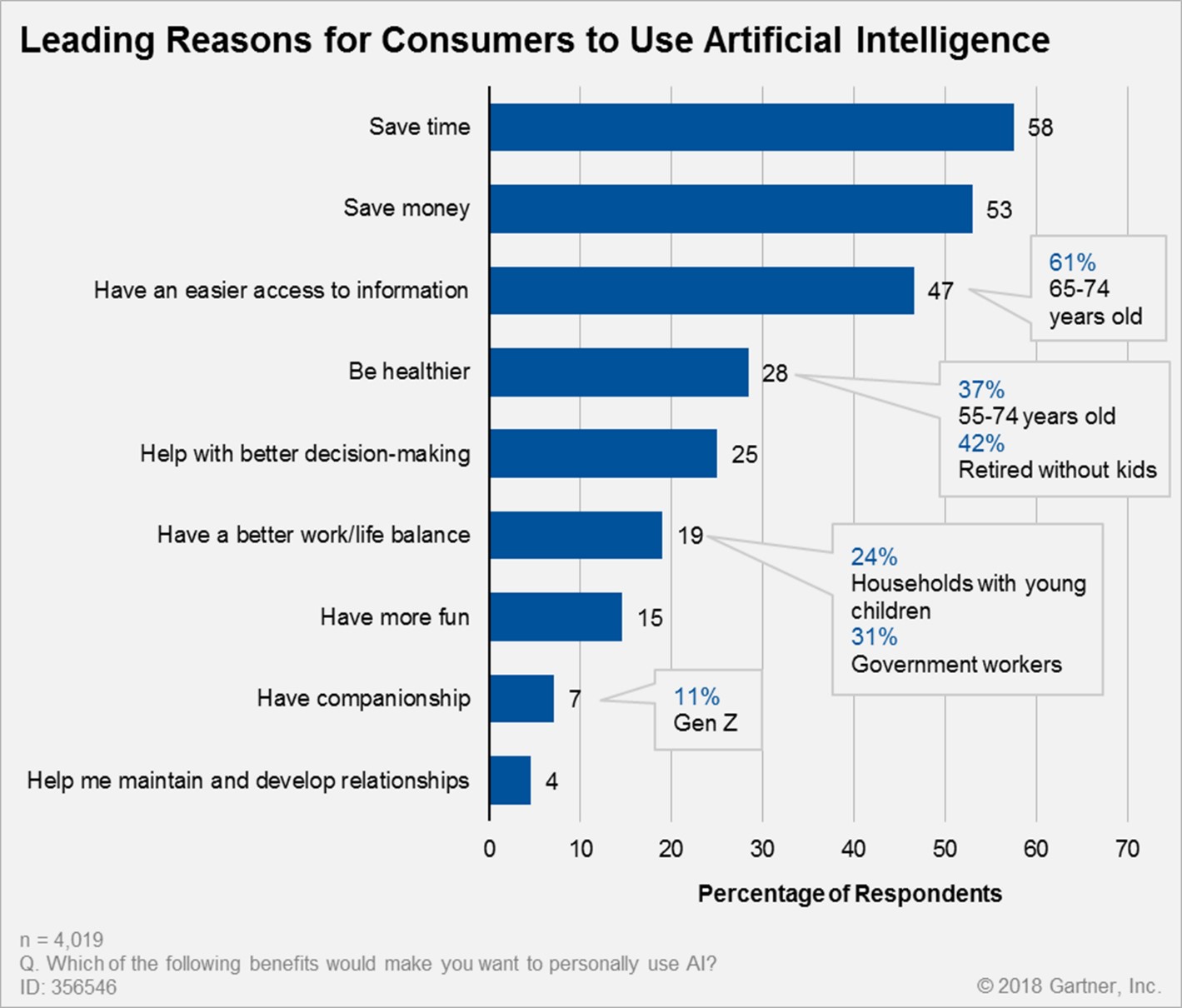
Reasons why consumers use AI
Consumers who feel uncomfortable with emotional AI
“Consumers are ready to form a new relationship with AI technology, but their preferences regarding how that relationship is formed are clear,” said Anthony Mullen, research director at Gartner.
According to survey results, more than 70% of respondents said they feel comfortable with AI analyzing their vital signs or recognizing their voice or face for secure transactions.
However, regarding AI reading emotions from users' voices or facial expressions, 52% of respondents stated that they do not want AI to analyze their facial expressions to understand what emotions they are feeling. Furthermore, 63% of respondents indicated that they do not want an approach where AI is constantly listening to learn more about the user.
"Not everyone who agrees to AI observing them has the same motivation," said Stephanie Bagdasarian, Research Director. "Millennials value AI better understanding them and interacting based on their behavior, emotions, and needs. Baby Boomers, on the other hand, demand safety and security regarding AI observation." "Generation X takes a similar attitude to Millennials regarding AI understanding their needs, and a similar attitude to Baby Boomers regarding safety and security," he explained.
Concerns about personal information protection
It has been found that consumers are expressing skepticism and concern regarding the impact of AI usage on personal information protection.
“65% of respondents believe that AI will destroy rather than improve privacy,” said Research Director Anthony Mullen. “As communication with systems shifts increasingly rapidly from humans to machines, IT leaders must personalize AI approaches to customer engagement to cater to diverse perspectives and preferences.” He added, "In addition, we must respect users' personal information and use AI tools to support privacy and transparency goals."
Gartner's customers can find more details in “ Market Insights: Accelerate Consumer AI Use with Efficiency, Security, and Sentiment ” and “ Market Insights: How Consumers Want to Interact with AI – Interface, Trust, and Autonomy .”
Comments
Related news

Global Security Spending on the Rise, Korea Nearing 2 Trillion Won
Gartner forecasts that global spending on information security products and services in 2018 will reach $114 billion, a 12.4% increase from the previous year. Additionally, spending in 2019 is expected to grow by approximately 8.7% to reach $124 billion. Korea's security-related spending in 2018 is projected to reach 2 trillion won, a 4% increase from the previous year, and in 2019, the scale is expected to grow by 9.4% to approach 2.2 trillion won.
2018.08.15by 이수민 기자
Huawei surpasses Apple to become the world's second-largest smartphone company.
Gartner announced global smartphone sales for the second quarter of 2018. Huawei surpassed Apple for the first time, securing the second position among global smartphone companies. Meanwhile, Samsung Electronics maintained its position as the number one smartphone company globally, despite a 12.7% decline in smartphone sales in the second quarter of 2018. In the smartphone OS market, Google's Android achieved an 88% market share in the second quarter of 2018, significantly outpacing Apple's iOS, which stood at 11.9%.
2018.09.06by 이수민 기자

Global Public Cloud Market to Grow 17.3% in 2019
Gartner announced its forecast for the global public cloud services market size in 2019. As demand for integrated IaaS and PaaS offerings drives cloud infrastructure adoption, the global public cloud market is expected to approach $206.2 billion in 2019. Meanwhile, domestic SaaS end-user spending is projected to reach approximately 840.4 billion won in 2018, accounting for nearly half of total cloud service spending, and is forecast to exceed 1 trillion won in 2019.
2018.09.15by 이수민 기자

[e4ds Tech Day 2026 ⑨] Sim Sang-gyu, Autocrypt CTO: "In the Physical AI Era, Automotive Security Must Extend Beyond the Vehicle"
At e4ds Tech Day 2026, Sim Sang-gyu, CTO of Autocrypt, explained automotive cybersecurity strategies in the era of Physical AI and SDV (Software-Defined Vehicle). Automobiles are evolving as part of an ecosystem connected to AI, cloud, chargers, IoT, and robots, and he emphasized that the scope of security must expand beyond the vehicle interior to the entire connected environment. In particular, AI model tampering, adversarial attacks, OTA updates, and EV charger hacking were identified as major threats. He explained that response measures require zero trust, AI model integrity protection, intrusion detection, Security by Design and Default, and full lifecycle security management, and that proactive security system establishment beyond regulatory compliance is critical for securing future mobility competitiveness.
2026.10.12by 배종인 기자
NVIDIA to Invest $1 Billion in U.S. Science Over Next Five Years
NVIDIA has announced plans to invest $1 billion over the next five years to strengthen U.S. scientific and technological competitiveness. The company will enhance cutting-edge artificial intelligence research and development capabilities in key areas including quantum computing, healthcare, and energy security, while expanding support for higher education research institutions and cloud service providers. NVIDIA is participating as a major industry partner in the White House Office of Science and Technology Policy's Genesis Mission, and is promoting supercomputer construction in collaboration with national laboratories including Argonne and Los Alamos.
2026.10.12by 배종인 기자











