


Global Robotic Process Automation Software Spending Increased by 57% in 2018
 Published2018.11.18 07:01
With sustained growth, it will reach $2.4 billion in 2022
RPA Adoption Rate Expected to Increase in 2019 Due to Price Decline

Gartner
On the 15th, Gartner announced its forecast for robotic process automation (RPA) software spending in 2018.
According to Gartner, global spending on RPA software in 2018 is expected to reach $680 million, a 57% increase from last year. If this growth trend continues, total spending on RPA software in 2022 is expected to reach $2.4 billion.
“Organizations are adopting RPA technology as an easy and fast solution to automate manual tasks,” said Cathy Tornbohm, Vice President at Gartner. “While some employees continue to perform simple tasks such as manually cutting, pasting, and modifying data, replacing them with RPA tools reduces errors and improves data quality.”

The entities that adopt RPA the most are banks, insurance companies, and telecommunications companies.
Today, the largest adopters of RPA are banks, insurance companies, utilities, and telecommunications companies. Vice President Tonboum explained, "Generally, these organizations struggle to integrate different elements of accounting and human resource management systems, so they choose RPA solutions to automate existing manual tasks or processes, or to automate the functions of legacy systems."
RPA tools utilize a combination of user interface interaction description technologies to mimic the "manual" paths humans take to complete tasks. The market offers a wide range of solutions using tools that operate on personal desktops or enterprise servers.
Gartner forecasts that 60% of organizations with revenue of over $1 billion will implement RPA tools by the end of this year. It is expected that by the end of 2022, 85% of large and ultra-large enterprises will have implemented some form of RPA. Vice President Tonboum added, "In 2019, the average price of RPA will drop by about 10% to 15%, driving adoption rates, and adoption will increase as organizations expect to generate better business results, such as cost reduction, improved accuracy, and enhanced compliance, through the technology."
However, RPA is not a universally applicable technology, and in some cases, other automation solutions achieve better results. RPA solutions are most effective when utilized by organizations to automate existing tasks or processes by building systematic data, add automated functions to legacy systems, and connect them to external systems that cannot be linked via other IT options.
RPA Becomes Mainstream
As organizations seek ways to reduce costs, connect with legacy applications, and achieve high ROI, RPA tools are currently at the 'Peak of Inflated Expectations' stage of the 2018 Gartner AI Hype Cycle. However, the potential to achieve a strong ROI depends on how well RPA fits the requirements of each organization.
Vice President Tonboum said, "We expect the number of RPA vendors to increase in the near future, and interest from software companies, such as software testing firms and business process management providers, will grow as they seek to profit from these capabilities."

RPA product vendors are trying to integrate AI capabilities.
There is also a growing trend to integrate AI capabilities into product lines. This phenomenon occurs because RPA vendors are adding or integrating machine learning and AI technologies to provide more types of automation.
RPA Implementation Projects Must Be Pre-evaluated
To successfully execute RPA projects, leaders must first evaluate possible RPA use cases within the organization and focus on revenue-generating activities.
Vice President Tonboum advised, “RPA should not be used simply to reduce labor costs,” adding, “Organizations must establish clear expectations regarding what the tool can do and how it can be utilized to support digital transformation as part of an automation strategy.”
The next step is to verify the rapid results of RPA. This task may involve personnel simply moving data between systems, or it may entail structured and digitized data processed by predefined rules. While the investigated use cases represent areas where RPA can provide a high ROI, it is important to consider existing alternative tools and services that offer a significant portion of the necessary functionality at a reasonable price. These alternatives can be used in parallel with RPA or as hybrid solutions. Additionally, when selecting a vendor, you should request future AI-based options.
Comments
Related news
LG Electronics Improves Productivity in Over 200 Tasks with AI and Robotics
LG Electronics has implemented Robotic Process Automation technology across 120 tasks spanning 12 job categories since the beginning of this year. The company plans to additionally apply this technology to over 100 tasks by the end of the year. RPA is a technology that automates repetitive and standardized tasks that would otherwise need to be handled by people using robot software. The volume of tasks currently being processed by robot software is equivalent to over 3,000 hours per month in human work hours.
2018.11.01by 이수민 기자

Gartner: "Asia-Pacific's Digital Maturity Has Reached a Turning Point"
Gartner has released survey results on digital maturity in the Asia-Pacific region. According to Gartner's survey, 31% of Asia-Pacific CIOs stated that they have advanced their organizations' digital initiatives to the scaling phase. Additionally, 34% of Asia-Pacific CIOs identified AI as the technology that will bring the most innovative change to their organizations in 2019, with AI ranking first, surpassing data and analytics, which currently stands at 26% in second place.
2018.11.01by 이수민 기자
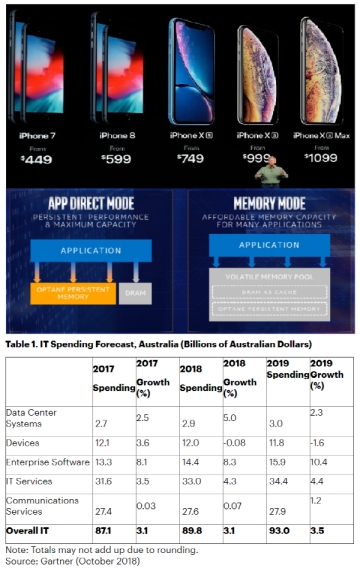
Intel Unveils Next-Generation Data Center Strategy
[Americas Weekly IT News] [1] Apple Unveils Budget-Friendly MacBook Air , [2] Facebook Strengthens Open Source AI Platform , [3] Intel Reveals Next-Generation Data Center Strategy , [4] "Apple to Stop Disclosing iPhone Sales Figures" , [5] Gartner: "Australian IT Market to Grow 3.5% Next Year"
2018.11.07by 류아연 외신

[e4ds Tech Day 2026 ⑨] Sim Sang-gyu, Autocrypt CTO: "In the Physical AI Era, Automotive Security Must Extend Beyond the Vehicle"
At e4ds Tech Day 2026, Sim Sang-gyu, CTO of Autocrypt, explained automotive cybersecurity strategies in the era of Physical AI and SDV (Software-Defined Vehicle). Automobiles are evolving as part of an ecosystem connected to AI, cloud, chargers, IoT, and robots, and he emphasized that the scope of security must expand beyond the vehicle interior to the entire connected environment. In particular, AI model tampering, adversarial attacks, OTA updates, and EV charger hacking were identified as major threats. He explained that response measures require zero trust, AI model integrity protection, intrusion detection, Security by Design and Default, and full lifecycle security management, and that proactive security system establishment beyond regulatory compliance is critical for securing future mobility competitiveness.
2026.10.12by 배종인 기자
NVIDIA to Invest $1 Billion in U.S. Science Over Next Five Years
NVIDIA has announced plans to invest $1 billion over the next five years to strengthen U.S. scientific and technological competitiveness. The company will enhance cutting-edge artificial intelligence research and development capabilities in key areas including quantum computing, healthcare, and energy security, while expanding support for higher education research institutions and cloud service providers. NVIDIA is participating as a major industry partner in the White House Office of Science and Technology Policy's Genesis Mission, and is promoting supercomputer construction in collaboration with national laboratories including Argonne and Los Alamos.
2026.10.12by 배종인 기자











