



Samsung presents blueprint for AI diagnostic assistance at the North American Society of Radiology.
 Published2018.11.27 09:59
Exhibition and symposium on medical imaging equipment lineup
AI algorithm-based diagnostic assistance function introduced
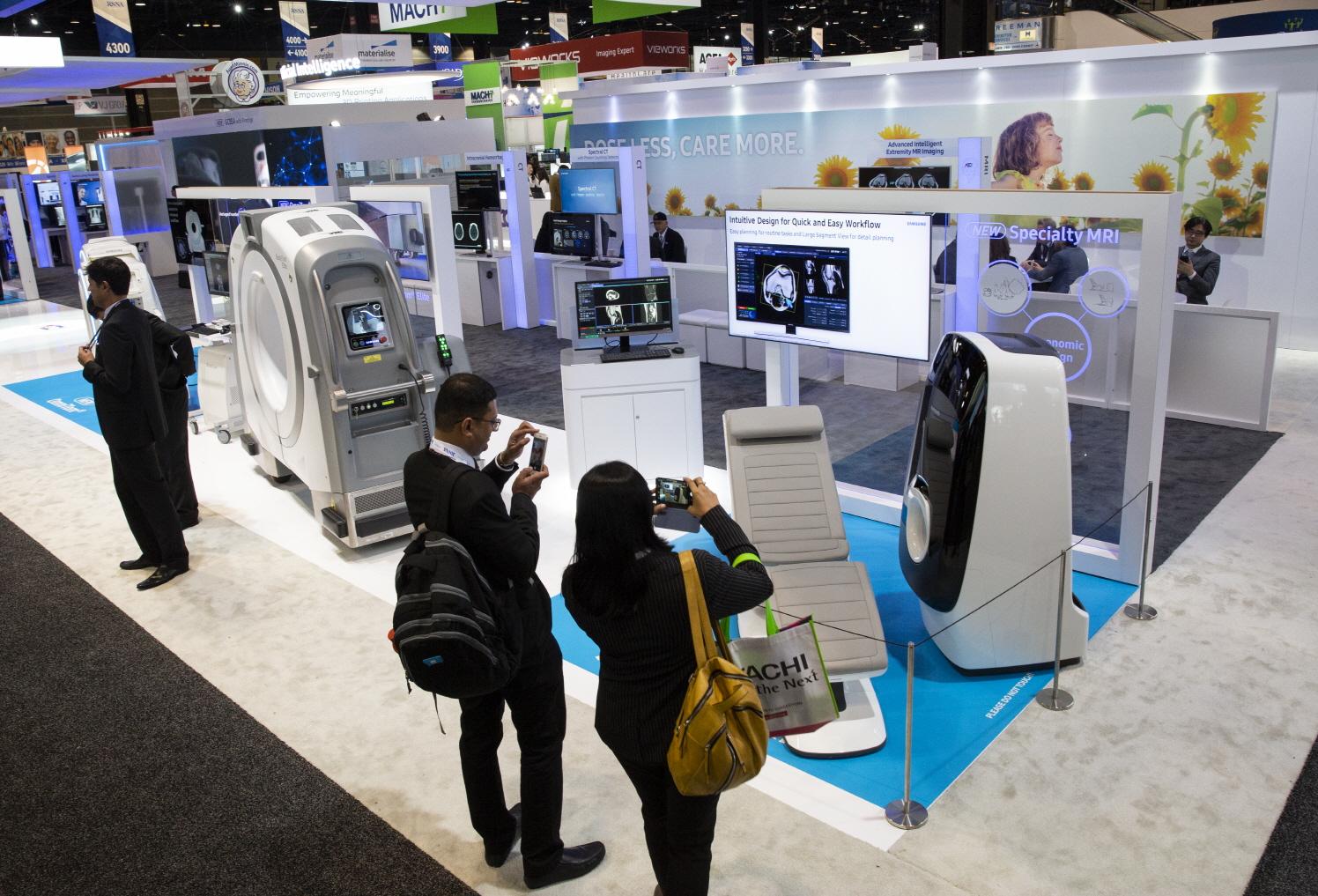
Spectators look at Samsung's limb MRI machine.
Samsung Electronics and Samsung Medison participated in the 'Radiological Society of North America 2018 (RSNA)' held in Chicago, USA from the 25th to the 30th, and unveiled their entire line of imaging diagnostic devices, including ultrasound, digital X-ray, CT (computed tomography), and MRI (magnetic resonance imaging), and showcased Samsung's unique AI diagnostic assistance functions.
The need for AI-based diagnostic devices continues to grow, both to support hospitals and medical staff in developing countries with relatively few doctors per thousand people and to reduce misdiagnosis rates for difficult-to-diagnose lesions.
Considering this medical environment, Samsung is actively applying AI technology, focusing on highly useful functions in each product group, and at this event, it provided an opportunity for academic experts to intensively experience AI-based diagnostic assistance functions.
Visitors look at Samsung's ultrasound diagnostic equipment for radiology.
The 'Ultrasound Zone', which showcased premium ultrasound equipment for radiology, highlighted the 'S-Detect for Breast' function, which analyzes the characteristics of selected lesions in breast ultrasound images using AI technology.
This function improves the accuracy of breast cancer diagnosis by unskilled medical staff by learning big data consisting of approximately 10,000 ultrasound diagnosis cases, helping to determine the presence or absence of lesions, analyzing their characteristics, and providing a standardized diagnosis report.
According to a paper published this year by Professor Tommaso Vincenzo Bartolotta, an Italian radiology expert, using the 'S-Detect Forbreast' function improved diagnostic accuracy from 0.93 to 0.95 on a scale of 1 to 1 for specialists with more than 10 years of experience, and from 0.83 to 0.87 for those with around 4 years of experience, proving that this function is particularly useful in hospitals with a shortage of skilled medical staff.
In 'X-ray Zone', functions that apply AI techniques in image processing were introduced. Representative examples include the 'Bone Suppression' function, which removes the ribs from chest X-ray images to clearly show lung lesions hidden by bones, and 'SimGrid', which provides a similar level of image quality while lowering the radiation dose by one level without the grid, an auxiliary component used for clear images.
According to research results presented by Professor Hong Gil-seon of Seoul Asan Medical Center at the Radiological Society of North America in 2017, the 'Bone Suppression' function helps inexperienced readers interpret difficult lung lesions such as pneumonia, tuberculosis, and lung metastases.
ALND (Auto Lung Nodule Detection), a lung nodule diagnostic assistance function currently under review by the U.S. Food and Drug Administration (FDA), has attracted attention as an AI CAD (Computer Aided Detection) solution based on a deep learning algorithm.
According to research results announced this year by Professor Myung-Jin Jeong of Samsung Seoul Hospital, ALND's detection rate for lung cancer smaller than 3 cm was 92%, which was an average of 7 percentage points higher than when diagnosed by a specialist without using this function.
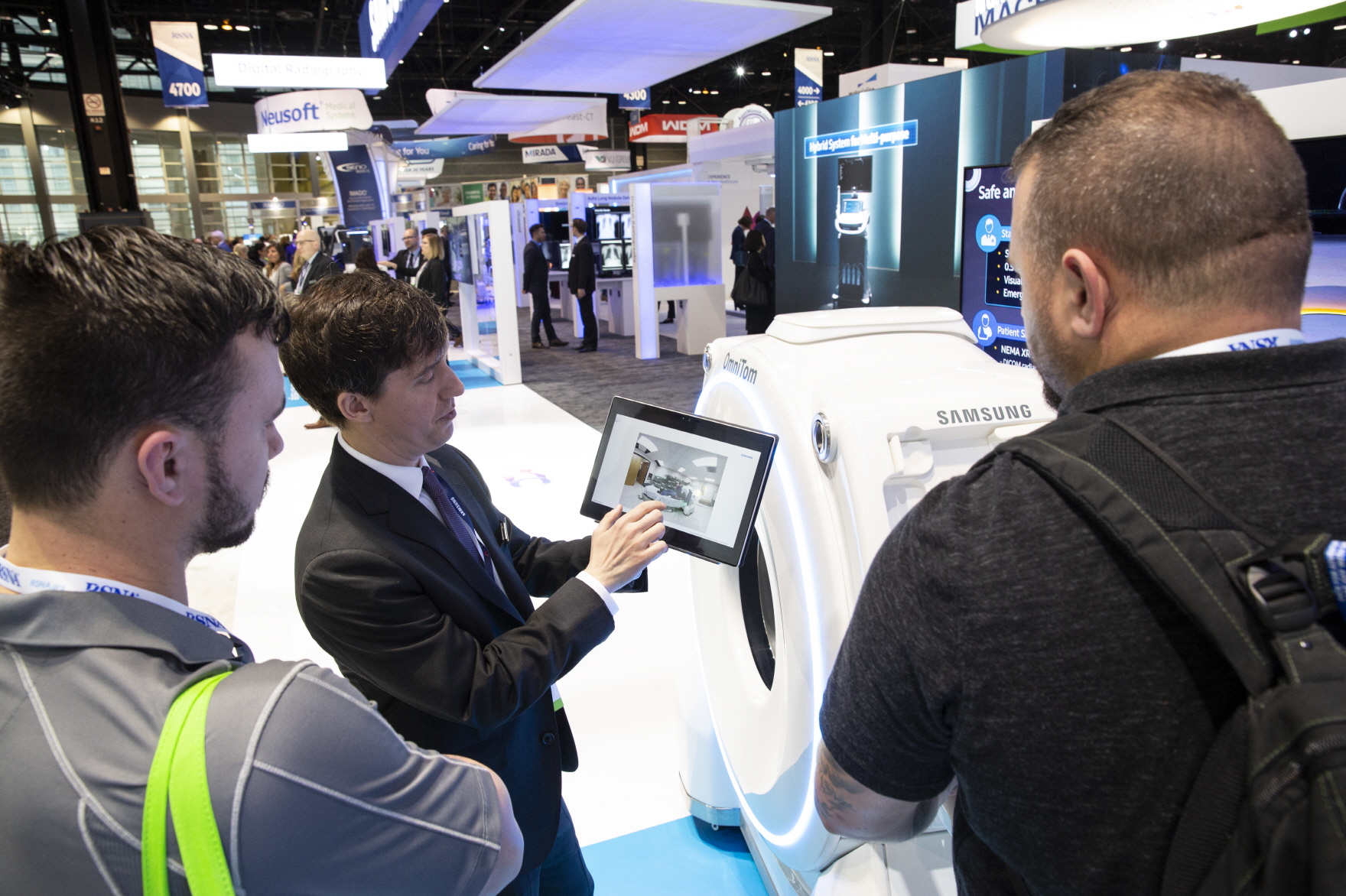
Visitors experience Samsung's mobile CT.
The 'CT Zone' exhibited a mobile CT equipped with a built-in battery that is widely used in various places such as a lung disease CT screening vehicle, a stroke emergency vehicle, intensive care unit, and operating room, and applied AI technology to diagnose stroke patients. The diagnostic assistance function for cerebral hemorrhage that helps in treatment decision-making has been highlighted.
In the 'MRI Zone', a prototype for limb imaging was showcased. It is equipped with a diagnostic assistance function that uses AI technology to compare and learn MRI images of normal people and patients with osteoarthritis, and provides segmented image information on the major tissues of the knee joint in 3D, helping medical staff to more quickly and accurately evaluate the degree of damage to articular cartilage.
In addition to exhibiting diagnostic devices for each product group, Samsung also set up a separate 'AI Zone' so that conference attendees could experience a variety of AI-based diagnostic assistance functions equipped in each product group. It also held a symposium to introduce the core capabilities of Samsung's imaging diagnostic devices that increase diagnostic accuracy and provide a safe treatment environment.
“We are pleased that Samsung’s AI-based diagnostic assistance features applied to existing imaging diagnostic devices are receiving positive responses in the market,” said Dong-soo Jeon, President and CEO of Samsung Medison and Head of the Medical Device Business Division at Samsung Electronics. “As a comprehensive imaging diagnostic device company, we will continue to work closely with hospitals and medical professionals to improve diagnostic accuracy with more advanced AI technology.”
Comments
Related news

Top 10 ICT Issues of 2019: 5G, Edge Computing, RPA, and More
The Information and Communication Technology Promotion Center announced the top 10 ICT issues for 2019. The 10 issues were compiled based on a survey of a total of 1,088 ICT industry professionals conducted from July to October of this year. The issues included 5G, ICT regulatory reform, edge computing and AI semiconductors, next-generation mobility, blockchain, automation and intelligence, eco-friendly ICT, next-generation devices, inter-Korean ICT exchange and cooperation, and China's rise.
2018.11.21by 이수민 기자
Xilinx Zynq UltraScale+ MPSoC Obtains IEC 61508 Specification Certification
Xilinx announced that its Zynq UltraScale+ MPSoC has been evaluated by Exida, a functional safety certification body, as SIL 3 level capable of implementing HFT1 in accordance with the IEC 61508 functional safety specification. Through this evaluation, product developers can now safely implement AI and high-performance systems for safety-critical applications using Xilinx's diverse, highly integrated single-chip MPSoC product portfolio. Youssef Kailirolai, Vice President of Xilinx's Core Vertical Markets Business Unit, stated, "The Zynq UltraScale+ MPSoC is a device designed with safety and security in mind, and it is an ideal architecture supporting IIoT or Industry 4.0 platforms as well as next-generation automotive, aerospace, and AI-based systems."
2018.11.22by 이수민 기자
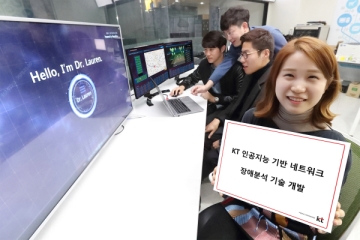
KT uses AI to identify the cause of network outages.
KT has developed Doctor Lorentz, a solution that analyzes communication failures using artificial intelligence technology to identify root causes and facilitate rapid recovery. Doctor Lorentz is a solution that collects operational big data generated in networks and analyzes the data based on artificial intelligence to identify the root cause of failures within a maximum of one minute. Since the system was modeled after learning the surveillance skills of KT experts through artificial intelligence-based training, rapid response is possible by quickly identifying root causes even when unexpected network failures occur.
2018.11.24by 이수민 기자

[e4ds Tech Day 2026 ⑨] Sim Sang-gyu, Autocrypt CTO: "In the Physical AI Era, Automotive Security Must Extend Beyond the Vehicle"
At e4ds Tech Day 2026, Sim Sang-gyu, CTO of Autocrypt, explained automotive cybersecurity strategies in the era of Physical AI and SDV (Software-Defined Vehicle). Automobiles are evolving as part of an ecosystem connected to AI, cloud, chargers, IoT, and robots, and he emphasized that the scope of security must expand beyond the vehicle interior to the entire connected environment. In particular, AI model tampering, adversarial attacks, OTA updates, and EV charger hacking were identified as major threats. He explained that response measures require zero trust, AI model integrity protection, intrusion detection, Security by Design and Default, and full lifecycle security management, and that proactive security system establishment beyond regulatory compliance is critical for securing future mobility competitiveness.
2026.10.12by 배종인 기자
NVIDIA to Invest $1 Billion in U.S. Science Over Next Five Years
NVIDIA has announced plans to invest $1 billion over the next five years to strengthen U.S. scientific and technological competitiveness. The company will enhance cutting-edge artificial intelligence research and development capabilities in key areas including quantum computing, healthcare, and energy security, while expanding support for higher education research institutions and cloud service providers. NVIDIA is participating as a major industry partner in the White House Office of Science and Technology Policy's Genesis Mission, and is promoting supercomputer construction in collaboration with national laboratories including Argonne and Los Alamos.
2026.10.12by 배종인 기자











