


Intel Provides AI Solutions to GE Healthcare's Medical Imaging
 Published2018.12.01 07:02
Intel AI Implements Deep Learning Solutions on Existing Infrastructure
GE Healthcare Provides Fast and Effective Treatment
Medical imaging is the largest and fastest-growing data source in the healthcare industry. While it accounts for 90% of all healthcare data, more than 97% of the information remains unanalyzed or unused.
Until now, processing such a vast amount of medical imaging data has required a long time from image acquisition to diagnosis and treatment. Furthermore, rapid analysis and delivery of images are essential, as there is a possibility that a patient's condition may deteriorate while waiting for a diagnosis.
Intel and GE Healthcare announced on November 30 that they have entered into a collaboration to provide AI solutions across various medical imaging formats to prioritize and streamline the process of treating patients.
Intel implements deep learning solutions on existing infrastructure with AI software solutions, and GE Healthcare provides more efficient and effective treatment. In addition, better value can be delivered to patients and healthcare providers by improving the decision-making process.
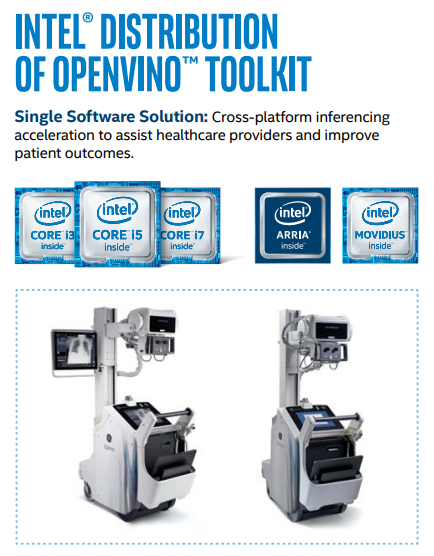
Intel Distribution optimizes workloads across multiple Intel processors.
GE Healthcare is accelerating deep learning in point-of-care medical imaging by leveraging the Intel Distribution of OpenVINO Toolkit on Intel processor-based X-ray systems. Using these systems, X-ray technicians, critical care teams, and radiologists can immediately review critical clues to rapidly process patient diagnoses.
A key application of this technology is the early detection of pneumothorax, a fatal lung disease. Radiologists can utilize predictive algorithms optimized for scanning and detecting pneumothorax within seconds during point-of-care, enabling rapid response for clinical diagnosis and the reallocation of X-ray priorities.
In initial tests, when GE Healthcare applied the OpenVINO toolkit to its pneumothorax model, the Intel processor-based X-ray system recorded a detection speed 3.3 times faster compared to the unapplied model. Performance improved across all models through optimization, with the pneumothorax model showing the best results. Overall, the speed of pneumothorax detection decreased from over 3 seconds to within a few seconds.
Keith Bigelow, Senior Vice President of Portfolio Strategy at GE Healthcare Edison, said, “GE Healthcare achieved a 3.3x improvement in deep learning optimization during the initial testing phase with the OpenVINO toolkit running on existing Intel processors,” adding, “This enables early prioritization and communication regarding critical conditions, allowing us to provide faster treatment to our patients.”
He also added, "GE Healthcare can transform the work of radiologists and patient care by extending AI solutions across various imaging equipment through Intel technology."
Comments
Related news

On Semiconductor Strengthens Bluetooth 5 Wireless Portfolio with New SiP Module
On Semiconductor unveiled a new SiP module and expanded its Bluetooth 5 certified wireless SoC RSL10 product family. The RSL10 devices, which support Bluetooth Low Energy wireless profiles, can be easily applied to all connected applications including sports, fitness, mobile health wearables, smart locks, and consumer appliances.
2018.09.13by 이수민 기자
Intel Accelerates Launch of Multimode Modem to Open Global 5G World
Intel has unveiled the "Intel XMM 8160 5G Modem," optimized for connecting 5G to devices. It is scheduled to be released in the second half of 2019, more than six months ahead of schedule, and supports a maximum speed of up to 6 gigabits per second—3 to 6 times faster than the latest LTE modems currently on the market. The Intel XMM 8160 is a multimode modem that supports legacy 4G/3G/2G radio as well as the new 5G NR standard including SA and NSA on a single chipset.
2018.11.15by 이수민 기자

Mobileye Reduces London Bus Collision Rate by 29% with Collision Avoidance Technology
Abelio London, one of London's major bus operators, has initiated a pilot program to validate the safety technology of Mobileye, an Intel subsidiary. The pilot program focuses on reducing collisions between buses and bicycles, motorcycles, pedestrians, and other road users. According to results obtained to date, the Mobileye collision avoidance technology has achieved a 29% reduction in collisions, with injuries from such collisions reduced by 60%.
2018.11.22by 이수민 기자
[e4ds Tech Day 2026 ⑨] Sim Sang-gyu, Autocrypt CTO: "In the Physical AI Era, Automotive Security Must Extend Beyond the Vehicle"
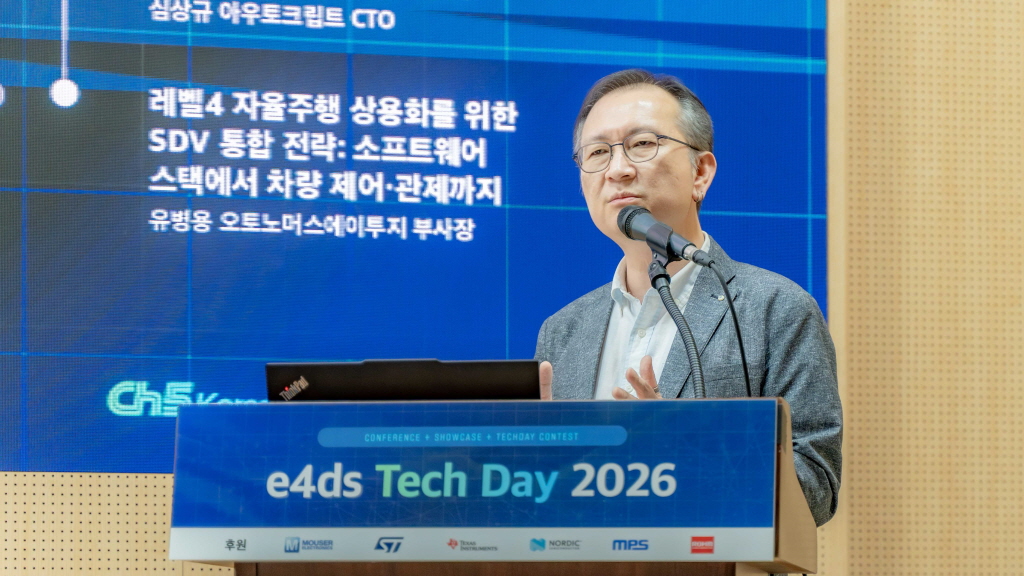
At e4ds Tech Day 2026, Sim Sang-gyu, CTO of Autocrypt, explained automotive cybersecurity strategies in the era of Physical AI and SDV (Software-Defined Vehicle). Automobiles are evolving as part of an ecosystem connected to AI, cloud, chargers, IoT, and robots, and he emphasized that the scope of security must expand beyond the vehicle interior to the entire connected environment. In particular, AI model tampering, adversarial attacks, OTA updates, and EV charger hacking were identified as major threats. He explained that response measures require zero trust, AI model integrity protection, intrusion detection, Security by Design and Default, and full lifecycle security management, and that proactive security system establishment beyond regulatory compliance is critical for securing future mobility competitiveness.
2026.10.12by 배종인 기자

NVIDIA to Invest $1 Billion in U.S. Science Over Next Five Years
NVIDIA has announced plans to invest $1 billion over the next five years to strengthen U.S. scientific and technological competitiveness. The company will enhance cutting-edge artificial intelligence research and development capabilities in key areas including quantum computing, healthcare, and energy security, while expanding support for higher education research institutions and cloud service providers. NVIDIA is participating as a major industry partner in the White House Office of Science and Technology Policy's Genesis Mission, and is promoting supercomputer construction in collaboration with national laboratories including Argonne and Los Alamos.
2026.10.12by 배종인 기자











