This page was machine-translated and may differ from the original. View original
We will continue to improve our computing and communications infrastructure.
Next-generation processors with enhanced AI capabilities are being released in large numbers.
Collaboration with Facebook, Comcast, Alibaba, and others 
Intel
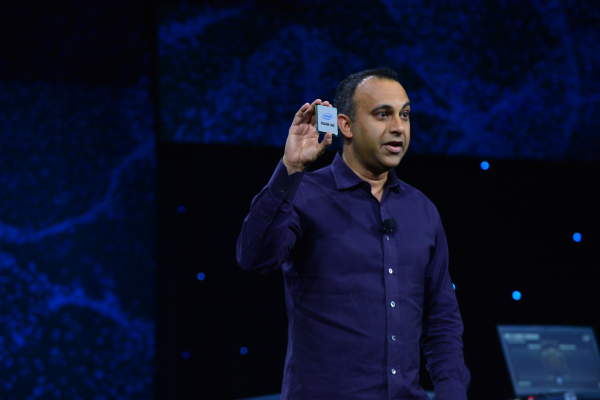
On the eve of CES 2019's opening, Intel's Gregory Bryant, executive vice president of the Client Computing Group, Navin Shenoy, executive vice president of the Data Center Group, and Professor Amnon Shashua, chairman and CEO of Mobileye, an Intel subsidiary, took the stage to announce Intel's commitment to continuously improving the computing and communications foundation that will advance the way people experience the world and expand human potential.
Intel made several announcements covering a range of topics, from PCs and new devices to growth areas like AI, 5G, and autonomous driving. And we discussed the innovation needed across data centers, cloud networks, and the edge to enable new user experiences and future form factors. 
Navin Shenoy, Executive Vice President and General Manager of Intel's Data Center Group
“Intel’s product, innovation and partnership announcements today underscore that our strategy is on track,” said Navin Shenoy, executive vice president and general manager of Intel’s Data Center Group. “Intel is making exceptional progress in pursuing the massive $300 billion data-centric market opportunity across the most critical workloads, including AI, 5G and autonomous driving.”
“While anyone can claim leadership in isolated use cases, Intel’s purpose is much broader,” said Gregory Bryant, executive vice president and general manager of the Client Computing Group at Intel. “The next era of computing demands a completely different level of innovation, one that encompasses the entire ecosystem and spans everything from compute to connectivity and beyond. And we will look no further than that.”
Intel today unveiled its latest Intel Xeon Scalable products and 9th generation Intel Core desktop products with enhanced AI and memory performance. Intel has introduced new 10nm products, the future of new chip designs based on its 3D packaging technology, Foveros, targeting PCs, servers, and 5G wireless access base stations.
Intel also highlighted what's possible when technologies work seamlessly across the entire spectrum of computing.
Comcast and Intel are partnering to make the connected home a reality, and a new initiative with Alibaba shows how Intel's AI could power athlete tracking technology during the next Olympics.
Mobileye and Ordnance Survey will bring us one step closer to smarter cities and safer roads.
Driving innovation across the PC industry
Intel's Client Computing Group is positioned to drive innovation across all areas of the PC industry because it brings together diverse technologies under one roof. Through this, Intel advances the PC industry and lays the foundation for today's data-centric world.
New Mobile PC Platform with Ice Lake / The vision for the future mobile PC platform is linked to the first batch of Intel's 10nm PC processors, codenamed 'Ice Lake'.
Ice Lake integrates Intel's new "Sunny Cove" microarchitecture, an instruction set and graphics engine that accelerate AI utilization, and Intel Gen11 graphics that improve graphics performance for richer gaming and content creation experiences.
It is expected that new products equipped with Ice Lake will be available to Intel's OEMs by the end of 2019. 
Athena Project
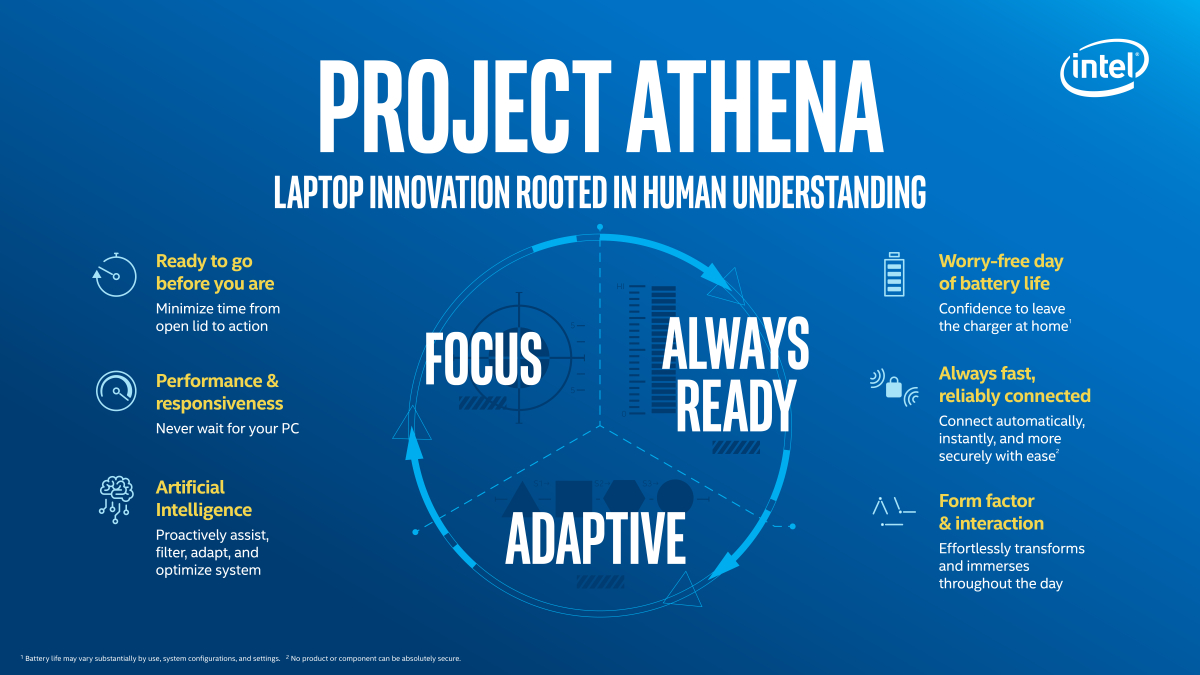
Project Athena / Intel announced an innovation program called 'Project Athena'. Project Athena is a new industry standard designed to provide users with new experiences leveraging emerging technologies, including 5G and AI.
From the first connected PC with integrated Wi-Fi on the Intel Centrino platform to driving mainstream adoption of ultra-thin and light designs, touchscreens, and 2-in-1 form factors with Ultrabooks, Intel has been a catalyst for delivering the next generation of PC experiences.
The first Project Athens device, combining a sleek and beautiful design with top-of-the-line performance, battery life, and connectivity, is expected to be unveiled in the second half of this year.
Lakefield Sun Unveiled / Intel is accelerating client innovation with a new approach to hybrid CPU architecture and packaging technology.
At CES 2019, Intel previewed a new client platform, codenamed "Lakefield," featuring the first version of its Foveros 3D packaging technology.
This hybrid CPU architecture allows for the integration of multiple previously separate pieces of IP into a single, smaller motherboard. This provides OEMs with greater flexibility in thin and light form factor designs.
Lakefield is expected to enter production this year.
9th Gen Intel Core Desktop Family Expands / Intel introduced new additions to its 9th Gen Intel Core processors, expanding their offerings across a broader range of desktop products. These processors deliver world-class performance, unlocking incredible new features and experiences for creators and gamers of all levels.
The first of the new 9th generation Intel Core desktop processor family is expected to be available starting this month.
Powering a data-driven world
Intel's Data Center Group is transforming industries by providing customers with exceptional assets that enable them to move, store, and process vast amounts of untapped data.
Advances in AI / Intel announced the Intel Nervana Neural Network Processor for Inference (NNP-I). This new class of chip is dedicated to accelerating inference for demanding workloads and is expected to enter production this year.
Facebook is one of Intel's NNP-I development partners. Intel also expects to unveil its Neural Network Processor for Training, codenamed "Spring Crest," later this year.
10nm server processor pre-release / Intel demonstrated for the first time its future 10nm-based Intel Xeon Scalable processor 'Ice Lake'.
The Ice Lake processor, which is compatible with the upcoming 14nm Cooper Lake, is aimed at servers. It is expected to feature improved performance, enhanced security features thanks to new hardware, and a variety of other features. Shipments are targeted for 2020.
Intel Expands 5G with 10nm SoC / Intel announced that it is expanding its decade-long investment in network infrastructure with a 10nm-based network SoC, codenamed 'Snow Ridge', which has been developed targeting 5G wireless access and edge.
Snow Ridge is specifically designed for 5G wireless access and edge computing. By integrating Intel architecture into wireless access base stations through a network SoC, more computing power will be distributed to the network edge. Snow Ridge is expected to be available in the second half of this year.
Next-Generation Xeon Scalable Processors Ship / Intel announced that it has started shipping its next-generation Xeon Scalable processors, codenamed 'Cascade Lake'.
Cascade Lake supports 'Intel Optane DC Persistent Memory' and 'Intel DL Boost' to accelerate AI deep learning inference. Cascade Lake is expected to be fully commercially available in the first half of this year.
Engineering for the Human Experience
Intel highlighted what is possible when the technology is seamlessly implemented across the entire spectrum of computing.
From devices to the cloud, and across the network to the edge, technology can deliver new immersive experiences.
Expanding the Impact of Vehicle Data / Mobileye announced an agreement with Ordnance Survey to provide ultra-precise location data to improve operations between businesses and cities, and to enable smarter cities and safer roads.
The National Geographic Information Institute's world-class geospatial and technology expertise, combined with Mobileye's automotive camera-based mapping capabilities, will provide new, highly accurate and customizable location services to National Geographic Information Institute customers across energy, infrastructure and other industries.
The new service will also support 5G, intelligent mobility and other digital services, creating a fully connected and digital Britain.
Intel and Alibaba announced a collaboration to develop AI-based 3D player tracking technology.
The tracking technology leverages Intel's existing and upcoming hardware and Alibaba's cloud to power compute-intensive, cutting-edge deep learning applications.
By combining computer vision and AI deep learning algorithms, we can do it without using special sensors or suits. Multiple standard video cameras will be able to capture 3D images of athletes in training and during competition. 
2020 Tokyo Olympics
Intel and Alibaba, along with partners, aim to showcase this cutting-edge tracking technology at the 2020 Tokyo Olympics.
Redefining Home Connectivity / Intel and Comcast are laying the foundation to bring new immersive experiences to every home.
According to Cisco, by 2022, each person in North America is expected to own 13 or more connected devices. Additionally, demand for high-resolution content streaming and gaming is increasing.
The collaboration between Intel and Comcast will deliver faster speeds, greater capacity, and a more responsive network that will power new immersive experiences for millions of people, including those attending the 2020 Tokyo Olympics.
For the next gigabit and beyond, Intel is collaborating with cable industry leaders on a global standard for 10-gigabit technology and has begun testing this standard in a lab environment.
Comcast and Intel are working together to develop technology based on Wi-Fi 6.
From next-generation communications to a new era of computing, Intel's technologies are committed to serving as the foundation for the world's most important innovations and advancements.
Next-generation processors with enhanced AI capabilities are being released in large numbers.
Collaboration with Facebook, Comcast, Alibaba, and others

Intel
On the eve of CES 2019's opening, Intel's Gregory Bryant, executive vice president of the Client Computing Group, Navin Shenoy, executive vice president of the Data Center Group, and Professor Amnon Shashua, chairman and CEO of Mobileye, an Intel subsidiary, took the stage to announce Intel's commitment to continuously improving the computing and communications foundation that will advance the way people experience the world and expand human potential.
Intel made several announcements covering a range of topics, from PCs and new devices to growth areas like AI, 5G, and autonomous driving. And we discussed the innovation needed across data centers, cloud networks, and the edge to enable new user experiences and future form factors.

Navin Shenoy, Executive Vice President and General Manager of Intel's Data Center Group
“Intel’s product, innovation and partnership announcements today underscore that our strategy is on track,” said Navin Shenoy, executive vice president and general manager of Intel’s Data Center Group. “Intel is making exceptional progress in pursuing the massive $300 billion data-centric market opportunity across the most critical workloads, including AI, 5G and autonomous driving.”
“While anyone can claim leadership in isolated use cases, Intel’s purpose is much broader,” said Gregory Bryant, executive vice president and general manager of the Client Computing Group at Intel. “The next era of computing demands a completely different level of innovation, one that encompasses the entire ecosystem and spans everything from compute to connectivity and beyond. And we will look no further than that.”
Intel today unveiled its latest Intel Xeon Scalable products and 9th generation Intel Core desktop products with enhanced AI and memory performance. Intel has introduced new 10nm products, the future of new chip designs based on its 3D packaging technology, Foveros, targeting PCs, servers, and 5G wireless access base stations.
Intel also highlighted what's possible when technologies work seamlessly across the entire spectrum of computing.
Comcast and Intel are partnering to make the connected home a reality, and a new initiative with Alibaba shows how Intel's AI could power athlete tracking technology during the next Olympics.
Mobileye and Ordnance Survey will bring us one step closer to smarter cities and safer roads.
Driving innovation across the PC industry
Intel's Client Computing Group is positioned to drive innovation across all areas of the PC industry because it brings together diverse technologies under one roof. Through this, Intel advances the PC industry and lays the foundation for today's data-centric world.
New Mobile PC Platform with Ice Lake / The vision for the future mobile PC platform is linked to the first batch of Intel's 10nm PC processors, codenamed 'Ice Lake'.
Ice Lake integrates Intel's new "Sunny Cove" microarchitecture, an instruction set and graphics engine that accelerate AI utilization, and Intel Gen11 graphics that improve graphics performance for richer gaming and content creation experiences.
It is expected that new products equipped with Ice Lake will be available to Intel's OEMs by the end of 2019.

Athena Project
Project Athena / Intel announced an innovation program called 'Project Athena'. Project Athena is a new industry standard designed to provide users with new experiences leveraging emerging technologies, including 5G and AI.
From the first connected PC with integrated Wi-Fi on the Intel Centrino platform to driving mainstream adoption of ultra-thin and light designs, touchscreens, and 2-in-1 form factors with Ultrabooks, Intel has been a catalyst for delivering the next generation of PC experiences.
The first Project Athens device, combining a sleek and beautiful design with top-of-the-line performance, battery life, and connectivity, is expected to be unveiled in the second half of this year.
Lakefield Sun Unveiled / Intel is accelerating client innovation with a new approach to hybrid CPU architecture and packaging technology.
At CES 2019, Intel previewed a new client platform, codenamed "Lakefield," featuring the first version of its Foveros 3D packaging technology.
This hybrid CPU architecture allows for the integration of multiple previously separate pieces of IP into a single, smaller motherboard. This provides OEMs with greater flexibility in thin and light form factor designs.
Lakefield is expected to enter production this year.
9th Gen Intel Core Desktop Family Expands / Intel introduced new additions to its 9th Gen Intel Core processors, expanding their offerings across a broader range of desktop products. These processors deliver world-class performance, unlocking incredible new features and experiences for creators and gamers of all levels.
The first of the new 9th generation Intel Core desktop processor family is expected to be available starting this month.
Powering a data-driven world
Intel's Data Center Group is transforming industries by providing customers with exceptional assets that enable them to move, store, and process vast amounts of untapped data.
Advances in AI / Intel announced the Intel Nervana Neural Network Processor for Inference (NNP-I). This new class of chip is dedicated to accelerating inference for demanding workloads and is expected to enter production this year.
Facebook is one of Intel's NNP-I development partners. Intel also expects to unveil its Neural Network Processor for Training, codenamed "Spring Crest," later this year.
10nm server processor pre-release / Intel demonstrated for the first time its future 10nm-based Intel Xeon Scalable processor 'Ice Lake'.
The Ice Lake processor, which is compatible with the upcoming 14nm Cooper Lake, is aimed at servers. It is expected to feature improved performance, enhanced security features thanks to new hardware, and a variety of other features. Shipments are targeted for 2020.
Intel Expands 5G with 10nm SoC / Intel announced that it is expanding its decade-long investment in network infrastructure with a 10nm-based network SoC, codenamed 'Snow Ridge', which has been developed targeting 5G wireless access and edge.
Snow Ridge is specifically designed for 5G wireless access and edge computing. By integrating Intel architecture into wireless access base stations through a network SoC, more computing power will be distributed to the network edge. Snow Ridge is expected to be available in the second half of this year.
Next-Generation Xeon Scalable Processors Ship / Intel announced that it has started shipping its next-generation Xeon Scalable processors, codenamed 'Cascade Lake'.
Cascade Lake supports 'Intel Optane DC Persistent Memory' and 'Intel DL Boost' to accelerate AI deep learning inference. Cascade Lake is expected to be fully commercially available in the first half of this year.
Engineering for the Human Experience
Intel highlighted what is possible when the technology is seamlessly implemented across the entire spectrum of computing.
From devices to the cloud, and across the network to the edge, technology can deliver new immersive experiences.
Expanding the Impact of Vehicle Data / Mobileye announced an agreement with Ordnance Survey to provide ultra-precise location data to improve operations between businesses and cities, and to enable smarter cities and safer roads.
The National Geographic Information Institute's world-class geospatial and technology expertise, combined with Mobileye's automotive camera-based mapping capabilities, will provide new, highly accurate and customizable location services to National Geographic Information Institute customers across energy, infrastructure and other industries.
The new service will also support 5G, intelligent mobility and other digital services, creating a fully connected and digital Britain.
Intel and Alibaba announced a collaboration to develop AI-based 3D player tracking technology.
The tracking technology leverages Intel's existing and upcoming hardware and Alibaba's cloud to power compute-intensive, cutting-edge deep learning applications.
By combining computer vision and AI deep learning algorithms, we can do it without using special sensors or suits. Multiple standard video cameras will be able to capture 3D images of athletes in training and during competition.

2020 Tokyo Olympics
Intel and Alibaba, along with partners, aim to showcase this cutting-edge tracking technology at the 2020 Tokyo Olympics.
Redefining Home Connectivity / Intel and Comcast are laying the foundation to bring new immersive experiences to every home.
According to Cisco, by 2022, each person in North America is expected to own 13 or more connected devices. Additionally, demand for high-resolution content streaming and gaming is increasing.
The collaboration between Intel and Comcast will deliver faster speeds, greater capacity, and a more responsive network that will power new immersive experiences for millions of people, including those attending the 2020 Tokyo Olympics.
For the next gigabit and beyond, Intel is collaborating with cable industry leaders on a global standard for 10-gigabit technology and has begun testing this standard in a lab environment.
Comcast and Intel are working together to develop technology based on Wi-Fi 6.
From next-generation communications to a new era of computing, Intel's technologies are committed to serving as the foundation for the world's most important innovations and advancements.
본 기사에 대한 정정·반론·추후보도 청구는 보도 청구 안내를, 그간 게재된 보도문은 정정·반론보도 모아보기를 참고해 주세요.