



With 5G Commercialization One Year Ahead, Where Is Korea Heading?
 Published2019.10.06 16:05
| 5G-based IoT endpoints expected to reach 48.6 million units by 2028
| Pan-Governmental Giga Korea Project Team Sets Tasks in 5 Major Areas
It has been almost a year since 5G mobile communication was first commercialized in Korea.
Despite various challenges, 5G mobile communications is steadily expanding its presence in several countries, including South Korea. Gartner projected that global 5G mobile infrastructure revenue would reach $4.2 billion in 2020, an 89% increase from $2.2 billion in 2019.
In addition, it was predicted that the market share of 5G phones in the smartphone market would increase to 56% in 2023, and that 5G-based IoT endpoints would increase approximately 14-fold from 3.5 million units in 2020 to 48.6 million units in 2028.
With the growth of the 5G market becoming certain, what kind of 5G roadmap does Korea have?
In December 2016, the Ministry of Science and ICT established the 5G mobile communication industry development strategy, presenting the strengthening of national competitiveness through convergence between ICT and other industries as a vision and setting leading the 5G convergence market as one of its goals. In addition, the inter-ministerial 'Giga KOREA' project, carried out from September 2013 to April 2018, conducted R&D focused on the development of core source technologies for 5G.
According to a report on the progress of the 5G convergence service pilot project by Lee Seong-chun, Head of the Giga Korea Project Group, the second phase of the project, launched in April 2018, focused on actual industrialization. The project group selected projects in five fields expected to have high synergy with 5G and is investing a total of approximately 150 billion won.
Now, let's take a look at what tasks are in the five fields and how they are being operated.
Autonomous driving C-ITS services and 5G V2X
Autonomous driving is the ultimate goal pursued by the automotive industry and is also a field of interest for the electronics and electric industries. The project team aims to develop 5G V2X-based autonomous driving and C-ITS technologies to discover new business models for services and reduce traffic accidents.
The project team identified proactive platforms, cognitive V2X infrastructure, and interactive vehicles as the three core technologies. In addition, there are plans to demonstrate three core services: 'Safe Autonomous Driving Shuttle Service,' which provides autonomous shuttle bus services based on 5G network control; 'Autonomous Driving Service for the Disabled,' which provides cloud-based autonomous driving and remote control personal mobility services; and 'AI Intersection Service,' which provides automatic traffic flow control and active accident avoidance services based on ultra-low latency situation awareness.
The project team plans to implement the 'Pangyo Safe Autonomous Driving Shuttle Service', 'Daegu Suseong Medical District Technopolis Autonomous Driving Service for the Disabled', and 'Seoul Sangam AI Intersection Service' in the first and second halves of 2020, which include LDM (Local Dynamic Map), 5G/C-V2X integrated terminal, 28GHz band 5G infrastructure, remote control, multi-lane and front object recognition technologies.
5G infrastructure-based smart city service platform
Governments around the world are accelerating research on smart cities to address deepening urbanization. In particular, the Seoul metropolitan area is one of the most densely populated regions in the world. The project team is building an integrated environment and conducting service demonstrations to solve urban problems by utilizing the ultra-low latency and high-reliability information transmission characteristics of 5G networks.
.jpg)
There are four core technologies. ▲ 'City Infrastructure' technology that transmits large volumes of information with ultra-low latency ▲ 'City Sensor' technology that processes information collected from CCTVs, drones, IoT devices, etc. ▲ 'City Service Platform' technology that provides data analysis and processing functions ▲ and 'City Service' technology that generates customized information necessary for operating 5G convergence services.
The core services include an intelligent road safety support service utilizing intelligent CCTV, a public facility control service utilizing 5G LPWA-based ICT sensors, a mobile shared facility management service, and a crowdsourcing-based road environment improvement sharing service that receives reports from citizens via smartphone applications. The project team plans to begin constructing related facilities in the second half of 2019 and conduct field demonstrations in 2020.
5G technologies leading the manufacturing renaissance
Last June, the government announced the Manufacturing Renaissance Strategy and stated that it would actively pursue AI-based industrial intelligence. The project team plans to combine 5G with this industrial intelligence. To this end, it plans to build 5G and TSN networks for equipment interoperability within factories, as well as an AI-based cloud platform.
There are also four key technologies for this. These are: ▲ technology for building a 5G-based ultra-low latency, ultra-high capacity data network ▲ technology for developing a manufacturing-specialized machine learning cloud platform ▲ technology for developing 5G-based cloud-oriented machine vision ▲ technology for developing AR content for manufacturing site management integrated with IoT technology. Key services include multi-functional autonomous mobile manufacturing robot services, manufacturing-specialized machine vision services, AR-based remote equipment management services, and OPC-UA-based production line management services.
The project team announced that in December 2018, an automotive parts factory raised its defect detection rate to 95.9% by utilizing machine vision for oil pump quality inspection. In the second half of 2019, they plan to establish a demonstration environment at the Smart Manufacturing Innovation Center in Ansan, Gyeonggi-do. In 2020, they intend to secure a dedicated 5G modem for smart factories to enhance functionality and performance, expand the scope of the demonstration, and apply it to commercial lines.
Development and demonstration of disaster safety services
The information obtainable at a disaster site is inevitably limited due to extreme conditions. The project team intends to develop and demonstrate a service that guarantees the safety and survival of people in need of rescue and those going to rescue them in disaster safety situations by utilizing 5G-based core technologies and the latest ICT technologies.
To this end, the project team is supporting the development of: ▲ an emergency recovery wireless network system equipped with 5G-based core functions; ▲ a 5G/WPS-based indoor precision positioning algorithm and system; and ▲ an intelligent situation response guardian server through the linkage of spatial information (GIS, BIMS) and field information.
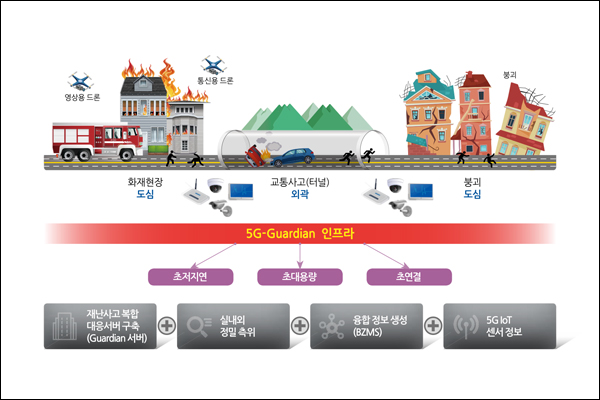
Using the above technologies, fire response services, collapse sign response services, traffic accident response services inside tunnels, dangerous accident response services for vulnerable road users, and real-time evacuation and rescue information provision app services are currently under development. The project team plans to establish a demonstration facility at 365 Safe Town in Taebaek, Gangwon-do in the second half of 2019 and provide disaster-related experience and pilot services starting in 2020.
5G-based interactive immersive media technology
With the number of subscribers already surpassing 2 million in August, the 5G era has officially begun. Consequently, there is a need to provide new and vivid media services rather than existing standardized content. The project team is supporting the development of ▲VR-based mental health management and telemedicine technologies ▲remote performance and immersive game broadcasting technologies ▲N-screen-based interactive AR technologies.
Through this, the project team planned VR-based mental health management and telemedicine services, remote performance and immersive game broadcasting services, and remote tourist attraction experience and promotional signage services, and has been continuously demonstrating them since the 2018 PyeongChang Winter Olympics.
A New Field of Opportunity, 5G
The promotion of 5G convergence services under the Ministry of Science and ICT's '5G Mobile Communication Industry Development Strategy (2017~2022)' was accelerated by the provision of commercial-level 5G pilot services around the time of the 2018 PyeongChang Winter Olympics.
The Giga Korea Project Group has formulated detailed implementation plans by specifying requirements centered on the private sector, such as the 5G Forum and the three mobile carriers, and is promoting the 5G convergence service pilot projects in the five fields described above.
"The most difficult part of pushing forward with the project is securing chipsets, such as industrial 5G modems," said Director Lee Seong-chun. "It is expected that they will be provided to companies implementing the service by the end of 2019 or the first half of 2020." In another sense, this is also evidence that the demand for 5G-related semiconductors will remain steady.
5G is presenting new opportunities across various industries. As it becomes possible to do things that were previously impossible due to network performance limitations, a situation has arisen where the performance of platforms and devices must be enhanced. Now, depending on how companies integrate and utilize 5G, they will either increase or decrease their competitiveness.
Comments
Related news
Huawei Unveils 5G Smartphone SoC Smaller Than Samsung and Qualcomm
Huawei unveiled new Kirin SoCs at IFA 2019, introducing the Kirin 990 and Kirin 990 5G. In particular, the Kirin 990 5G integrates a 5G modem to reduce size and power consumption, and supports both 5G NSA and SA. It supports both TDD and FDD across all frequency bands, while delivering maximum downlink speeds of 2.3 Gbit/s and maximum uplink speeds of 1.25 Gbit/s. Manufactured using a 7nm EUV process, the Kirin 990 5G also features a dual-core NPU based on the Davinci architecture, which consists of large and small NPU cores.
2019.09.08by 이수민 기자
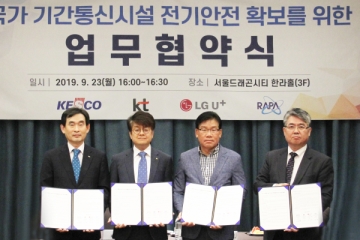
MOU Signed to Secure Electrical Safety in National Key Telecommunications Facilities
The Korea Electrical Safety Corporation, Korea Radio Promotion Association, KT, and LG Uplus have signed a memorandum of understanding to secure electrical safety at national critical telecommunications infrastructure. This agreement was undertaken to ensure stability of electrical facilities at national critical telecommunications infrastructure for preventing communication disasters in the 5G era. The four parties plan to strengthen cooperative relationships for preventing electrical hazards at national critical telecommunications infrastructure and diversify activities to secure electrical safety at national critical telecommunications infrastructure.
2019.09.25by 이수민 기자
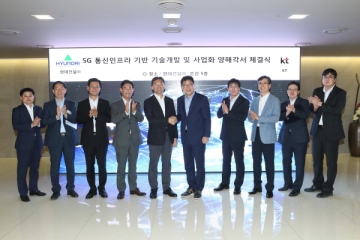
"Automating Construction Sites with 5G": KT Signs MOU with Hyundai E&C
KT and Hyundai Engineering and Construction have announced that they have signed a memorandum of understanding on technology development and commercialization of 5G-based smart construction automation, and agreed to cooperate in developing 5G construction automation technology. Through this MOU, the two companies plan to proceed with technology development for productivity and quality improvement in the 5G-based construction field, development of 5G smart construction technology, development of 5G construction site monitoring technology, and information exchange. Additionally, they plan to establish a working-level task force to rapidly commercialize the developed technologies and achieve digital innovation at construction sites, while continuing 5G collaboration.
2019.10.08by 이수민 기자
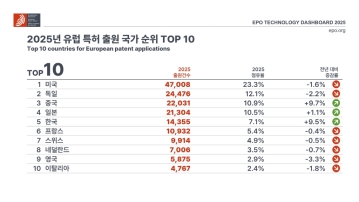
European Patent Applications Surpass 200,000 for the First Time… South Korea Maintains 5th Place, Led by Batteries and Telecommunications
According to the European Patent Office (EPO)'s 'Technology Dashboard 2025', European patent applications last year reached 201,974, surpassing 200,000 for the first time. Korean companies and inventors filed 14,355 applications, representing a 9.5% increase from the previous year and maintaining 5th place by country. Battery, digital communication, and semiconductor technologies led the growth, with Samsung ranking as the top EPO applicant for the second consecutive year and LG reaching 3rd place. The presence of major domestic cities such as Seoul, Suwon, and Yongin was also confirmed. It was also revealed that Korea's European patent strategy is expanding beyond individual technologies to span the entire industry.
2026.03.24by 명세환 기자
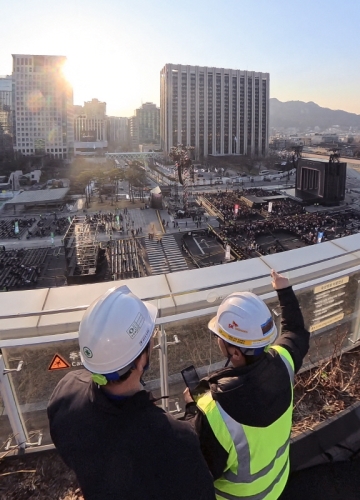
SK Telecom First Applies AI-Based Network Operations at Gwanghwamun K-Pop Concert
SK Telecom announced that it applied an AI-based network operation system for the first time at a large-scale K-pop concert held in the Gwanghwamun area of Seoul on March 21st, managing communication quality throughout the event. Mobile data usage during the three hours before and after the concert reached 12.15TB, approximately doubling compared to the same time slot the previous weekend. SK Telecom monitored traffic using the AI system 'A-One' in five-minute and 50-meter units to respond to potential overload situations, while also operating temporary communication facilities and on-site personnel in parallel. This case is interpreted as confirmation of the practical applicability of AI-based autonomous network operation in an environment where demand from dense events and foreign users increases simultaneously.
2026.03.23by 명세환 기자











