



Next-generation solution for mobile device motion control unveiled
 Published2019.12.26 11:33
Hillcrest Labs combines algorithms and software stacks
Motion-based gestures, 3D motion tracking, and low power consumption
CEVA, a smart connected technology provider, contributes to the spread of motion control capabilities by providing sensor fusion solutions for consumer mobile devices.
.jpg)
▲ CEVA has launched MotionEngine Air software, a new sensor fusion solution for consumer mobile devices. <Image=CEVA>
CEVA unveiled Hillcrest Labs' next-generation sensor fusion product family on the 26th with the launch of MotionEngine Air software.
The solution provides low power consumption, motion-based gesture control, 3D motion tracking, and pointing capabilities in the mass-produced portable device market, including smartphones, PC stylus pens, smart TVs, OTT (Over the Top) remotes, game controllers, AR and VR controllers, and PC peripherals.
With the recent rapid expansion of wireless portable controllers, including Bluetooth, in the global market, experts predict that more than 500 million RF devices will be shipped by 2022.
Power consumption of the entire system, powered by new advancements in low-power inertial sensors and Bluetooth Low Energy along with Motion Engine Air Sensor Fusion softwareIt lowers the amount to a level below milliampere, while contributing to the spread of motion control functions for always-on power and always-on awareness user experience.
Motion Engine Air software is now fully ready for mass production and provides performance optimized for embedded devices.
Key features include: ▲ accurate pointing, gesture, and motion control algorithms; ▲ a cursor for point-and-click control in the screen UI; ▲ gestures such as flick, shake, tap, tilt, rotate, and circle for intuitive UI control; ▲ 6-axis sensor fusion enabling 3D motion tracking in games and VR; ▲ power saving when motion events such as pick-up, flip, and stability detectors occur; ▲ orientation correction and adaptive shake cancellation for a consistent and intuitive user experience; ▲ pre-certification of sensors from major inertial sensor vendors; ▲ integration and simplification of operating systems and software such as Android, Windows, MacOS, and Linux through a comprehensive software stack featuring host drivers and sensor management functions; and ▲ Arm Cortex M-based evaluation boards and related firmware.
In particular, as a low-power, small-memory-footprint solution that can run on various processors such as Arm Cortex M, RISC V, CEVA BX, and CEVA TeakLite DSP families, it has features that allow it to be used in full-featured solutions requiring accelerometers and gyroscopes (IMUs), as well as gesture and motion event-based solutions requiring only accelerometers.
Chad Lucien, Vice President and General Manager of CEVA’s Sensor Fusion Business Unit, stated, “Since MEMS inertial sensors were first used for remote control, Hillcrest Labs’ MotionEngine Air solution combines the most powerful capabilities of any solution created in the last 15 years.” He added, “Through OEM and ODM products, it can be easily integrated into commercial software RF SoCs or MCUs, enabling direct operation with battery-powered controllers, as well as "By applying precise motion control capabilities to mobile, PC, TV, AR/VR, games, and enterprise peripherals, we are now able to provide diverse user experiences," they stated.
Meanwhile, CEVA plans to participate in CES 2020, held in Las Vegas, USA from January 7 to 10, and demonstrate its Motion Engine Air software and evaluation board.
Comments
Related news
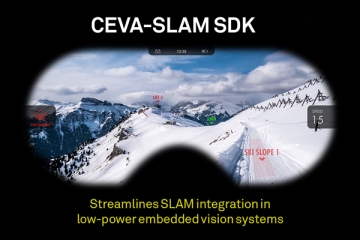
CEVA Announces SLAM SDK for Low-Power Embedded Systems
CEVA has announced the CEVA-SLAM software development kit to provide convenient development of SLAM (Simultaneous Localization and Mapping) applied to mobile devices, AR/VR headsets, robots, autonomous vehicles, and camera-based devices. Available for the CEVA-XM intelligent vision DSP and NeuPro AI processor product families, CEVA-SLAM integrates hardware, software, and interfaces to significantly lower the entry barrier for companies seeking to implement SLAM in low-power embedded systems.
2019.06.05by 이수민 기자
.png)
Immervision's wide-angle image processing capabilities are being ported to CEVA.
CEVA and Immervision have entered into a strategic partnership. Under this partnership, CEVA has made a technology investment of $10 million to secure exclusive licensing rights to Immervision's patented wide-angle image processing technology and software portfolio. Immervision's portfolio includes real-time adaptive dewarping, stitching, image color and contrast enhancement, and electronic image stabilization. The two companies plan to showcase an end-to-end solution featuring wide-angle panoramic optical lens design and complementary image enhancement software.
2019.08.07by 이수민 기자
What smart factory sensor technologies should we pay attention to now?
Germany's Industry 4.0, defined by the German government for the revival of German manufacturing, pursues mass production of diverse product types, unlike the heavy and rigid Industry 3.0, through modular processes, variable and flexible equipment, autonomous and distributed control, wireless communication, and real-time location tracking. To realize Industry 4.0, sensors mounted on each piece of equipment in smart factories are trending toward transformation into MEMS that integrate sensing elements and sensor SoCs equipped with intelligent algorithms, moving away from board-form implementations.
2019.10.21by 이수민 기자
Camera for Both Humans and Machines: ST BrightSense 5MP Dual Shutter Image Sensor
Video consumed by humans and imagery analyzed by machines impose different requirements on the sensor in terms of shutter method and wavelength band. Until now, sensors had to be separated or supplemented with companion chips and high-performance processors, and this cost and complexity became a bottleneck in vision system design. The ST BrightSense next-generation 5MP image sensor (VD5943, VD1943, VB5943, VB1943) with 2.25 µm pixels supports both global and rolling shutters, and through on-chip staggered HDR (up to 100 dB), on-chip RGB-IR separation and 5MP NIR smart upscaling, and frame-by-frame context switching, absorbs both requirements internally at the sensor level. This white paper describes the rationale, choices, trade-offs, and results of each design decision based on presentation slides and technical Q&A, and specifies application boundaries. The product is scheduled for mass production in February 2026, and evaluation and sampling are currently available.
2026.10.13by 편집부
Practical Application of ESP32 Arduino Development Environment: From GPIO to Web Server
This white paper, based on the presentation slides and technical Q&A from the e4ds-hosted webinar "Completing Your Own IoT System with ESP32," explains five fundamental hands-on exercises for working with ESP32 on the Arduino platform (GPIO input/output, serial debug, UART communication, Bluetooth SPP, Wi-Fi web server) from a design decision perspective. Each exercise is organized around causality—identifying what problem prompted it, what was chosen, and what was sacrificed—and boundary conditions that must be verified during the productization phase, such as power consumption, electrical protection, security, and OTA, are explicitly stated based on technical Q&A.
2026.10.13by 편집부











