


KT Launches World's First 5G Medical Service at Samsung Hospital
 Published2020.01.14 10:36
Transmit high-definition real-time surgery video with 5G SyncCam
Introduction of Autonomous Operating Room Robots and AI-Based Ward Care
KT is building the world's first smart innovation hospital in collaboration with Samsung Seoul Hospital by utilizing 5G in medical practices.

KT and Samsung Seoul Hospital launch the world's first 5G-based medical service.
By applying enterprise-dedicated 5G to the medical field, autonomous robots in the operating room carry supplies and waste and care for patients in the ward using AI services, while the surgeon's surgery is transmitted in real-time in high definition via a 5G Sync Cam.
KT announced on the 14th that it has jointly developed 'innovative 5G medical services for building a 5G smart innovation hospital' with Samsung Seoul Hospital.
Previously, the two companies signed a memorandum of understanding in September of last year to build a 5G smart innovation hospital and have been identifying projects to apply 5G to medical operations.
Under the agreement, the two companies have completed verification of ▲5G digital pathology diagnosis ▲5G proton therapy information lookup ▲5G surgery guidance ▲establishment of AI-based Smart Care Giver in hospital rooms ▲autonomous robots in operating rooms.
KT built a dedicated enterprise 5G network at Samsung Seoul Hospital to verify the project and conducted a pilot operation in operating rooms and proton therapy rooms. This is because, given the nature of hospitals handling personal medical information, it is essential to establish a dedicated enterprise 5G service with enhanced security that allows only authorized users to access it.
Building on the success of this project, both companies plan to continue developing 5G services to improve hospital operational efficiency and innovate medical practices based on 5G, including the development of smart patient care services.
(1).jpg)
▲ A professor from the Department of Pathology at Samsung Seoul Hospital is reviewing recently captured pathology data in his office. <Photo=KT>
Real-time digital pathology diagnosis and medical image viewing available
5G digital pathology analysis is the world's first instance where KT has utilized 5G to apply it to actual medical practice. In conventional pathology diagnosis, tissue removed during surgery was processed for analysis by a pathology professor, who then conducted the analysis in a location next to the operating room. This required professors to travel a 20-minute walk, and spatial limitations made it difficult for various pathology faculty members to participate in the analysis.
5G digital pathology diagnosis is a service that utilizes a 5G network characterized by ultra-high speed and ultra-low latency to enable fast and accurate analysis of pathology data generated during surgery. It is possible to view high-capacity pathology data of up to 4GB per page even in the pathology office, contributing to the improvement of the quality of medical services for patients.
Guidance and training conducted in the training area outside the operating room
In the past, medical students and trainee medical staff found it difficult to receive effective training during surgical field education due to spatial constraints caused by the presence of surgeons, support nurses, and surgical equipment.
5G surgical guidance is a service that provides real-time video and audio from the perspective of the professor performing the surgery using a Sync CAM powered by 5G. This allows many trainee medical staff to receive training even outside the operating room, thereby enhancing their professional surgical capabilities.
Both companies plan to continuously develop more accurate and effective surgical training methods by advancing 5G medical technology that incorporates AR and VR technologies into real-time surgical training.
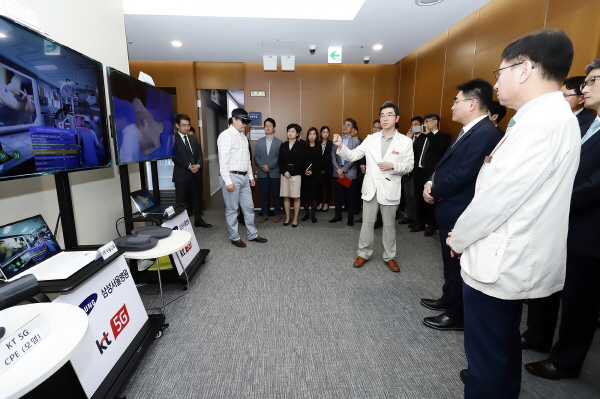
Officials from KT and Samsung Seoul Hospital observed surgical training using VR and AR during the 5G Smart Hospital MOU demonstration last September. <Photo=KT>
Introduction of 5G autonomous driving robots, AI-based hospital rooms, etc.
By introducing 5G autonomous transport robots in the operating room, large amounts of infectious materials or medical waste that are repeatedly generated during surgery are effectively managed. 5G autonomous robots support medical staff by automatically handling this and delivering supplies.
In particular, it helps improve medical services by minimizing the risk of secondary and tertiary infections caused by invasive contact during the handling of contaminated items, and by enabling the efficient deployment of insufficient personnel to essential medical tasks without waste. Furthermore, by leveraging the hyper-connectivity of 5G, it provides services that ensure no interruptions or delays occur, regardless of how many robots or terminals are connected.
The Smart Care Giver, an AI-based patient support system installed in hospital rooms, was built on KT's AI service GiGA Genie engine. It is designed to allow the hospital room to be controlled solely by the patient's voice, and if the patient consents, it constantly monitors the patient's physical condition to enable medical staff to respond immediately in the event of an emergency.
Professor Park Seung-woo, Head of Planning at Samsung Seoul Hospital, said, “Based on verified medical services, we will continue to do our best to enhance the convenience of all customers within the hospital, including patients, medical staff, and visitors.”
Park Woon-young, Executive Vice President and Head of KT’s Corporate Business Division, stated, “Based on 5G services, we will jointly build a 5G smart innovation hospital within this year to secure the mobility of medical staff and the continuity of medical practice, while also providing better medical services.”
Comments
Related news
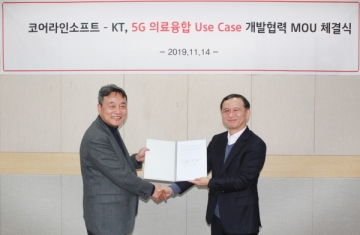
KT Applyes AI to 5G-Based Medical Imaging… Increased Safety and Speed
KT has signed a memorandum of understanding (MOU) with Coreline Soft to discover use cases for providing medical convergence services that apply AI technology to 5G-based medical imaging solutions. Under the agreement, the companies will pursue the development of ultra-low-latency 5G-based 3D VR surgical guidance for medical applications, enhancement of medical 3D imaging collaboration solutions, establishment of a 5G platform-based medical industry collaboration ecosystem, and development and acquisition of 5G medical imaging content.
2019.11.17by 최인영 기자
5G will cover 65% of the world's population by 2025.
By 2025, 5G services are projected to cover 65% of the global population and handle 45% of mobile data traffic. Average monthly data traffic per smartphone is expected to increase from 7.2GB to 24GB, and IoT connections are anticipated to grow from 1.3 billion at the end of 2019 to 5 billion by the end of 2025.
2019.12.19by 최인영 기자
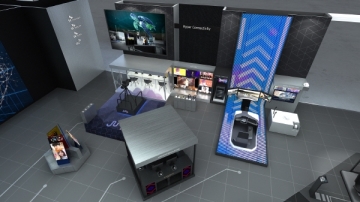
SKT, Prelude to '5G-based Media and Mobility' at CES 2020
SK Telecom will showcase media and mobility technologies based on 5G through CES 2020. SK Telecom, which is unveiling autonomous driving-related technologies and services, is expanding its booth size eightfold compared to the previous year and actively pursuing 5G-based mobility businesses. The 5G 8K TV, being shown for the first time in the world, demonstrates SK Telecom's 5G MEC technological capabilities.
2020.01.06by 최인영 기자

“AI, autonomous driving, and 5G are the technologies that excite us the most”
The survey results revealed that the most exciting technology trends for the next decade are AI, autonomous vehicles, biotechnology, IoT, and 5G. When NowandBay conducted a survey of 1,400 adults regarding newsworthy technology trends and technologies that excite them, artificial intelligence received the highest response rate across the board.
2020.01.08by 최인영 기자
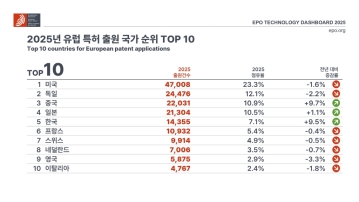
European Patent Applications Surpass 200,000 for the First Time… South Korea Maintains 5th Place, Led by Batteries and Telecommunications
According to the European Patent Office (EPO)'s 'Technology Dashboard 2025', European patent applications last year reached 201,974, surpassing 200,000 for the first time. Korean companies and inventors filed 14,355 applications, representing a 9.5% increase from the previous year and maintaining 5th place by country. Battery, digital communication, and semiconductor technologies led the growth, with Samsung ranking as the top EPO applicant for the second consecutive year and LG reaching 3rd place. The presence of major domestic cities such as Seoul, Suwon, and Yongin was also confirmed. It was also revealed that Korea's European patent strategy is expanding beyond individual technologies to span the entire industry.
2026.03.24by 명세환 기자











