


Samsung Electronics Strengthens Foundry and Expands Overseas 5G Business
 Published2020.03.18 10:31
Development of 4th generation 10nm DRAM and 7th generation V-NAND this year
Preparing for the 4.3nm process to strengthen foundry competitiveness
Samsung Electronics held its 51st regular shareholders' meeting on the 18th at the Suwon Convention Center in Suwon, Gyeonggi Province, with approximately 400 shareholders, institutional investors, and executives in attendance.
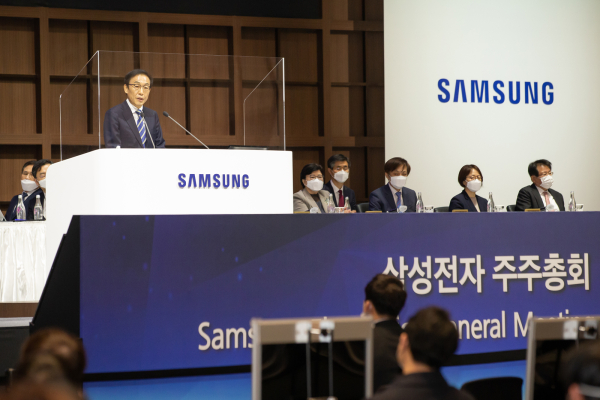
In his opening remarks, Vice Chairman Kim Ki-nam said, “Last year, difficult business conditions continued, including stagnant global economic growth, a sluggish memory industry, and intensifying competition in the set business,” and added, “Our 2019 business performance slowed down compared to the previous year, recording consolidated sales of KRW 230 trillion and operating profit of KRW 28 trillion.”
Samsung Electronics' 2018 business performance was KRW 243.77 trillion in sales and KRW 58.89 trillion in operating profit.
Prior to the agenda, Vice Chairman Kim Ki-nam, Head of DS Division, President Kim Hyeon-seok, Head of CE Division, and President Koh Dong-jin, Head of IM Division, explained the management status of each business division and answered questions from shareholders in attendance.
Samsung Electronics achieved sales of 95.5 trillion won and operating profit of 15.6 trillion won in the components sector last year.
In memory, we maintained our competitive edge as the global number one. In the foundry sector, the company mass-produced 7nm Extreme Ultra Violet (EUV) technology and commercialized 100-megapixel image sensors and embedded Magnetic Random Access Memory (eMRAM) solutions. In the system LSI sector, the company commercialized a 5G modem SoC and developed a high-resolution image sensor, achieving the top market share in China. In the display sector, the company has completed products such as premium hole displays for smartphones and 8K TVs.
Samsung Electronics plans to develop 4th-generation 10nm-class DRAM and 7th-generation V-NAND this year, expand its 5nm process, and develop 4nm and 3nm processes. It also plans to secure a next-generation technology foundation for business expansion into AI, automotive electronics, and other sectors. Furthermore, it will continue to enhance the price competitiveness of small and medium-sized displays and advance the sophistication of large displays.
The CE division recorded sales of KRW 44.8 trillion and operating profit of KRW 2.6 trillion, both representing year-over-year increases.
Samsung Electronics plans to expand its distribution network for B2B products like built-in appliances and system air conditioners by partnering with construction companies, kitchen distribution companies, and installation specialists. It also plans to continue strengthening its home IoT business by leveraging its AI and IoT technologies. Through collaborations with construction companies, the company plans to spearhead the expansion of its home IoT platform and continue developing IoT solutions for specific spaces, such as the kitchen and living room.
The IM division recorded sales of 107 trillion won and operating profit of 9.3 trillion won. Sales increased slightly compared to the previous year, but operating profit decreased.
Samsung Electronics plans to launch differentiated premium smartphones and strengthen its entry-level smartphone lineup this year. It also plans to enhance connectivity between devices, including PCs, tablets, smartwatches, and wireless earphones. In the network business, the company plans to leverage its experience in commercializing a nationwide 5G network in Korea, building on its 5G end-to-end solutions—from chipsets to terminals and network equipment—to advance its overseas 5G business.
Comments
Related news
Samsung Electronics' growth engines for 2020 are 5G chips and high-resolution sensors
Samsung Electronics announced its fourth-quarter 2019 results on the 30th, reporting consolidated revenue of 59.88 trillion won and operating profit of 7.16 trillion won. First quarter 2020 is expected to see a decline in results due to seasonal off-season effects. Nevertheless, Samsung Electronics anticipates that major business divisions will grow in 2020.
2020.01.31by 이수민 기자
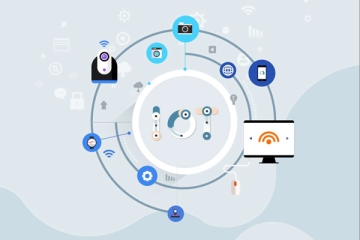
South Korea's IoT Sales Surpass 10 Trillion Won for the First Time in History in 2019
IoT sales exceeded 10 trillion won for the first time in 2019. The Ministry of Science and ICT announced the results of the 2019 Internet of Things Industry Survey, which covers the status of South Korea's IoT industry over the past year. According to the announcement, domestic sales accounted for 9.734 trillion won, representing 89.0% of total IoT industry sales, while exports showed rapid growth at an average annual rate of 46.3% from 2015 to 2019.
2020.02.26by 이수민 기자
.jpg)
Global smartphone sales down 0.4% in Q4 2019
Last quarter, global smartphone sales declined 0.4% year-on-year, and annual sales for 2019 decreased 1% compared to the previous year. Gartner reported that among the top five smartphone companies, only Apple and Xiaomi recorded growth. Despite the revenue decline, Samsung maintained its leading position with a 17.3% market share.
2020.03.04by 최인영 기자
ESP32 Development Environment Selection and GPS Application Implementation
The ESP32 is a microcontroller that integrates Wi-Fi, Bluetooth, 12-bit ADC, capacitive touch, PWM, DAC, and UART in a single SoC. However, the abundance of features does not by itself solve the designer's problems. The real challenges lie in selecting the appropriate development environment, determining which pins can be used and which must be avoided, and converting raw data from modules into usable information. This document addresses ESP32 peripheral constraints (ADC2 and Wi-Fi coexistence limitation, UART1 occupancy, ADC non-linear regions), the trade-offs between Arduino IDE and ESP-IDF, and the process from connecting NEO-6M/NEO-M8N GPS modules to UART2, parsing NMEA sentences, and visualizing routes in Google Earth, all organized based on documented references.
2026.10.12by 편집부

[e4ds Tech Day 2026 ⑨] Sim Sang-gyu, Autocrypt CTO: "In the Physical AI Era, Automotive Security Must Extend Beyond the Vehicle"
At e4ds Tech Day 2026, Sim Sang-gyu, CTO of Autocrypt, explained automotive cybersecurity strategies in the era of Physical AI and SDV (Software-Defined Vehicle). Automobiles are evolving as part of an ecosystem connected to AI, cloud, chargers, IoT, and robots, and he emphasized that the scope of security must expand beyond the vehicle interior to the entire connected environment. In particular, AI model tampering, adversarial attacks, OTA updates, and EV charger hacking were identified as major threats. He explained that response measures require zero trust, AI model integrity protection, intrusion detection, Security by Design and Default, and full lifecycle security management, and that proactive security system establishment beyond regulatory compliance is critical for securing future mobility competitiveness.
2026.10.12by 배종인 기자











