


Microchip Launches Radiation-Tolerant Parallel Memory for Space Systems
 Published2020.12.16 10:50
Microchip's COTS-based processors and
Ensuring reliability by supplementing the communication interface
Spaceflight certification systems are time-consuming, expensive, and risky to develop. To mitigate this, the industry is beginning development with commercial off-the-shelf (COTS) components and later replacing them with space-certified, radiation-hardened equivalents that have the same pin-out distribution and are available in plastic and ceramic packages.
Microchip Technology Inc. (NASDAQ: MCHP) today announced the availability of a radiation-hardened 64-megabit (Mbit) parallel interface SuperFlash® memory device that features high Total Ionizing Dose (TID) tolerance, ensuring reliability and robustness in the radiation environment of space.
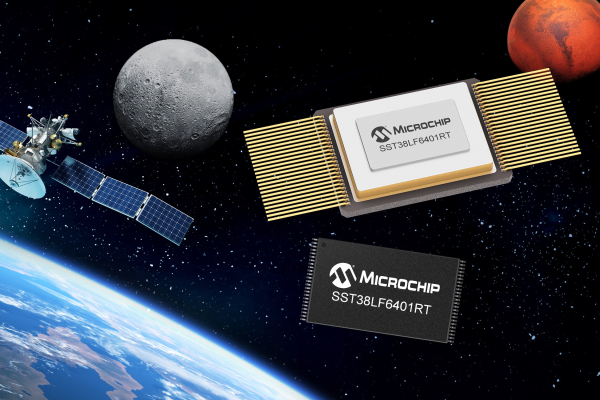
64-megabit SuperFlash memory launched [Image = Microchip]
The SST38LF6401RT SuperFlash memory device is a companion device for space-qualified MCUs, MPUs, and FPGAs that provides a building block for highly scalable development models.
“This device provides critical protection for space systems that require the most robust digital processing when companion Flash memory is needed to store critical software code or bitstreams that power the entire system,” said Bob Vampola, vice president of Microchip’s Aerospace and Defense Business Unit.
The SST38LF6401RT device provides up to 50Krad (kilorad) of radiation tolerance, even when the flash is biased and operational, ensuring smooth operation in a wide range of space applications where any loss of code execution that could result in catastrophic failure and system loss is unacceptable.Supports catalogs.
Microchip selects relevant devices from its automotive and industrial-grade product families and improves its silicon process to provide enhanced protection against single-event latch-up in heavy-ion environments. The radiation performance of these modified devices is fully documented and supported through dedicated radiation reports for each functional block.
This device is suitable for a wide range of applications, from launch vehicles and satellites to space stations. Developers can easily start implementing systems with readily available COTS devices before replacing them with pin-out compatible, space-certified equivalents in high-reliability plastic or ceramic packages. The SST38LF6401RT operates from 3.0 V to 3.6 V.
The SST38LF6401RT SuperFlash device is currently available for sampling in ceramic version, and is supported by an evaluation board and demo software. An FPGA flight programming reference case is also available, enabling integration with the FPGA and the SAMRH71 processor with supporting software.
Comments
Related news
Rohde & Schwarz Unveils AESA Radar TRM Verification Solution
AESA radar is a technology utilized across the global aerospace and defense industries. The performance of AESA radar systems is determined by the performance of TRMs assembled in the antenna array. Accordingly, Rohde & Schwarz has unveiled a TRM performance validation solution that maximizes the performance of AESA radar.
2020.10.27by 이수민 기자
Microchip Ships Radiation-Tolerant FPGA Engineering Silicon in Progress with 'QML Class V' Certification
Microchip has commenced engineering silicon shipments for radiation-tolerant PolarFire FPGAs undergoing MIL-STD-883 Class B, QML Class Q and V certification procedures, which are reliability standards for space industry components. Engineers can now develop hardware prototypes with identical electrical and mechanical performance to what space-qualified RT PolarFire FPGAs provide for high-bandwidth satellite onboard processing systems.
2020.12.03by 강정규 기자
TI Builds "HiRel Semiconductor" Instant Purchase System on TI.com
Texas Instruments announced that it is selling most of its high-reliability (HiRel) semiconductors on TI.com to enable aerospace and defense industry customers to design products compliant with next-generation standards. Aerospace and defense engineers and procurement managers can purchase thousands of TI high-reliability products, including radiation-hardened products manufactured in plastic, ceramic, and metal packages that have obtained U.S. Department of Defense QML certification.
2020.12.10by 강정규 기자

Intel Unveils Next-Generation 'Core Ultra Series 3' and vPro Platform for Enterprise PCs
Intel has officially unveiled the "Intel Core Ultra Series 3" for next-generation enterprise PCs and the latest vPro platform, addressing a wide range of demands from enterprise notebooks to high-performance workstations.
2026.03.26by 배종인 기자

ROHM Launches ESD Protection Diode Compatible with High-Speed Interfaces of 10Gbps or Higher
Semiconductor specialist ROHM has developed the 'RESDxVx series' of ESD (electrostatic discharge) protection diodes capable of responding to next-generation high-speed data communication environments exceeding 10Gbps, simultaneously enhancing both signal quality maintenance required in high-speed interfaces and IC protection performance.
2026.03.26by 배종인 기자











