


Microchip Unveils Reference Offline Power Control Solution
 Published2021.01.07 09:51
Utilizing Wurth's Indiflux feedback insulation technology
Eliminates the need for a standalone bias power supply
In offline AC/DC power solutions, programmability and adaptive control provide the flexibility and intelligence needed to improve the interface between smart home devices and power systems. In these systems, without a separate bias power supply, the secondary-side MCU typically cannot power the system.
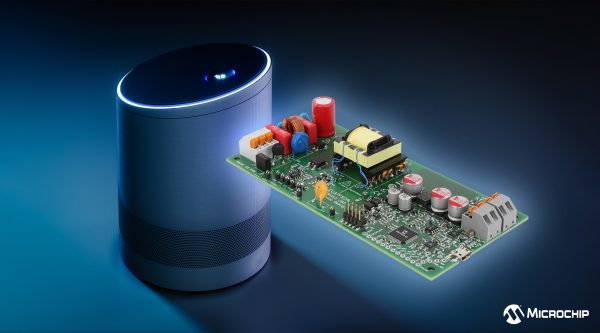
Microchip Technology Inc. today announced a new reference design, the EV37F82A, that enables the MCP1012 high-voltage auxiliary AC/DC controller to eliminate standalone bias power supplies in many applications.
[Photo = Microchip]
The MCP1012 offline auxiliary device allows the system to offload power and duty cycle control functions to a secondary MCU. Simplified design allows for greater control accuracy between systems and loads, and allows for combinations as needed, reducing size and cost.
The 15W MCP102 Offline Reference Design EV37F82A uses Würth Elektronik eiSos' patented "Inde-Flux" power isolation technique for feedback isolation. Würth used this technology and Microchip's EV37F82A to create the Inde-Flux transformer (part number 750318659).
The Indiflux transformer integrates signal power and communications into a single device, eliminating the need for optical feedback and independent signal converters. Furthermore, the reference design can adopt the traditional approach of using a planar pulse transformer, or utilize design features that work with optocouplers and signal converters. Secondary control is achieved through the combination of the transformer, Microchip's SAM D20 series 32-bit MCU, and the MCP1012 AC/DC controller.
The MPC1012 primary auxiliary controller supports system operation, gating, and protection of an offline flyback converter for a secondary MCU. It offers direct voltage/current measurement and active regulation, high loop bandwidth through direct loop closure, and simplified communication for load-referenced systems.
The 15W MCP102 Offline Reference Design provides key working elements for a 15W offline power supply design, along with the firmware required to eliminate the auxiliary power supply on the primary side. This eliminates the need for an optocoupler and reduces system complexity. Indiflux transformer technology can be scaled to standard transformer designs or custom designs to suit different voltage/power levels as needed.
“Indiflux technology, the SAM D20 series 32-bit MCUs and the MCP1012 AC/DC controller simplify and reliably implement complex bidirectional communications between primary and secondary components in many isolated applications that utilize offline power,” said Rich Simoncic, senior vice president of Microchip’s Analog, Power and Interface business unit.
“By applying this solution to a system with a secondary MCU, customers can reduce the bias supply area by up to 60% and lower the bias supply BOM (Bill of Materials) cost by more than $3,” he said.
The EV37F82A includes a user guide, schematics, bill of materials (BOM), design files, firmware, and a demo unit. Also included is the DT100118, a basic 1-W evaluation board for the MCP1012 AC-DC controller. It is priced at $225 each. The DT100118 1-W reference design is priced at $115 each. The MCP1012-V/EKA is available now, starting at $40 each in 5,000-piece quantities.
Comments
Related news

"Static electricity countermeasures" to protect users and products' safety
Static electricity is a phenomenon in which electrical charge accumulates on objects insulated from ground due to friction, peeling, and similar causes. Although instantaneous current can reach several amperes, electricity actually flows for an extremely short duration, so injury from static electricity is rare. However, electronic components, semiconductors, and products are easily damaged by static electricity, and in the case of chemical substances, it can even lead to explosions. Therefore, not only circuit designers but also factory and equipment managers must have a comprehensive understanding of static electricity in order to prevent accidents beforehand, protect products from damage, and prevent disasters caused by explosions.
2020.11.06by 김동우 기자

Microchip Unveils 8-Bit MCU for CAN FD Networks
Communication bandwidth for automotive and industrial applications is increasing day by day, and demand for flexible data transmission rates is growing. In response, Microchip has launched the PIC18-Q84 MCU family, which can be utilized for data transmission and reception through CAN FD bus. The MCU family is equipped with CIP that processes various tasks without CPU intervention, reducing the cost and time required when connecting systems to CAN FD networks.
2020.11.24by 명세환 기자
ST Unveils 'Compact High-Voltage Converter IC' That Does Not Require External Components
STMicroelectronics has unveiled VIPer31, a compact high-voltage converter IC. The VIPer31 is optimized for commonly used offline AC/DC converter topologies including isolated and non-isolated flyback, buck, and buck-boost converters. With minimal external components required, it contributes to cost-effective compact PCB designs.
2020.12.09by 강정규 기자

Intel Unveils Next-Generation 'Core Ultra Series 3' and vPro Platform for Enterprise PCs
Intel has officially unveiled the "Intel Core Ultra Series 3" for next-generation enterprise PCs and the latest vPro platform, addressing a wide range of demands from enterprise notebooks to high-performance workstations.
2026.03.26by 배종인 기자
ROHM Launches ESD Protection Diode Compatible with High-Speed Interfaces of 10Gbps or Higher
Semiconductor specialist ROHM has developed the 'RESDxVx series' of ESD (electrostatic discharge) protection diodes capable of responding to next-generation high-speed data communication environments exceeding 10Gbps, simultaneously enhancing both signal quality maintenance required in high-speed interfaces and IC protection performance.
2026.03.26by 배종인 기자











